Chinese Culture

Explore the rich traditions, customs, and cultural insights of China
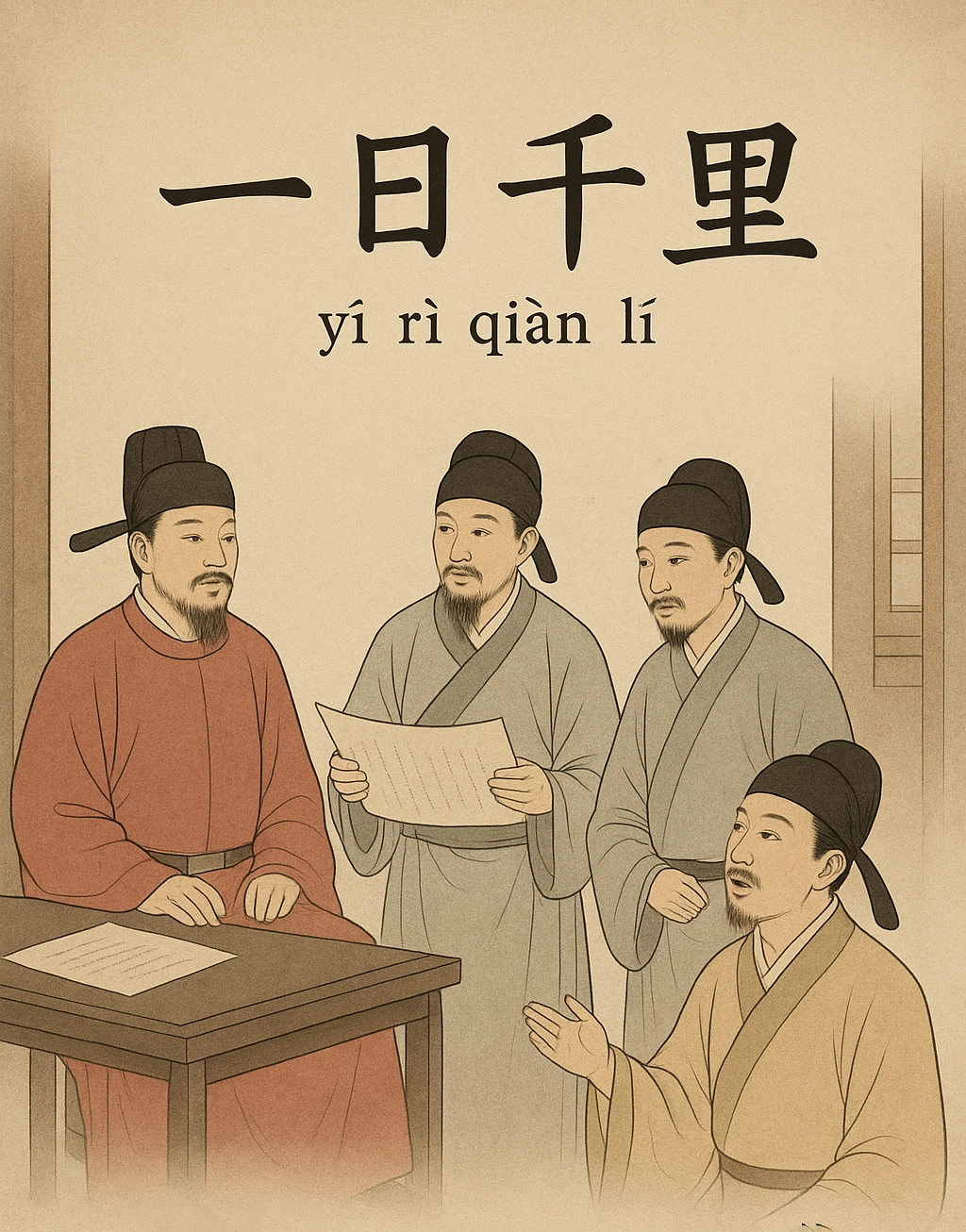
Educational illustration of Ouyang Xiu revising his article after receiving advice, showing rapid development and the idiom 一日千里.
一日千里
During the Northern Song Dynasty, Qian Weiyan, the governor of Luoyang, built a courier inn in the city. He invited local literary talents—Xie Xishen, Yin Shilu, and the rising star Ouyang Xiu—to each...
Read More
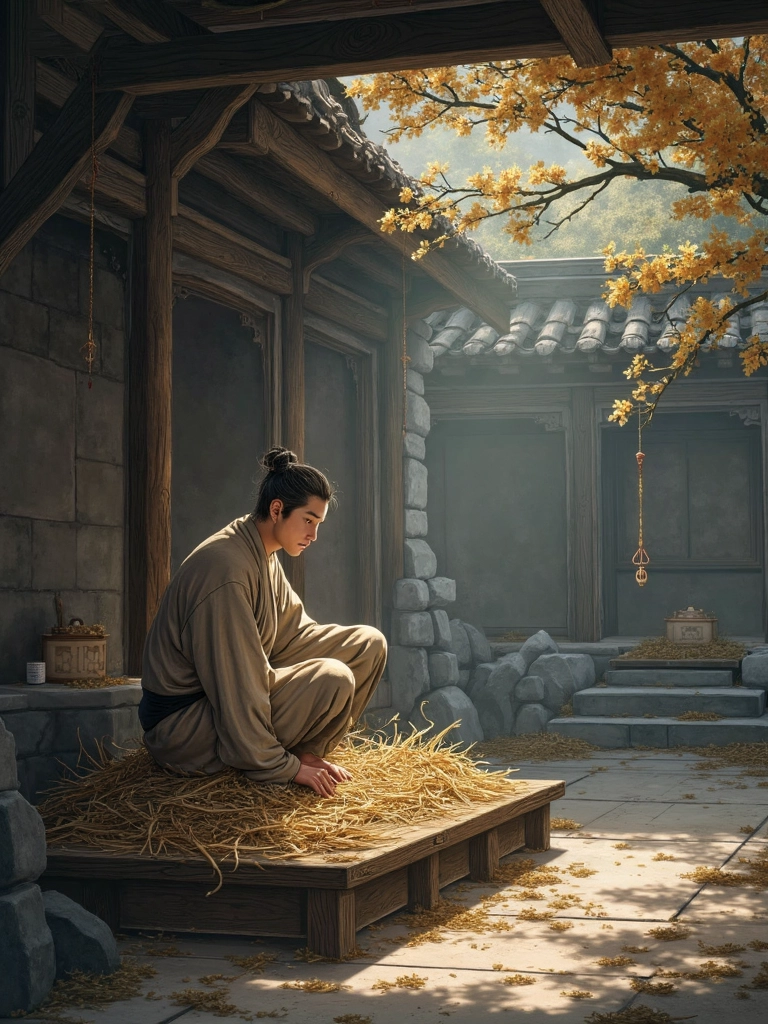
King Goujian of Yue sleeping on firewood and tasting bitter gall, symbolizing patience and determination.
卧薪尝胆
During the Spring and Autumn period, there was a war between the states of Wu and Yue. The King of Wu was seriously injured and soon died. His son, Fuchai, became the new king of Wu and vowed to aveng...
Read More
Illustration of China's Qixi Festival, showing the Cowherd and Weaver Girl stars, traditional customs like threading needles and eating Qiao cakes, with Chinese characters, pinyin, and English translations for learners.
China's Valentine's Day - Qixi Festival
In China, on the night of the seventh day of the seventh lunar month, the air is fragrant, and the Milky Way stretches across the sky. Ancient people looked up at the stars and noticed two bright star...
Read More
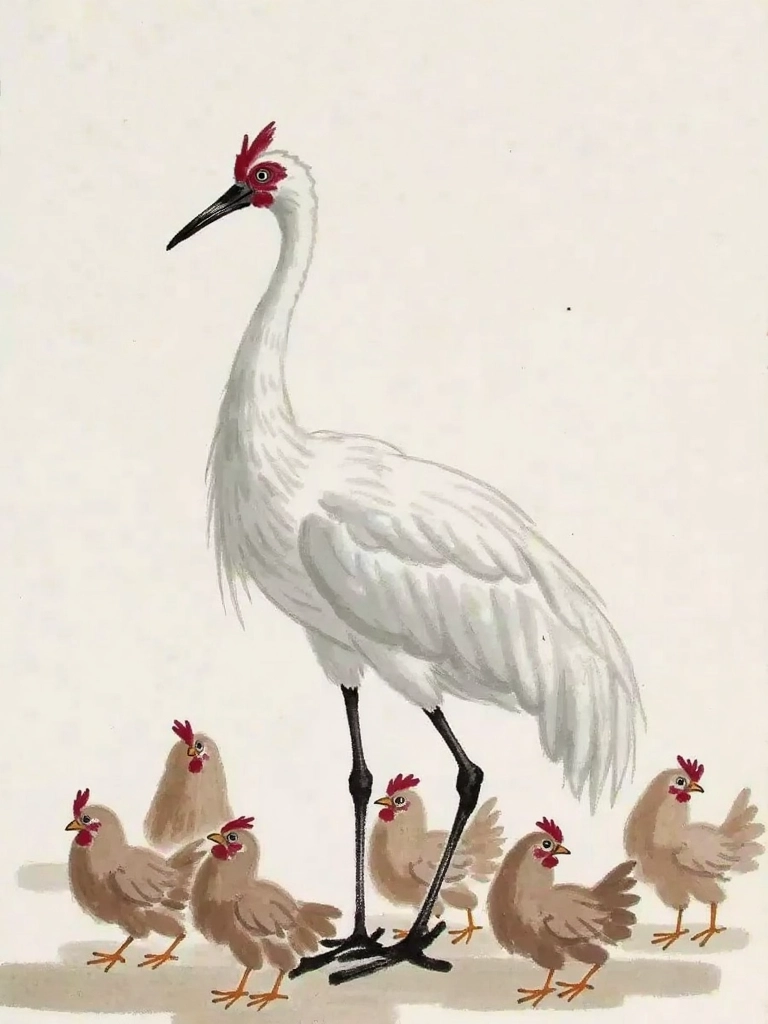
Illustration of a graceful crane standing among ordinary chickens in a meadow, representing the Chinese idiom 鹤立鸡群 (Hè Lì Jī Qún), meaning someone who stands out from the crowd.
鹤立鸡群
In a meadow, there was a group of chickens. Among them, one proud rooster boasted about his strength and shiny golden feathers, claiming he was the most outstanding. Another speckled rooster disagreed...
Read More
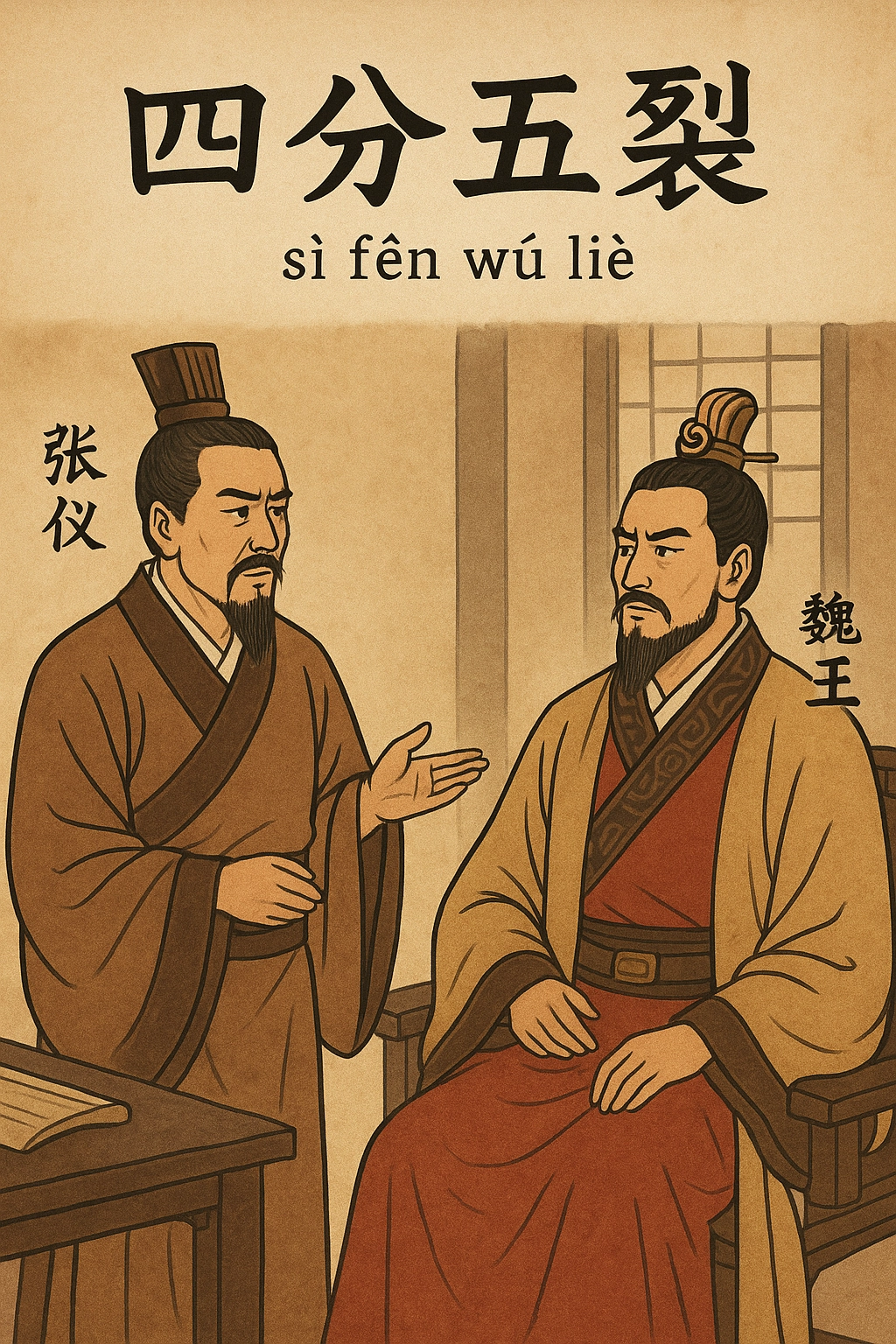
Illustration of seven Warring States, with Qin separated from the others, symbolizing the Chinese idiom 四分五裂 (sì fēn wǔ liè), meaning fragmented or divided.
四分五裂
During the Warring States period, among the seven major kingdoms, Qin(秦) was the most powerful. The other six kingdoms tried to form an alliance to resist Qin together. However, King Qin(亲王) sent his ...
Read More
Illustration of the Chinese idiom 狐假虎威 (Hú Jiǎ Hǔ Wēi), showing a clever fox using a tiger's power to intimidate other animals — perfect for Mandarin learners and Chinese culture content.
狐假虎威
A tiger once caught a fox, intending to eat it. The fox said, “I am appointed by the Heavenly Emperor as the king of all beasts. If you eat me, you will be punished by heaven.” The tiger did not belie...
Read More
Illustration of the Chinese idiom 车水马龙 (Chē Shuǐ Mǎ Lóng), showing a bustling street with carriages and horses, perfect for Mandarin learners exploring Chinese idioms and culture.
车水马龙
During the Eastern Han Dynasty, Emperor Zhang wanted to grant official titles and noble ranks to the relatives of the Empress Dowager's family. The Empress Dowager strongly opposed this. She said to E...
Read More
Illustration of the Chinese idiom 半途而废 (Bàn Tú Ér Fèi), showing a scholar stopped midway in his studies, ideal for Mandarin learners exploring idioms about perseverance.
半途而废
During the Eastern Han Dynasty, a scholar named Lè Yángzi went away to study. After one year, feeling homesick, he returned home early. When his wife saw him, she cut the silk thread on the loom with ...
Read More
Illustration of the Chinese idiom 栩栩如生 (Xǔ Xǔ Rú Shēng), showing a vividly lifelike butterfly, representing realistic depictions in art and literature — ideal for Mandarin learning and Chinese culture education.
栩栩如生
The ancient Chinese philosopher Zhuangzi (庄子) once recorded a story in his writings: "Once, Zhuang Zhou dreamed he had become a butterfly—vivid and lifelike, truly a butterfly. He was so carefree and ...
Read More
Illustration of the Chinese idiom 胸有成竹 (Xiōng Yǒu Chéng Zhú), showing a painter confidently painting bamboo with a clear plan in mind — perfect for Mandarin learning and Chinese culture education.
胸有成竹
In the Song Dynasty, there was a famous painter named Wen Yuke (文与可), who was especially skilled at painting bamboo. His bamboo paintings were vivid and lifelike. To perfect his craft, he planted many...
Read More
Illustration of the Chinese idiom 画龙点睛 (Huà Lóng Diǎn Jīng), showing a painter adding eyes to dragons and bringing them to life — perfect for Mandarin learning and Chinese culture education.
画龙点睛
During the Southern and Northern Dynasties, there was a renowned painter named Zhang Sengyao (张僧繇). According to legend, he once painted four dragons on the wall of a Buddhist temple—but he left out t...
Read More
Illustration of the Chinese idiom 千载难逢 (Qiān Zǎi Nán Féng), showing a rare and precious opportunity, inspired by scholar Han Yu during the Tang Dynasty — ideal for Mandarin learners.
千载难逢
During the Tang Dynasty, the famous scholar Han Yu (韩愈) was demoted from his official position because he opposed enshrining the relics of the Buddha, Shakyamuni, in the imperial palace. Later, he sub...
Read More