Why can Chinese express time clearly even though it has no verb tenses?

Table of Contents
- I. Introduction: Grammatical "Absence" or Cognitive "Transcendence" in Mandarin Time Expression?
- II. The Core Mechanism of Chinese Temporal Expression: A Multi-Dimensional Precision System
- III. Differences in Chinese and Western Linguistic Philosophy: The Divide Between Formal Logic and Imagistic Thinking
- IV. Efficiency in Actual Communication: Cognitive Load and Translation Challenges
- V. Clarifying Common Misconceptions: Breaking the Myths of "Vagueness" and "Simplicity"
- VI. Conclusion: A Fluid View of Time and Future Implications for Language
- FAQ: Chinese Without Tense – How Does It Work?
Introduction: Grammatical "Absence" or Cognitive "Transcendence" in Mandarin Time Expression?
The "Stillness" of Verbs vs. the "Flow" of Time
When we first begin learning English or other Indo-European languages, nothing is more daunting for beginners than the complex tables of tense conjugations. In English, verbs act like chameleons, constantly changing their form as time passes: from "do" to "did," from "doing" to "done," and further to "will do," "have done," or "had been doing." This grammatical imperative demands that the speaker, at the very moment of speaking, must mentally stamp the action with a precise timestamp; otherwise, the sentence is grammatically incorrect. However, when we turn our gaze to native Chinese, we discover a startling phenomenon: Chinese verbs are inherently "static." Whether it was yesterday, is today, or will be tomorrow, "eat" (吃) is always "eat," and "go" (去) is always "go." They do not add suffixes because an event happened in the past, nor do they alter their characters because an action is currently in progress.
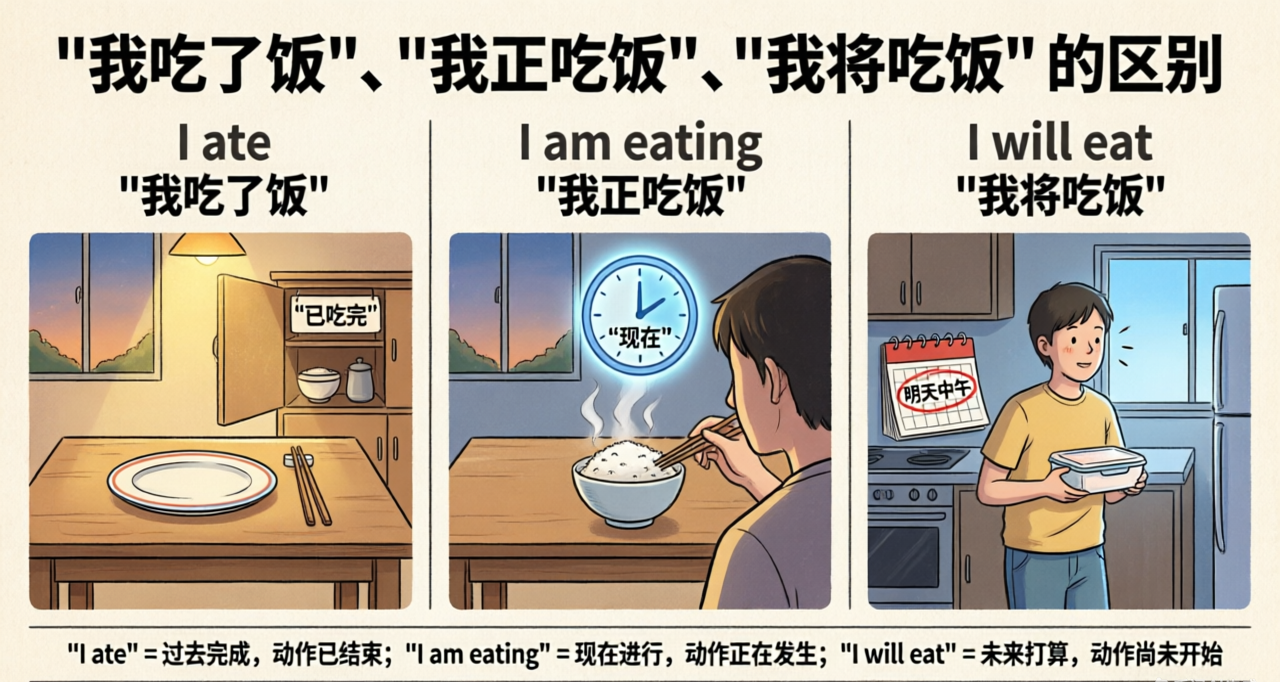
This raises a classic and fascinating question in linguistics: Since Chinese verbs lack morphological tense changes, how do Chinese speakers express time concepts so clearly in communication—sometimes even more subtly than Indo-European languages? Is Chinese expression vague? Certainly not. Any native Chinese speaker can effortlessly distinguish the vast temporal differences between "I ate" (我吃了饭), "I am eating" (我正吃饭), and "I will eat" (我要吃饭), with precision matching that of English speakers. This phenomenon, which appears to be an "absence" but is actually a "transcendence," reveals two distinctly different paths human languages have taken to construct temporal logic. Understanding how Chinese expresses time without tense is key to mastering the language.
Convergence via Different Paths: Formal Marking vs. Contextual Inference
Indo-European language systems tend toward a "formalized" view of time, treating it as an absolute attribute that must be explicitly marked through verb morphology. This mechanism resembles a precision mechanical clock, where every gear (verb ending) must mesh perfectly with specific time markers. If a gear is installed incorrectly, the entire machine (the sentence) fails to function. This grammatical structure forces the speaker to constantly focus on the absolute point in time when an action occurs, creating a "grammatically mandatory" temporal mindset.
In contrast, Chinese exhibits a "semantic" and "contextual" view of time. Mandarin Chinese does not rely on verb inflection to carry temporal information; instead, it distributes the task of expressing time across other components of the sentence: temporal adverbs, dynamic particles, word order, and the broader context. This is not a sign of grammatical simplicity or degeneration, but rather a highly evolved strategy. Chinese liberates verbs from the burden of cumbersome morphological changes, allowing them to focus on expressing the nature and state of the action itself, while entrusting the positioning of time to more flexible lexical means and logical inference. This mechanism is more like an ink wash painting: time is not a label painted directly onto objects but an atmosphere that naturally emerges through the use of negative space, composition, and the surrounding scenery (context). This high-context nature of Chinese is crucial for understanding its efficiency.
The Deep Reflection of Eastern and Western Thought Patterns
This difference is not merely grammatical; it profoundly reflects the similarities and differences between Eastern and Western modes of thought. Western thinking often leans towards analysis, deconstruction, and formal logic, pursuing definitional precision and rigid rules. Eastern thinking, particularly the Chinese mindset influenced by Daoist ideas of "following nature" (道法自然) and Confucian concepts of the "Golden Mean," tends more towards holistic observation, dynamic balance, and intuitive understanding. In Chinese, time is not an isolated parameter that needs to be forcibly marked, but a flowing process intricately interwoven with the state of events.
Therefore, exploring the proposition that "Chinese can clearly express time without tense" is actually an exploration of how language shapes our cognition of reality and how human wisdom solves the same communication challenges through different symbolic systems. This characteristic of Chinese not only creates no barrier to communication but endows the language with immense flexibility and expressiveness. It allows speakers to freely choose, based on their emphasis, whether to highlight the precise point in time, the state of the action, or to rely entirely on context for the listener to infer meaning. This wisdom of "controlling the complex with the simple" allows Chinese to handle complex temporal relationships with an elegant ease.
In the following chapters, we will delve into the four pillars supporting the edifice of time in Chinese: the precise positioning of temporal adverbs and phrases, the descriptive power of the dynamic particle system, the powerful logic of contextual inference, and the implicit rules of word order. We will see that although Chinese lacks the "form" of tense, it possesses the "spirit" of time. It weaves an invisible yet tight web, firmly anchoring the past, present, and future in every vivid sentence. This is not just an analysis of Chinese linguistic mechanisms, but a tour of the unique aesthetics and philosophical depth of the Chinese language.
The Core Mechanism of Chinese Temporal Expression: A Multi-Dimensional Precision System
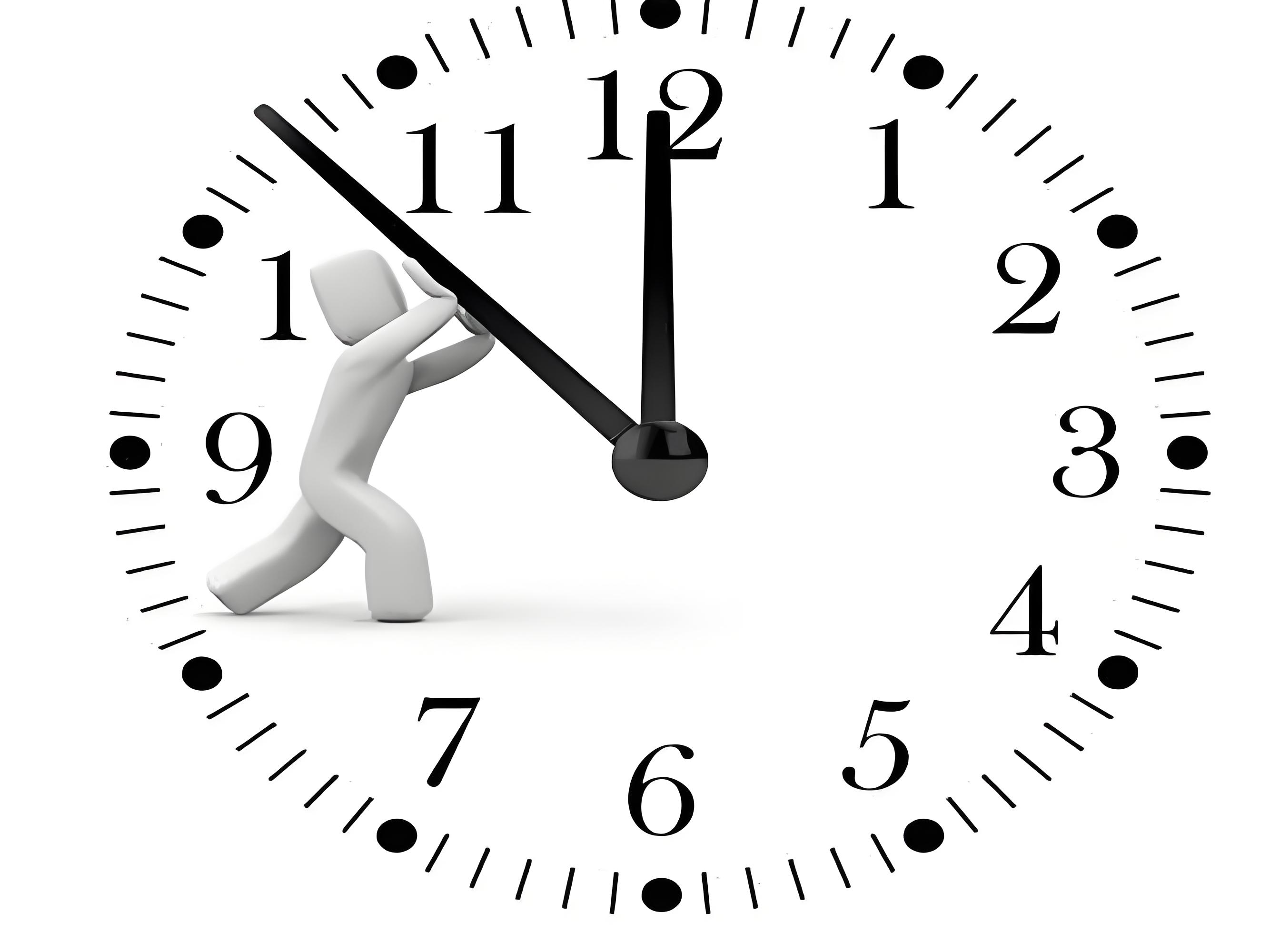
Temporal Adverbs and Phrases: Precise Spacetime Coordinates
The reason Chinese can express time precisely without verb tense changes is that it possesses a multi-dimensional expression system far richer, more three-dimensional, and more flexible than relying solely on verb inflection. This system comprises temporal adverbs and phrases, dynamic particles, contextual inference, and word order structures. Working in concert, they resemble a well-trained symphony orchestra playing a clear movement of time.
First, temporal adverbs and phrases are the most direct and explicit tools in Chinese time expression. Unlike English, which must imply time through verb changes, Chinese tends to directly use vocabulary to "name" the time. The Chinese language boasts an incredibly rich lexicon of time words, ranging from the macroscopic ("ancient times," "future," "century") to the microscopic ("instant," "moment," "split second"); from the absolute ("March 10, 2026," "Friday") to the relative ("yesterday," "tomorrow," "the day before yesterday," "the day after tomorrow"). These words can be placed at the beginning or middle of a sentence, acting like signposts that clearly indicate the time coordinate of an action. For example, in "He comes tomorrow" (他明天来) and "He came yesterday" (他昨天来了), the direction of time is unambiguous solely through the words "tomorrow" and "yesterday"; the verb "come" requires no change. This use of explicit time markers in Chinese replaces the need for verb conjugation.
Even more subtle are adverbs indicating relative time and the progress of actions, such as "already" (已经), "currently" (正在), "about to" (将要), "just now" (刚刚), "immediately" (马上), and "sooner or later" (迟早). These words do more than mark a time point; they indicate the state of the action relative to the moment of speaking. "Already" implies completion before a reference time; "currently" locks the action in progress; "about to" points to future possibility. In the sentence "He has already eaten" (他已经吃过饭了), "already" and the final particle "le" work together to construct a perfect aspect of completion, whose clarity far exceeds the simple past tense in English because it simultaneously conveys two layers of meaning: "completion" and "relevance to the present." This lexicalized expression of time gives Chinese extreme freedom in describing complex temporal sequences, allowing multiple temporal adverbials to be superimposed to build intricate time networks, such as: "At this time last year, he originally planned to depart tomorrow, but just now changed his mind."
The Dynamic Particle System (Le, Zhe, Guo): Delicate Portrayal of Action States
Secondly, the dynamic particle system (了 le, 着 zhe, 过 guo) is the essence of Chinese temporal expression and the core element often misunderstood as "tense markers." It must be clarified that these three characters mark not "Tense" (the absolute time an action occurs) but "Aspect" (the internal state or stage of the action). Understanding the difference between Aspect vs. Tense in Chinese is vital for learners.
🔹 "Le" (了): The Marker of Perfective Aspect
Primarily serves as a perfective marker, emphasizing the completion of an action or a change of state, rather than simply the past.
● Past: "I ate an apple yesterday" (我昨天吃了一个苹果) (Action ended).
● Future: "Eat your meal before you leave tomorrow" (你明天走之前吃了饭) (Completion before a future point).
● Hypothetical: "If you come, I will tell you" (如果你来了,我就告诉你) (Completion under a hypothetical condition).
● Core Logic: It focuses on the "completiveness" of the action, not its "past-ness." This explains why "Le" is not the Chinese past tense.
🔹 "Zhe" (着): The Scroll of Continuous Aspect
Focuses on continuous and progressive aspects, depicting the sustained existence of an action or state.
● Examples: "The door is open" (门开着), "He spoke while smiling" (他笑着说话).
● Core Logic: It cares neither about when the state started nor when it will end, focusing only on the continuous picture of the present. This static capture of state offers a nuance that the English progressive tense (be + doing) struggles to fully cover.
🔹 "Guo" (过): The Imprint of Experiential Aspect
Indicates experiential aspect, meaning an action or state occurred at some stage in life and has since ended.
● Example: "I have been to Beijing" (我去过北京).
● Core Logic: It emphasizes the accumulation of "experience," not a specific time point.
The combination of these three particles can construct extremely complex spacetime landscapes. For instance, in the sentence "He had been there before; at that time, it was raining; later, the rain stopped, and he left," the particles "guo," "zhe," and "le" each play their part, clearly outlining the flow of time and the transition of states, while the verbs themselves remain in their original form. Mastering Chinese particles Le, Zhe, and Guo is the key to fluency.
Contextual Inference: Logical Completion in High-Context Culture
Thirdly, contextual and textual inference is the most powerful yet often overlooked mechanism in Chinese time expression. Chinese is a High-Context language; much information is not directly encoded on the surface of words but is embedded in the background of the conversation, the logical relationships preceding and following, and the shared knowledge of the communicators. In a coherent narrative, once an initial time baseline is established, the time of subsequent actions can often be automatically deduced through logical succession without repeated marking.
For example, when telling a story: "Yesterday I walked into the park. (Baseline: Yesterday) I saw a bird perched on a tree. (Implied: Saw yesterday) The bird suddenly flew away. (Implied: Flew yesterday) I felt very regretful. (Implied: Felt yesterday)." In this paragraph, except for the first sentence which explicitly states "yesterday," none of the subsequent verbs have temporal markers. Yet, the reader never experiences ambiguity because the logical flow of the narrative naturally locks the timeline.
This mechanism is exhibited to an extreme degree in modern instant messaging. Consider a typical WeChat conversation:
A: Where are you? (Literally: Arrived where?)
B: Just went downstairs.
A: Hurry, the movie is about to start.
B: Got it, arriving soon.
In this dialogue, no verb carries a time marker, nor do words like "now," "just now," or "soon" appear. Yet both parties instantly understand:
● "Just went downstairs" = Just now/Now (Completed the action of going downstairs, currently on the way).
● "About to start" = Imminent Future.
● "Arriving soon" = Near Future.
This extremely high information density and omission rate is the embodiment of Chinese contextual inference ability. It greatly enhances the economy of language, avoiding the tediousness of repeatedly adjusting tenses in every clause as required in English, making communication flow as smoothly as water. This efficiency is a hallmark of learning Mandarin.
Word Order and Sentence Structure: The Iconicity of Temporal Sequence
Finally, word order and sentence structure implicitly regulate the expression of time. Chinese follows the strict Principle of Temporal Sequence, meaning the order of syntactic structures usually corresponds to the chronological order of events. Temporal adverbials are typically placed before the verb; for example, "Morning I run" (早上我跑步) is standard, while "I run morning" is rare. In complex sentences, clauses are arranged strictly according to chronological order or logical causality. For example, "He put on his clothes, walked out the door, and got into the car." The order of these three actions cannot be reversed because they are linear in time. This Iconicity makes the Chinese sentence itself a timeline; the listener simply needs to follow the flow of the sentence to reconstruct the trajectory of events in their mind. Furthermore, correlative conjunctions like "as soon as... then..." (一……就……), "just... then..." (刚……就……), or "not yet... when..." (还没……就……) lock in the tight temporal relationship between two actions through fixed sentence structures, expressing nuances of instantaneity, immediacy, or time gaps.
In summary, Chinese temporal expression does not rely on a single verb inflection but mobilizes full-spectrum resources of vocabulary, grammar, pragmatics, and logic. Temporal adverbs provide coordinates, dynamic particles depict states, context provides the background, and word order constructs the flow. These four elements complement each other, forming a rigorous yet flexible system. It is precisely this system that allows Chinese, having shed the "shackles" of verb morphological changes, to gain greater freedom and higher precision in expressing time, handling everything from instants to eternity, and from the concrete to the abstract, with ease.
Differences in Chinese and Western Linguistic Philosophy: The Divide Between Formal Logic and Imagistic Thinking
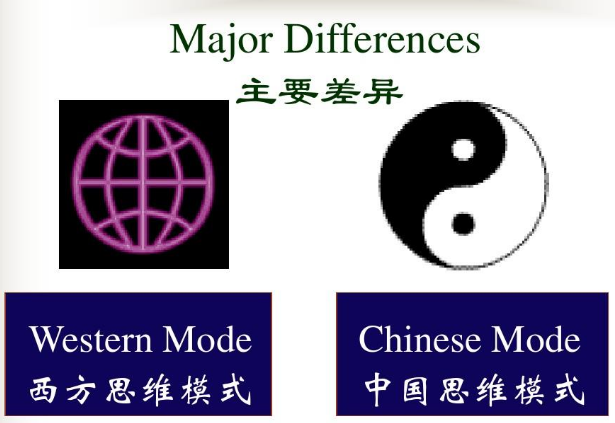
Western Formal Rationality: The Pursuit of Certainty and Precision
The reason Chinese chose a "tense-less" path different from the Indo-European family is deeply rooted in the distinct linguistic philosophies and thinking traditions of East and West. Language is not only a tool for communication but also a carrier of thought and a projection of worldview. The unique way Chinese handles time profoundly reflects the philosophical traits of Eastern culture—"valuing semantic connection," "holism," and "fluidity"—standing in sharp contrast to the Western thinking patterns of "valuing formal connection," "analysis," and "fixation."
In the linguistic philosophy of Indo-European systems, deeply influenced by ancient Greek logic and formal rationalism, Western thinking tends to deconstruct the world into independent entities and attributes, attempting to define their relationships through rigorous rule systems. Manifested in language, this is a pursuit of explicit, formal, and consistent grammar. Time is viewed as an objective, linear, and divisible physical quantity that must be explicitly marked through verb morphology. This requirement for "formal marking" reflects the Western persistence (or obsession) for certainty and precision. In their view, a sentence that lacks a time marker in its grammatical form is incomplete, vague, or even logically chaotic. This mindset drove Indo-European languages to develop extremely complex tense systems (such as the 16 tenses in English, or even more conjugations in French), attempting to nail every action firmly onto the time axis using the cage of grammar. This is an "analytical" wisdom that eliminates ambiguity by establishing cumbersome rules, ensuring the logical rigor of information transmission.
Eastern Imagistic Thinking: Holistic Observation and Dynamic Balance
Conversely, the philosophical foundation of Chinese stems from the fusion of Daoism, Confucianism, and Buddhism, forming a unique "imagistic thinking" and "holistic view." Traditional Chinese culture believes that all things in the universe are in eternal flow and change ("Time flows on like this, day and night"). Time is a continuous, indivisible river, not a series of isolated slices. In this worldview, attempting to cut time with rigid verb inflections is seen as contrary to the Way of Nature. Chinese values "parataxis" (意合), organizing sentences through intrinsic connections of meaning rather than relying on external formal connectors or morphological changes.
The Chinese view of time is "event-centered" rather than "time-centered." Chinese people care more about the state of the action itself (has it started, ended, or is it continuing?) and its relationship to the immediate situation, rather than the position of the action on an absolute time axis. This is why Chinese developed a sophisticated "Aspect" system (Le, Zhe, Guo) while lacking a strict "Tense" system. For the Chinese mindset, the "quality" (state) of an action is more important than its "position" (time point). Once the state of the action and the context are known, the time is naturally obvious, making formal marking redundant. This thinking embodies the Daoist wisdom of "controlling the complex with the simple": not pursuing formal complexity, but seeking the accessibility of spirit and rhyme. This distinction is central to understanding Chinese grammar.
The Aesthetics of "Flowing Sentences" and "Intuitive Understanding"
Linguist Zhao Yuanren succinctly pointed out that the characteristic of Chinese grammar is the "flowing sentence" (流水句), which flows like water, following the momentum, unconfined by formal boxes. Lü Shuxiang also emphasized that Chinese relies on "intuitive understanding" (悟); many grammatical rules are implicit and must be grasped through language sense rather than rote memorization of rules. This process of "understanding" is the embodiment of Eastern holistic thinking. In Chinese, time is not "carried" by the verb but permeates the entire sentence, paragraph, and even the atmosphere of the conversation. The listener must mobilize their holistic perceptual abilities, combining context, tone, and situation, to "intuit" the meaning of time. Although this mode of expression may seem loose, its internal logic is extremely rigorous, requiring a high degree of tacit understanding and shared cognitive background between communicators.
Furthermore, differences in understanding the relationship between "subject" and "object" in Chinese and Western philosophy also influence temporal expression. Western languages often emphasize the subject's control over the action; verb tense changes are often a dual function of subject person and time (e.g., I am, He is, They were). This reflects the tradition of Western individualism and analyticism, emphasizing the individual's exact position in time. In Chinese, however, subjects can often be omitted (zero-subject), and verbs do not change with person or time. This reflects the Eastern concept of "unity of heaven and humanity" and the fusion of subject and object. From this perspective, actions happen naturally as part of the universal transformation; there is no need to artificially dress the verb in a time "uniform" to assert its identity.
The Beauty of Ambiguity: Philosophical Acceptance of Transitional States
This philosophical difference is also reflected in attitudes toward "ambiguity." Western linguistic philosophy often views ambiguity as a defect, striving to eliminate it through precise grammar. Eastern philosophy, however, considers ambiguity a form of beauty, a space left for imagination and realization. The flexibility of Chinese temporal expression is precisely an embodiment of this philosophy. It allows time boundaries to be soft and transitional in specific contexts, rather than black and white. For example, in "It is getting dark" (天快黑了), the word "getting" (快) is neither completely present nor purely future; it is a dynamic transitional state. Chinese can naturally express this subtlety, whereas Indo-European languages often require complex circumlocutions.
In conclusion, the absence of tense in Chinese is not a poverty of grammar but an inevitable philosophical choice. It abandoned rigid formal markers in exchange for broad freedom of meaning; it rejected the mechanical slicing of absolute time to embrace the holistic grasp of flowing time. This is a brilliant crystal of Eastern wisdom in the realm of language, demonstrating another excellent possibility for human thought in constructing the concept of time. Understanding this not only helps us master Chinese better but also allows us to peer through the window of language into the deep spiritual map of Chinese and Western cultures.
Efficiency in Actual Communication: Cognitive Load and Translation Challenges

Cognitive Offloading: Modular Processing and High Information Density
After exploring the mechanisms and philosophical foundations of Chinese temporal expression theoretically, we must return to the real world to examine how this unique mode of expression performs in actual communication. A common skepticism is: Does the lack of tense markers increase the difficulty of understanding and reduce communication efficiency? On the contrary, extensive linguistic research and daily observation show that Chinese is not only efficient in transmitting temporal information but superior to tensed languages in certain aspects, while presenting unique challenges and charms in cross-language translation.
First, from the perspective of cognitive load and information processing speed, native Chinese speakers demonstrate astonishing efficiency in processing temporal information. In Indo-European languages, speakers must constantly perform "tense monitoring" when constructing sentences; the brain must continuously calculate the time of the action, its duration, and its relationship to the moment of speaking, converting verb forms in real-time. Although this process becomes automated with proficiency, it still consumes cognitive resources when dealing with complex temporal nesting (such as the past perfect continuous in subjunctive moods). In Chinese, however, since verb forms are fixed, speakers can devote more cognitive resources to content organization, logical deduction, and emotional expression. Temporal information is processed via simple adverbs (like "yesterday," "currently") or automatically completed by context. This "modular" processing method greatly reduces the complexity of syntactic generation.
Psychological experiments and neurolinguistic studies corroborate this. Research finds that when understanding sentences containing temporal information, Chinese users activate slightly different brain regions compared to English users. Chinese users rely more on context-processing and semantic-integration areas, while English users activate regions related to morphosyntactic analysis. This means Chinese users acquire temporal information through "holistic scanning" and "logical inference." This method is often smoother and faster when processing long narratives or rapid conversations. Because once the time frame is established in a continuous dialogue, Chinese can omit a large number of time markers, achieving extremely high information density. For example, when telling a long story, a Chinese speaker can rattles off dozens of actions without repeating time words, and the listener can follow the timeline without obstruction. In contrast, English requires constant tense switching at key nodes and complex sequence-of-tenses adjustments in clauses, which somewhat slows down the rhythm of narration. This highlights the efficiency of the Chinese language.
Fault Tolerance: Robustness Brought by Contextual Redundancy
Secondly, fault tolerance and flexibility in actual communication are major advantages of Chinese. In daily spoken language, people often omit components or are not rigorous in temporal expression. In English, using the wrong tense (e.g., using present tense when past tense is required) can lead to serious misunderstandings or make the speaker appear logically confused. In Chinese, however, since temporal information is multi-source input (adverbs, context, logic), even if a time word is missing or misused, the listener can quickly correct their understanding through context. This redundancy mechanism gives Chinese communication stronger robustness. For example, if someone says, "Tomorrow I go to that place from yesterday," although logically convoluted, a Chinese listener immediately understands it means "Tomorrow I will go to the place I visited yesterday." Context automatically resolves the ambiguity. This flexibility makes Chinese particularly adept in scenarios like instant messaging and informal conversation.
The Translation Dilemma: Explicit Reconstruction of Implicit Information
However, this efficiency brings huge challenges in cross-language translation, which conversely proves the uniqueness of Chinese time expression.
When translating Chinese into tensed languages like English, the translator's biggest challenge is "tense completion." The Chinese original often contains only a bare verb; the translator must forcibly judge the absolute time and relative state of the action based on context, logic, and even cultural background, then select the appropriate English tense. This is a high-difficulty process of "decoding and re-encoding." For example, the Chinese sentence "He left" (他走了), without context, could be translated as "He left" (Simple Past), "He has left" (Present Perfect), "He is leaving" (Present Continuous for future), or even "He will leave" (in specific contexts). The translator must act like a detective searching for clues; a slight mistake can distort the original meaning. This process of "making implicit information explicit" often makes the translation appear more cumbersome and stiff than the original. This is a key challenge in Chinese to English translation.
Conversely, when translating English into Chinese, the challenge lies in "tense simplification" and "preserving the spirit." Complex English tense changes (e.g., "I had been waiting for two hours when he arrived") can often be expressed clearly in Chinese with just a few characters ("When he arrived, I had already waited for two hours"). Chinese does not need to pile up temporal layers through verb inflection but reconstructs logic through function words like "already," "le," and "when," along with word order. Excellent translators do not mechanically correspond tenses but grasp the core temporal logic of the original and retell it in idiomatic Chinese. If one sticks too rigidly to English tense forms, trying to imitate them stiffly in Chinese (e.g., inventing non-existent verb suffixes), it destroys the fluency and aesthetic of the Chinese language.
AI Implications: From Rule Matching to Semantic Understanding
Furthermore, in the field of Artificial Intelligence and Natural Language Processing (NLP), the characteristics of Chinese temporal expression are a research hotspot. Early machine translation systems often made mistakes with tenses in Chinese-English translation because they struggled to accurately capture the implicit temporal clues in Chinese. With the development of deep learning, AI models have begun to learn to infer Chinese temporal information using context windows, significantly improving accuracy. This conversely proves that although Chinese temporal logic is hidden, it is rule-governed, and these rules are deeply rooted in the deep structures of semantics and pragmatics.
In summary, without tense markers, Chinese achieves extremely high communication efficiency through context dependence, lexical assistance, and logical deduction. It not only reduces the syntactic burden on speakers and enhances fault tolerance but also demonstrates unique linguistic elasticity. Although challenges exist in cross-language conversion, this is precisely the value of linguistic diversity. The Chinese temporal expression mechanism reminds us that the key to efficient communication lies not in formal complexity but in accurate information transmission and smooth reception. In this regard, Chinese interprets the communication wisdom of "the Great Way is simple" in its own unique way.
Clarifying Common Misconceptions: Breaking the Myths of "Vagueness" and "Simplicity"

Misconception 1: No Tense Equals Vague Expression?
Despite the obvious ingenuity of Chinese temporal expression, misconceptions about "Chinese having no tense" persist in linguistics, foreign language teaching, and public perception. These misunderstandings often stem from rigidly applying Indo-European grammatical frameworks to Chinese or lacking a deep understanding of Chinese internal mechanisms. Clarifying these misconceptions helps correctly recognize Chinese grammatical features, eliminates learner confusion, and improves the quality of cross-cultural communication.
Misconception: "Chinese has no tense, so its expression is vague and less precise than English."
This is the most common bias. Proponents believe that the lack of verb morphological changes means loss or uncertainty of temporal information. However, as mentioned earlier, precision depends on whether information can be accurately conveyed, not on whether a specific grammatical form is used. Through temporal adverbs (like "instantly," "presently"), dynamic particles (Le, Zhe, Guo), and rigorous contextual logic, Chinese can achieve precision equal to or exceeding that of Indo-European languages.
For example, the English Past Tense can sometimes be very vague. The sentence "I lived in Beijing" only states that the speaker lived there in the past, but it doesn't specify whether they moved out just now or ten years ago, nor does it grammatically guarantee they don't still live there (though it usually implies they don't). In contrast, Chinese can say "I used to live in Beijing" (我住过北京) (emphasizing experience, not living there now), "I lived in Beijing last year" (我去年住在北京) (emphasizing the time period), or "I just moved out of Beijing" (我刚搬出北京) (emphasizing the moment of state change). By combining different vocabulary, Chinese can depict the start and end of time, duration, and relationship to the present with great depth. The so-called "vagueness" is often because the observer failed to read the Chinese contextual clues, not a defect of the language itself. In fact, in literary descriptions and legal texts, Chinese's definition of temporal sequence and causal relationships is breathtakingly rigorous. Chinese is not vague; it is contextually precise.
Misconception 2: Is "Le" Equivalent to the English Past Tense?
Misconception: "Le" is a marker of the past tense.
This is one of the biggest pitfalls in foreign language teaching. Many textbooks and beginners simply equate "Le" with the English "-ed" or past tense. This is a dangerous oversimplification. As stated, "Le" is a perfective marker focusing on the "completion" or "change of state" of an action, unrelated to absolute time.
Counterexamples are everywhere:
1. "Le" in Future Tense: "Eat your meal before you come tomorrow." (你明天来之前吃了饭) Here, "ate" (吃了) happens in the future, indicating that "eating" must be completed before the action of "coming."
2. "Le" in Hypothetical Sentences: "If you win the competition, I will treat you to a meal." (如果你赢了比赛,我就请你吃饭) "Won" (赢了) is a hypothetical future completion, absolutely not the past.
3. Habitual Actions: "Every day after getting off work, he goes to the gym." (每天下班后,他就去健身房) Here, "Le" indicates the completion of the state of "getting off work" every day; it is habitual, not specific to one day.
Equating "Le" simply with the past tense leads learners to make serious errors when expressing future perfect or hypothetical situations. It also prevents them from understanding why sometimes past events do not use "Le" (e.g., "Yesterday I went to the library" vs. "Yesterday I went-to the library"; the former focuses on narrating the itinerary, the latter on the completion of the action—a huge subtle difference). Clarifying this is key to mastering Chinese grammar.
Misconception 3: Inability to Express Complex Temporal Nesting?
Some believe that without complex tense conjugations, Chinese cannot handle complex temporal nesting like "When I arrived, he had already left" (Past Perfect) or "At this time tomorrow, I will be flying" (Future Continuous). This completely underestimates Chinese syntactic capability.
Chinese can easily express these concepts through vocabulary combinations and sentence structures:
● Past Perfect: "By the time I arrived, he had long gone." (我到达的时候,他早就走了) ("Long ago" + "Le" perfectly corresponds to Past Perfect).
● Future Continuous: "At this time tomorrow, I should be sitting on the plane." (明天这个时候,我应该正坐在飞机上呢) ("Currently" + "at" + particle "ne" vividly depicts Future Continuous).
● Past Future Perfect: "He thought at the time that by this time next week, he should have finished all tasks." (他当时想,到下个星期这个时候,他就应该已经完成所有任务了)
Chinese expression does not "brute force" temporal relationships through verb inflection but flexibly constructs them like building blocks, using temporal adverbs, particles, and logical connectors. This construction method has no upper limit; freed from the constraints of morphological changes, it can create more diverse layers of temporal expression. Limited by finite tense combinations, English sometimes requires lengthy clauses to explain, whereas Chinese often hits the core with concise phrases. Chinese can express complex time relationships effectively.
Misconception 4: Is Chinese Temporal Expression Rule-Free?
Some feel that Chinese temporal expression relies entirely on "language sense" and seems to have no rules to follow. This is another major misconception. Chinese temporal expression has strict principles of Temporal Sequence, rules of Virtual-Real Collocation, and mechanisms of Contextual Constraint. For example, the position of temporal adverbials, co-occurrence restrictions of particles (e.g., "Zhe" and "Le" usually cannot modify the same verb at the same level simultaneously), and the impact of negators on temporal meaning ("Mei" negates the past and completion, "Bu" negates the present, future, and habits) all have rigorous internal logic. Although these rules are not as visually apparent as Indo-European conjugation tables, they are deeply embedded in Chinese syntactic structures. Violating these rules similarly results in ungrammatical sentences or distorted meanings.
Clarifying these misconceptions helps us jump out of the "Indo-European-centric" grammatical perspective and truly appreciate the unique charm of Chinese temporal expression. Chinese does not "lack tense"; rather, it possesses a more advanced, flexible, and cognitively aligned "Time-Aspect" expression system. It does not pursue formal uniformity but seeks precision and spirit in meaning. Realizing this is a liberation of thinking for both Chinese learners and linguistic researchers.
Conclusion: A Fluid View of Time and Future Implications for Language

The Crystallization of Eastern Wisdom: The Dialectic of Change and Constancy
Throughout this article, we have delved from the superficial mechanisms of Chinese temporal expression to its philosophical roots, analyzed its efficiency in actual communication, and clarified common misconceptions. This journey reveals a core truth: Although Chinese lacks the explicit verb tense changes of Indo-European systems, it is by no means silent on the subject of time. On the contrary, Chinese has constructed a magnificent and exquisite temple of time, supported by rich temporal vocabulary, dynamic particles, powerful contextual inference, and syntactic structures that conform to temporal sequence.
The Chinese view of time is essentially a fluid, holistic, and relational view. It does not treat time as a cold ruler external to events but as the intrinsic life rhythm of events. In Chinese, the past, present, and future are not three distinctly separated boxes but a ceaselessly flowing river. The unchanging form of the verb symbolizes the constancy of the action's essence, while the adverbs, particles, and context surrounding the verb act like ripples, whirlpools, and currents in the river, endowing the action with specific temporal forms. This mode of expression embodies the profound Eastern understanding of the dialectical relationship between "change" and "constancy": All things flow; only the Dao (the essence of the action) remains constant.
Impact on Thinking Paradigms: From Interpersonal Relations to Macro Strategy
This unique linguistic characteristic has had a profound impact on human thought and culture. It has cultivated a Chinese mindset that values holistic connections, excels at reading between the lines, and emphasizes "meaning beyond words." In interpersonal interactions, Chinese users tend to reach understanding through contextual tacit agreement rather than relying on rigid rules. This thinking pattern often demonstrates unique advantages in handling complex social relations, conducting macro strategic planning, and artistic creation. It teaches us that true precision lies not in the listing of data but in the holistic grasp of the situation; true clarity lies not in formal completeness but in the resonance of spirit.
Future Outlook: AI Development and Cross-Cultural Bridges
Looking to the future, the Chinese temporal expression mechanism holds significant implications for Artificial Intelligence, Natural Language Processing, and cross-cultural communication.
In the field of AI, current language models are mostly built on Indo-European grammatical frameworks and often face difficulties with "tense alignment" when processing Chinese. Deeply understanding Chinese context dependence and paratactic features will help develop the next generation of AI models that better understand Chinese logic and capture its spirit. Future machine translation should no longer be mechanical tense conversion but "reconstruction of artistic conception" based on deep semantic understanding.
In today's era of increasingly frequent cross-cultural exchanges, understanding the Chinese view of time also helps eliminate cultural barriers. If Westerners can realize that Chinese "vagueness" is actually "flexibility" and "absence" is actually "transcendence," they will gain a deeper understanding of Chinese thinking patterns and behavioral logic, thereby building more effective communication bridges.
The Ultimate Echo: Possessing Everything of Time
Language is the home of existence. In its own unique way, Chinese provides a spiritual space for settling time. Here, time is no longer a shackle binding us but a dimension through which we can travel freely. Chinese has no tense, yet it possesses everything of time. With silent verbs and vocalized context, it composes a grand symphony about time. This is not only the pride of the Chinese language but also a shining pearl in the treasure trove of human linguistic diversity.
In the days to come, with the deepening of globalization and technological progress, the Chinese traits of "controlling the complex with the simple" and "valuing meaning over form" may provide humanity with a new thinking paradigm: in a complicated world, learn to see the essence through phenomena and grasp eternal truths amidst flowing changes. Chinese temporal expression is a vivid portrayal of this wisdom. It tells us that no matter how eras change or how language forms evolve, human perception of time and understanding of the world will always be filled with infinite possibilities and profound poetry.
FAQ: Chinese Without Tense – How Does It Work?
If Chinese has no verb tense changes, how do speakers know if an action happened in the past or will happen in the future?
Chinese doesn't rely on changing the verb itself (like eat → ate). Instead, it uses a "multi-dimensional precision system":
- Temporal Adverbs: Words like "yesterday" (昨天), "tomorrow" (明天), or "just now" (刚刚) explicitly mark the time coordinate.
- Contextual Logic: In a narrative, once a time baseline is set (e.g., "Yesterday..."), all subsequent actions are understood to happen within that timeframe without needing repeated markers.
- Word Order: Chinese strictly follows the Principle of Temporal Sequence, meaning events are described in the exact order they occurred, making the timeline intuitive.
Is the particle "Le" (了) exactly the same as the English Past Tense?
No, this is a common misconception. "Le" is an Aspect Marker (specifically Perfective Aspect), not a Tense Marker.
- It indicates the completion of an action or a change of state, regardless of when it happens.
- Example: You can use "Le" for the future: "Tomorrow, when you have finished (吃了) your meal, call me." Here, the action is in the future, but "Le" marks its completion relative to another action.
- Unlike English "-ed" which locks an action in the past, "Le" focuses on the status of the action (done/changed).
Doesn't the lack of tense make Chinese vague or ambiguous compared to English?
On the contrary, Chinese is often more precise.
- English Past Tense can be vague: "I lived in Beijing" doesn't specify if you moved out yesterday or ten years ago.
- Chinese allows for granular precision through vocabulary: You can distinguish between "I used to live there" (emphasizing experience, 过), "I lived there last year" (emphasizing duration), or "I just moved out" (emphasizing the immediate change).
- Chinese achieves "contextual precision." In legal and literary texts, the logical flow and specific particles create a rigorous definition of time that is often clearer than simple morphological changes.
How does Chinese express complex time relationships like "Past Perfect" (had done) or "Future Continuous" (will be doing)?
Chinese constructs these complex timelines using logical connectors and aspect particles rather than verb conjugations. It's like building with blocks:
- Past Perfect: Instead of changing the verb, Chinese adds time words like "already" (已经) and "before that time" (那时之前). E.g., "When I arrived, he had already left" (我到的时候,他已经走了).
- Future Continuous: Uses "at that time" (到时候) + "currently/in the middle of" (正在). E.g., "At this time tomorrow, I will be flying" (明天这个时候,我正在飞机上).
This modular approach allows Chinese to express infinite layers of temporal nuance without being limited by a fixed set of tense forms.
Why did Chinese evolve without tense while Indo-European languages developed complex tense systems?
This reflects a deep philosophical divergence between East and West:
- Western Thought (Formal Rationality): Views time as an objective, linear physical quantity that must be precisely measured and marked on every action (like a mechanical clock). This led to rigid grammatical rules.
- Eastern Thought (Holistic & Fluid): Views time as a flowing river intertwined with events. Chinese philosophy values "semantic connection" over formal markers. It focuses on the state of the action (is it ongoing? completed? experienced?) rather than its absolute position on a timeline. This "tense-less" structure is not a lack of grammar, but a transcendence that prioritizes flexibility and holistic understanding.