Why Do Chinese Sentences Often End with “了” (Le)? Decoding the Ultimate Mystery for Learners
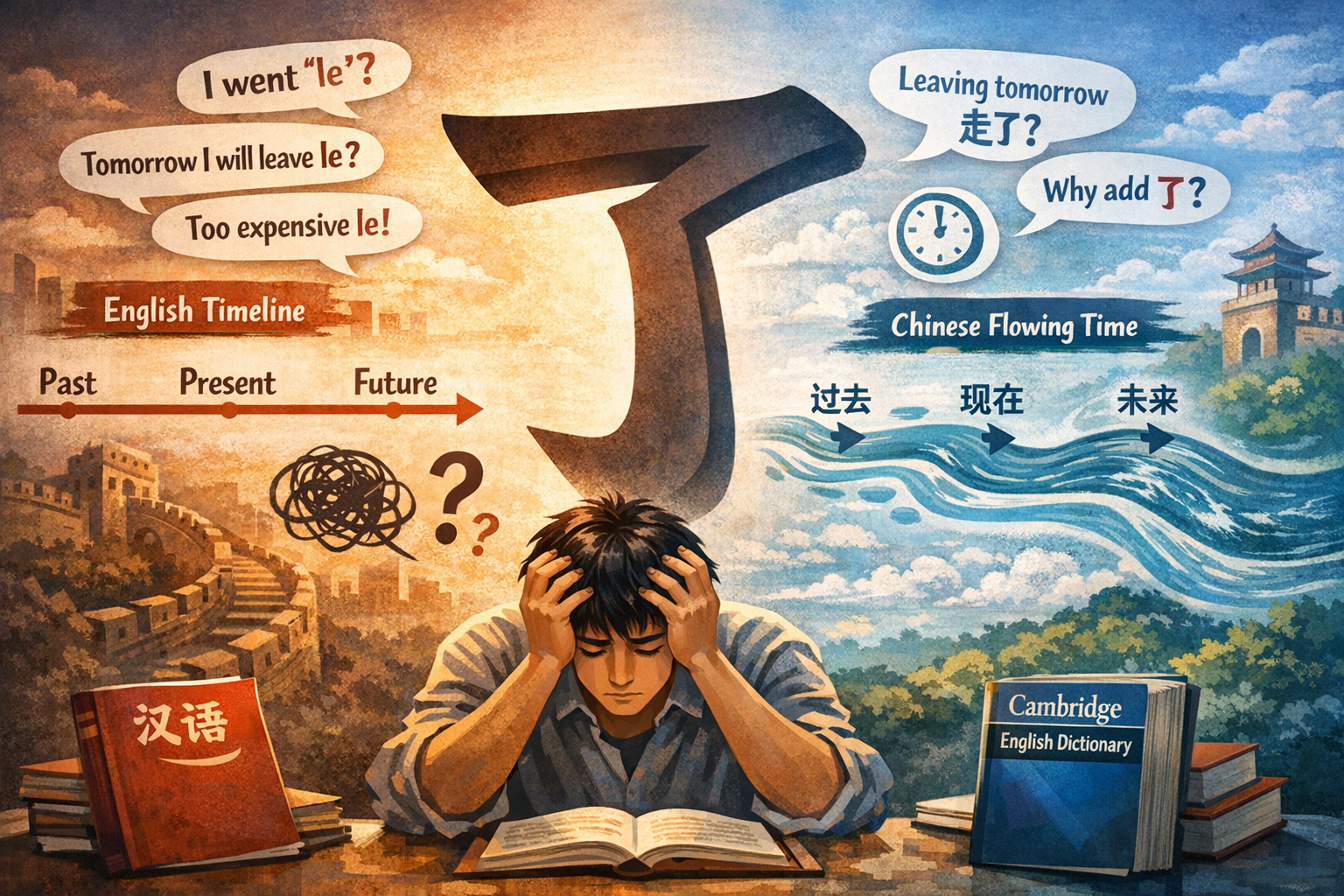
Table of Contents
- Introduction: The Beloved and Hated“了”
- Core Concept Distinction: Actually, You Have Two“了”s
- Deep Dive: Why Must Sentences End with“了”?
- Common Misconceptions and Counter-Examples: Avoiding the Pitfalls
- Practical Advice for Learners: How to Master the Intuition
- Conclusion: Embracing Flowing Chinese
- FAQ
Introduction: The Beloved and Hated“了”
For any foreigner learning Chinese, the character“了” (le) is undoubtedly a formidable mountain to climb, or even a“nightmare.”In beginner classes, teachers often explain that“了”indicates the past tense, equivalent to the“-ed”suffix in English verbs. Delighted by this simple rule, learners might mistakenly try to construct sentences like“Yesterday I went le to the park.”While the intention is correct, the execution reveals a deeper complexity.
However, as proficiency grows, confusion mounts. When you want to say you are leaving tomorrow, the teacher says:“明天我就走了 (Tomorrow I will be leaving).”Wait, tomorrow hasn’t happened yet. Why use a marker often associated with the past? When you exclaim that something is expensive, you hear:“太贵了!(Too expensive!)”No action took place here, so why add it? Even more frustrating is that sometimes, even when an action is clearly completed, you cannot add“了”; yet other times, when describing a current state, the sentence must end with this very particle.
The root of this confusion lies in our attempt to force the“Tense”logic of Indo-European languages onto the“Aspect”logic of Chinese. In English thinking, time is a straight line, and actions must be pinned to a specific point in the past, present, or future. In Chinese thinking, time is more like a flowing state; we focus not on when an action occurred, but on whether the action is complete and whether the situation has changed.
This article will deeply analyze why Chinese sentences so frequently end with“了”, unveiling the cognitive logic behind this grammatical point to help learners shift from“rote memorization”to“intuitive understanding.”
Core Concept Distinction: Actually, You Have Two“了”s
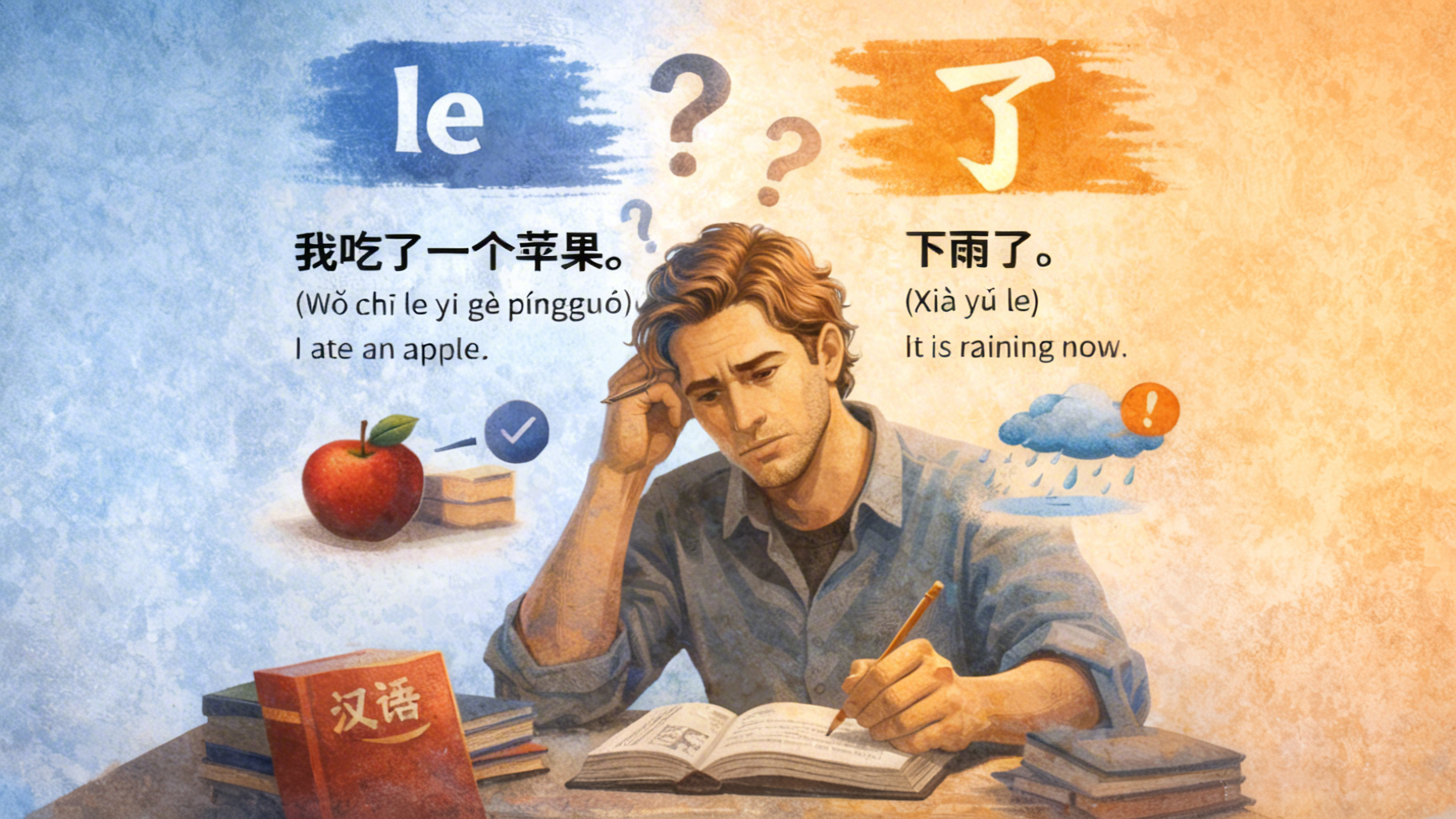
To solve the mystery, we must first acknowledge a frequently overlooked fact: there are actually two distinct“了”s in Chinese. Although they share the same pronunciation and character, their functions are entirely different. Confusing these two is the starting point of all misunderstandings.
1. The“了”After the Verb (Le1): The Marker of Completion
The first“了”, often referred to by linguists as“了₁”(Le1), is placed immediately after the verb and before the object.
- Structure: Verb + 了 + Object
- Function: It marks the completion of an action. Think of it as drawing a period at the end of an action, signaling that the task is done.
- Example:
Chinese: 我吃了一个苹果。 (Wǒ chī le yí gè píngguǒ.)
English: "I ate an apple."
Note: Here, 了 sits right after "eat" to show the eating is finished. - Logic: The focus here is strictly on the fact that the action of“eating”has finished. This structure does not necessarily tell us whether I am full now, or exactly when this happened; it simply emphasizes the completion of the action itself.
2. The“了”at the End of the Sentence (Le2): The Signal of Change
The second“了”, the protagonist of this article, is“了₂”(Le2). It sits at the very end of the sentence.
- Structure: Sentence + 了
- Function: It marks a change of state or the emergence of a new situation. It is the tonal core of the sentence, telling the listener:“Attention! The current situation is different from before!”
- Example:
Chinese: 下雨了。 (Xià yǔ le.)
English: "It is raining now." (Implying: It wasn't raining before.) - Logic: The point of this sentence isn't when the action of“raining”started, but rather conveying a piece of information: the state has switched from "no rain" to "rain."
3. When the Two Meet: The Double“了”Structure
Sometimes, a sentence needs to express both the completion of an action and a change in state. In such cases, both particles appear.
- Structure: Verb + 了₁ + Object + 了₂
- Example:
Chinese: 我吃了饭了。 (Wǒ chī le fàn le.)
English: "I have eaten (and thus I am full/done)." - Breakdown:
- The first 了:The action of eating is complete.
- The second 了:My state has changed (e.g., I am no longer hungry, or I am free to do something else).
- Nuance: If one simply omits the first 了 in colloquial speech (e.g., 我吃饭了), the meaning of completion is often implied by default. However, using both places stronger emphasis on how the“completion”affects the“current state.”
Understanding this distinction is the first step toward correctly interpreting the sentence-final particle: The“了”at the end of the sentence is not just about time; it is about“change.”
Deep Dive: Why Must Sentences End with“了”?
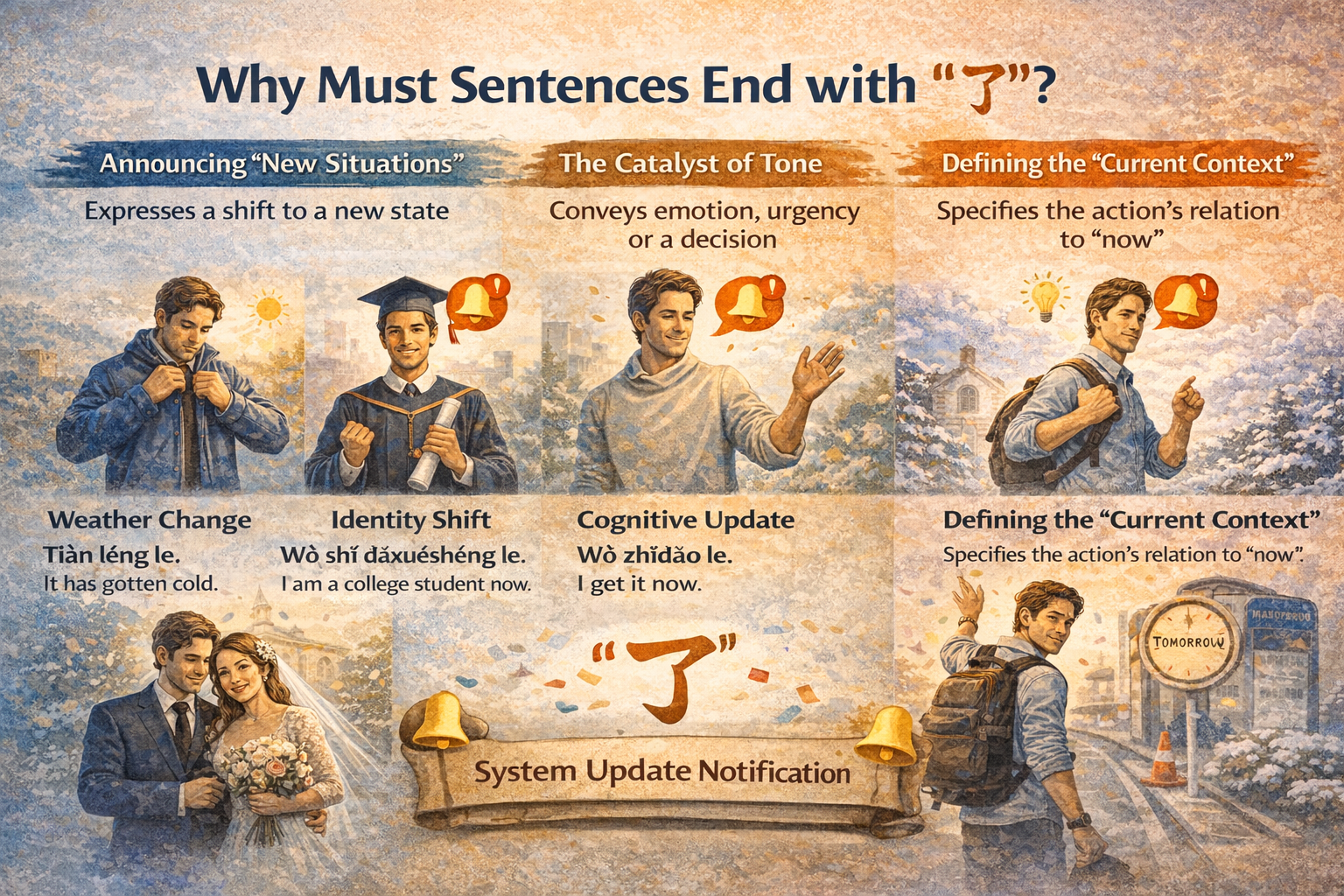
If the sentence-final“了”represents change, why does it appear so frequently in Chinese? This reflects the unique cognitive style and pragmatic habits of Chinese speakers.
1. A Dynamic Worldview: Announcing“New Situations”
Chinese speakers tend to view the world as a constantly flowing, changing process. When they speak, they are often reporting a new state relative to a previous moment to their interlocutor.
Imagine these scenarios:
- Weather Change: It used to be warm, now it is cold.
Chinese: 天冷了。 (Tiān lěng le.)
Meaning: "It has gotten cold." (Without 了,saying 天冷 sounds like a static geographical fact, e.g., "It is cold in Antarctica," rather than a report on the current weather change.) - Identity Shift: You were a student yesterday, but today you graduated.
Chinese: 我是大学生了。 (Wǒ shì dàxuéshēng le.)
Meaning: "I am a college student now." (Emphasizes the leap from "non-student" to "student".) - Cognitive Update: You did not know something before, but now someone has told you.
Chinese: 我知道了。 (Wǒ zhīdào le.)
Meaning: "I get it now." (Your brain state switched from "unknown" to "known".)
In English, these meanings can be implied through tenses (Present Perfect, Present Continuous) or context. In Chinese, however, without this particle, the sentence loses its soul of“dynamic updating,”becoming static and stiff. The sentence-final“了”is essentially the“System Update Notification”of the Chinese language.
2. The Catalyst of Tone: Emotion and Decision
Beyond indicating objective state changes, the sentence-final particle also serves rich subjective tonal functions. It makes the sentence sound like a genuine interaction rather than a cold statement.
- Urgency and Decision:
Chinese: 走了! (Zǒu le!)
English: "Let's go!" / "Time to go!"
Analysis: The action of“going”isn't necessarily completed yet. However, adding 了 conveys a sense of“the time has come, no more hesitation.”If one just says 走,it sounds like a bare command lacking situational context. - Exclamation and Exaggeration:
Chinese: 太漂亮了! (Tài piàoliang le!) — "So beautiful!"
Chinese: 饿死了! (È sǐ le!) — "I'm starving!"
Analysis: In these exclamatory sentences, the particle acts to intensify the tone, indicating that a degree has reached a new peak, triggering a strong emotional reaction. - Reminder and Warning:
Chinese: 小心了! (Xiǎoxīn le!)
English: "Watch out!"
Analysis: This implies that a dangerous situation has just emerged or is about to worsen.
As seen, the sentence-final particle fills language with“human touch”and a sense of“being present.”It connects the shared immediate context of the speaker and the listener.
3. Compensating for the Lack of Tense: Defining the“Current Context”
Chinese verbs themselves do not change form (go, went, and gone are all expressed by the same character 去). So, how do speakers tell the listener the relationship between the action and“now”? The sentence-final“了”serves as a crucial anchor.
When speakers add this particle at the end of a sentence, they are effectively drawing a temporal boundary: From this point on, things are significantly different from before.
- Chinese: 他结婚了。 (Tā jiéhūn le.)
English: "He got married." / "He is married now."
Meaning: Before this, he was single; after this, he is married. The particle clearly cuts between the past and present states without needing extra time adverbials. - Chinese: 我要走了。 (Wǒ yào zǒu le.)
English: "I am leaving now."
Meaning: Before this, I was staying; after this, I will be leaving. Even for future events, as long as speakers emphasize an“impending change of state,”the particle can still be used.
This is why“明天我就走了”(Tomorrow I will be leaving) is perfectly correct. Because looking from the perspective of the decision made now, "leaving" is about to become the new reality tomorrow. Chinese focuses on the inevitability of change, not the absolute time point of the action.
Common Misconceptions and Counter-Examples: Avoiding the Pitfalls
Although the“Change Theory”explains most cases, learners can still fall into certain traps.
Misconception 1:“了”Equals Past Tense
This is the biggest misconception. As mentioned earlier, the particle can be used for the future.
- Incorrect Understanding: Automatically translating the presence of“了”as the English past tense suffix“-ed”.
- Correct Interpretation:
- Past: 昨天他病了。 (Zuótiān tā bìng le.) — "He got sick yesterday." (State changed from healthy to sick).
- Present: 下雨了。 (Xià yǔ le.) — "It is raining now." (State changed from no rain to rain).
- Future: 明年我就三十岁了。 (Míngnián wǒ jiù sānshí suì le.) — "Next year I will be thirty." (State will change from twenty-nine to thirty).
- Judgment Criteria: Don’t ask“When is it?”Ask“Has it changed?”
Misconception 2: All Completed Actions Need“了”
Not every sentence indicating a completed action requires the particle, especially in negative sentences.
- Negative Sentences:
Incorrect: 我没吃了饭。 (Wǒ méi chī le fàn.)
Correct: 我没吃饭。 (Wǒ méi chī fàn.) — "I didn't eat."
Analysis: The negator 没 (méi) itself denies the occurrence of the action. Since the action didn't happen, there is no“completion”to mark, so 了 is omitted. - Exception: If the negative indicates the disappearance of a state, 了 is used. E.g., 没钱了 (Méi qián le - "I have run out of money"), marking the change from having money to having none.
- Narrating Sequential Actions:
Unnatural: 昨天我去了书店,买了书,然后回了家。 (Too many 了s make it choppy).
Natural: 昨天我去书店买书,然后回家。 ("Yesterday I went to the bookstore to buy books, and then returned home.")
Analysis: When narrating a series of past actions, Chinese relies on time words and word order. Too many particles make the sentence feel fragmented. Usually, 了 is only used at the very end to mark the conclusion of the whole event.
Misconception 3: Static Descriptions Must Add“了”
If a fact is constant and unchanging, you absolutely must not add the particle.
- Incorrect: 他是老师了。 (Tā shì lǎoshī le.) — Wrong if he has been a teacher for ten years.
- Correct: 他是老师。 (Tā shì lǎoshī.) — "He is a teacher."
- Analysis: You would only say 他是老师了 if:
- He just got the job (identity changed).
- Someone thought he wasn't, and you are correcting them.
Practical Advice for Learners: How to Master the Intuition
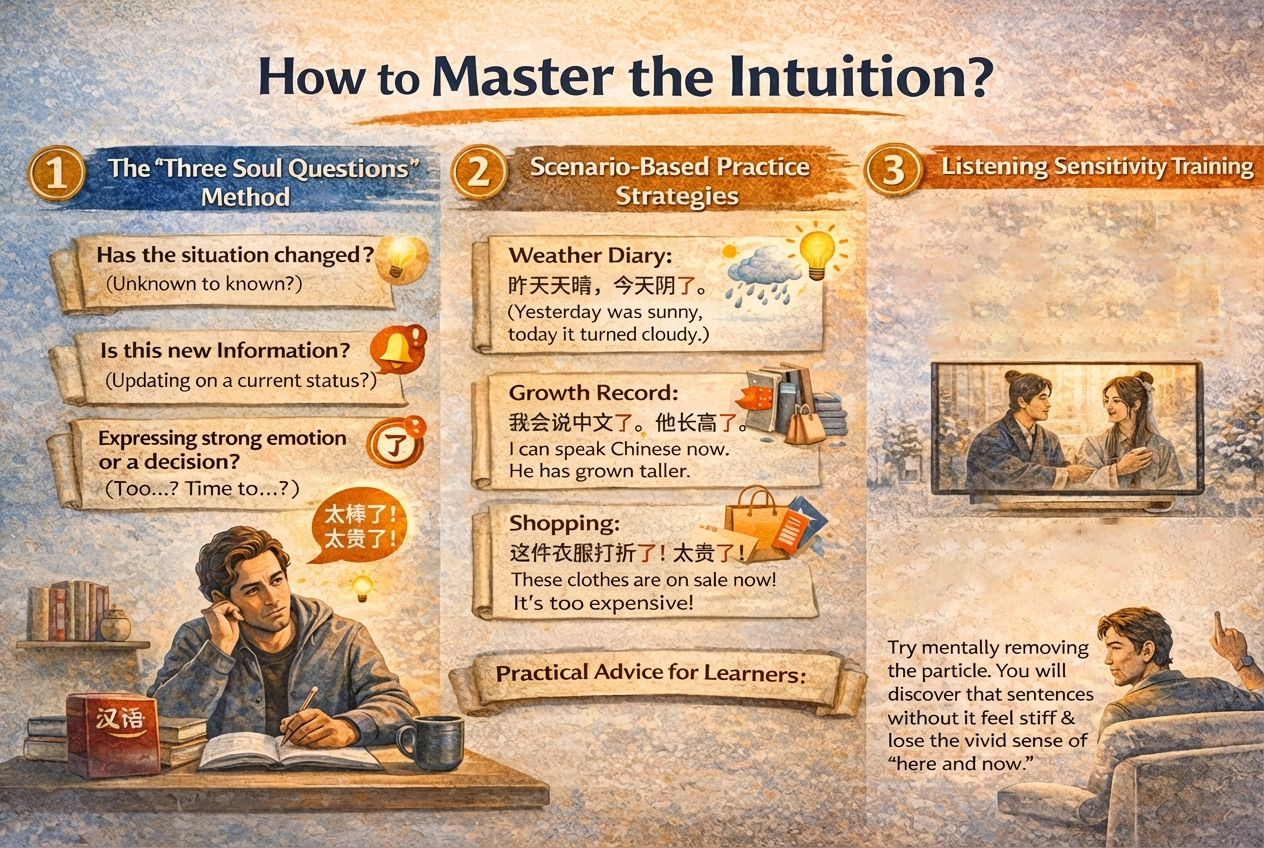
Truly mastering the sentence-final particle requires a shift in thinking patterns.
1. The“Three Soul Questions”Method
Every time you want to add the particle at the end of a sentence, ask yourself:
- Has the situation changed? (From unknown to known? From none to some?)
- Is this new information? (Am I updating the listener on a current status?)
- Am I expressing strong emotion or a decision? (Is it“too…”? Is it“time to…”?)
If the answer is yes, the sentence likely needs 了.
2. Scenario-Based Practice Strategies
Practice within specific“change scenarios”:
- Weather Diary: 昨天晴,今天阴了。 ("Yesterday was sunny, today it turned cloudy.")
- Growth Record: 我会说中文了。 ("I can speak Chinese now.") / 他长高了。 ("He has grown taller.")
- Shopping: 这件衣服打折了! ("These clothes are on sale now!") / 太贵了! ("It's too expensive!")
- Travel: 车来了! ("The car is here!") / 走了走了! ("Let's go, let's go!")
3. Listening Sensitivity Training
When watching Chinese media, pay attention to the particle at the end of sentences.
- Notice the context when speakers say 太棒了 ("Awesome!"), 完了 ("It's over!"), or 好了 ("Okay/Done!"). Observe the turning point in the situation.
- Try mentally removing the particle. You will discover that without it, sentences often sound stiff, like reading a manual, losing that vivid sense of "here and now."
Conclusion: Embracing Flowing Chinese

Why do Chinese sentences often end with this particle? Ultimately, it is because Chinese is a language that focuses on change, values the present, and is full of dynamic vitality.
For foreign learners accustomed to rigorous tense systems, this concept is a challenge. It is not a mathematical formula; it is an art of living. It reminds us that the world is not a static slice, but a rushing river.
When you stop struggling with“Is this past or future?”and start perceiving“the difference between this moment and that moment,”when you can naturally blurt out“下雨了”(It’s raining),“天黑了”(It’s dark), or“我明白了”(I understand), you are no longer just using a grammar point. You are experiencing the world through the Chinese mindset.
That tiny particle“了”is no longer a stumbling block; it is a golden key. It marks your transition from“learning Chinese”to“living in Chinese.”Next time you want to express a new situation, a new feeling, or a new decision, confidently add that particle to the end of your sentence—because life updates every single moment, and your Chinese should be just as vibrant.
FAQ
If“了”indicates a change of state, can I use it with adjectives that don’t seem to imply an action?
Yes, absolutely. In Chinese, adjectives often function as stative verbs. When you add“了”to an adjective (e.g., 大了 - dà le, "big now"), it signifies that the degree of that quality has changed compared to before. For example, saying“孩子大了”(The child is big now) doesn't just describe their size; it implies they have grown from being small to being big. It marks the transition. If you simply say“孩子大”, it sounds incomplete or like you are comparing two specific children rather than describing a change over time.
Why do we sometimes omit“了”even when talking about something that happened yesterday?
This usually happens in narratives or when the focus is on the sequence of events rather than the completion of individual steps. As mentioned in the article, if you list a series of actions (e.g., "I woke up, brushed my teeth, and left"), adding“了”after every verb makes the sentence sound choppy and overly emphasized. Native speakers often rely on time words (like "昨天" - yesterday) and the logical order of verbs to show these things happened in the past. The final“了”might appear at the very end of the story to mark the conclusion of the whole event, but intermediate“了”s are often dropped for flow.
Can I use“了”in a sentence that starts with“因为...所以...” (Because... therefore...)?
Generally, you should be careful. The particle“了”focuses on a new situation or a change. If the "Because" clause explains a general fact or a permanent state, do not use“了”. For instance,“因为下雨了,所以地湿了”is correct because both the rain starting and the ground becoming wet are changes that just occurred. However, if you are stating a general logical truth (e.g., "Because water is wet, clothes get wet"), no“了”is needed. You only use it in these structures if both the cause and the result represent a specific change relevant to the current moment.
What is the difference between“没...了”(méi...le) and just“没”(méi)?
This is a crucial distinction regarding the disappearance of something.“没”(Méi) alone simply negates an action or existence (e.g.,“我没钱”- "I don't have money" as a general state). In contrast,“没...了”(Méi...le) specifically highlights the change from having to not having. It means "run out of." For example,“没钱了”(Méi qián le) means "I used to have money, but now I have run out." It emphasizes the loss or the transition to a state of emptiness, fitting perfectly with the core theme:“了”equals change.
Is the sentence-final“了”(Le2) ever used to express regret or realization?
Yes, this is an advanced tonal usage related to "Cognitive Update." When a speaker realizes something too late or understands a consequence,“了”adds a tone of finality or emotional weight to that realization. For example,“完了!”(Wán le!) literally means "Finished," but pragmatically it means "It's over!" or "We're doomed!" expressing sudden despair. Similarly,“我错了。”(Wǒ cuò le.) means "I was wrong" (admitting a change in stance/realization). Without“了”(“我错”), it sounds unnatural and incomplete. Here,“了”signals the shift from "thinking I was right" to "accepting I am wrong."