Why Are There So Many Chinese Four-Character Idioms?
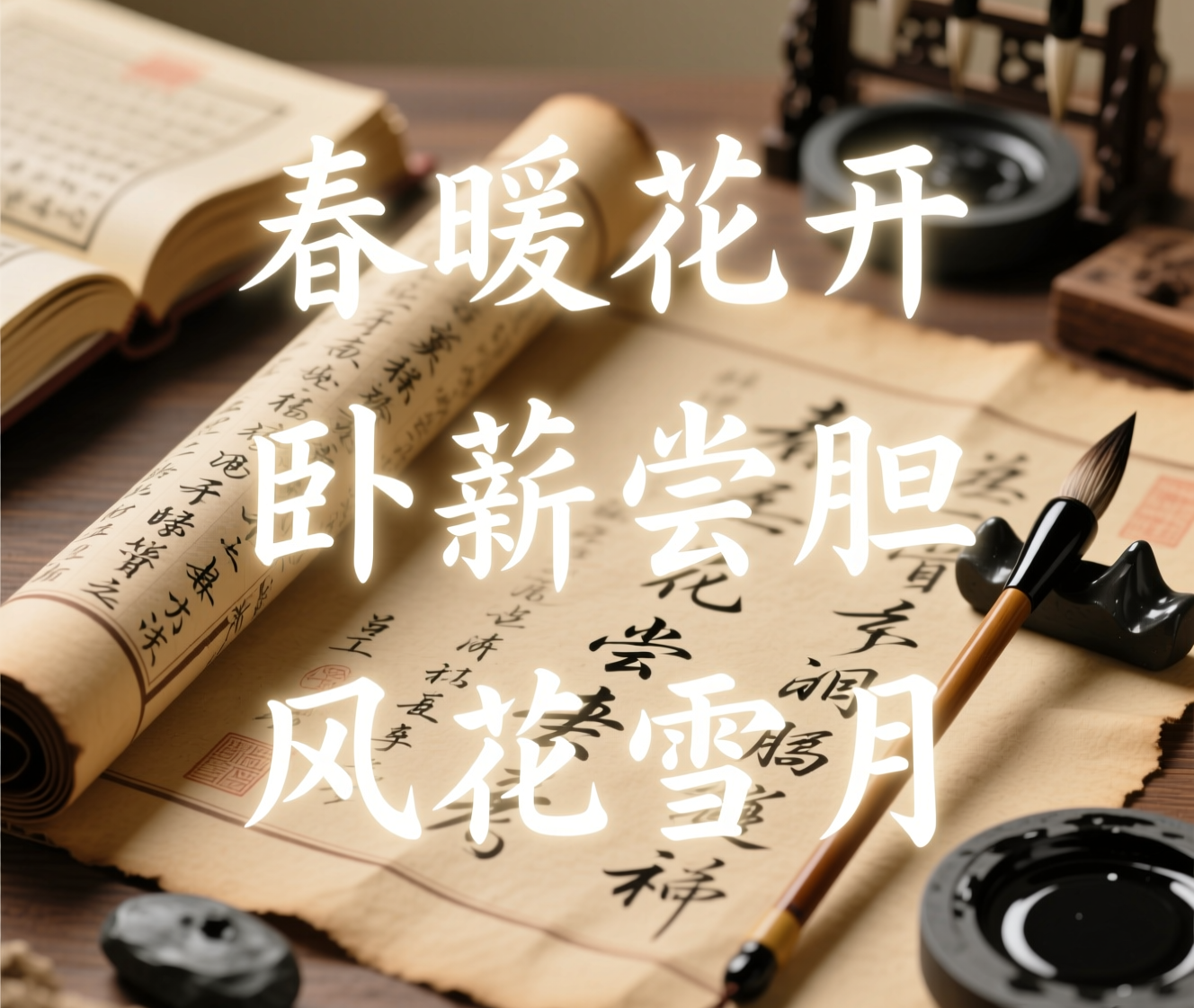
Table of Contents
- Historical Origins: From the Book of Songs to the Crystallization of Chinese Historians
- Linguistic Ontology: The Balance of Chinese Phonology and Grammar
- Cultural Psychology: Symmetrical Aesthetics and the Meaning of Number 4 in China
- Functional Evolution: From Ancient Classics to Modern Internet Slang
- Conclusion: The Enduring Power of Chinese Four-Character Idioms
- Frequently Asked Questions (FAQ)
The ocean of Chinese vocabulary is vast, yet its most brilliant gems are undoubtedly the four-character phrases, known as Chengyu. From the brightness of "spring warmth and flower bloom" (chūn nuǎn huā kāi 春暖花开) to the resilience of "sleeping on brushwood and tasting gall" (wò xīn cháng dǎn 卧薪尝胆), from the romance of "wind, flowers, snow, and moon" (fēng huā xuě yuè 风花雪月) to the majesty of "thunder and ten-thousand pounds of force" (léi tíng wàn jūn 雷霆万钧), these Chinese idioms seem to possess a magical power. They carry immense weight with minimal brevity. But why exactly "four"? This is no accidental coincidence. It is the optimal solution refined by the Han people over a long historical river, polishing sound, meaning, and aesthetics. The four-character structure is not merely the building block of language; it is the concentrated expression of the Chinese cultural gene.
Historical Origins: From the Book of Songs to the Crystallization of Chinese Historians
The prosperity of four-character phrases in Chinese is first rooted in deep historical soil, with its origins traceable to the Shijing (Book of Songs), the earliest anthology of Chinese poetry. In the pre-Qin period, four-line poetry was the dominant literary form. Timeless lines like "Guan guan go the ospreys, on the islet in the river" (guān guān jū jiū, zài hé zhī zhōu 关关雎鸠,在河之洲) and "When I left home, willows were swaying" (xī wǒ wǎng yǐ, yáng liǔ yī yī 昔我往矣,杨柳依依) established the orthodoxy of the "two-two" rhythm in Chinese linguistics. This rhythm not only aligned with the breathing patterns of the people at the time but also became the standard paradigm for early Chinese expression. As this poetic rhythm permeated daily language and philosophical speculation, the four-character idiom structure began to sprout.
During the era of the Hundred Schools of Thought, thinkers strove for conciseness and power to gain the upper hand in debates. Phrases in the Analects like "learning and timely reviewing" (xué ér shí xí 学而时习) and "reviewing the old to know the new" (wēn gù zhī xīn 温故知新), or in Mencius like "pulling seedlings to help them grow" (yà miáo zhù zhǎng 揠苗助长), all attempted to summarize profound philosophies in the shortest possible statements. Meanwhile, historical prose such as the Zuo Zhuan and Strategies of the Warring States recorded countless thrilling stories. As these stories circulated, they were gradually refined into distinctive four-character fragments with specific referential meanings, laying the foundation for modern Chengyu.
The true crystallization occurred during the Han Dynasty. With the establishment of a unified empire, culture required a carrier that was solemn, elegant, and easy to disseminate. The descriptive parallelism of Han Fu poetry relied heavily on the stacking of four-character sentences to create momentum, while Sima Qian's Records of the Grand Historian used his monumental pen to solidify anecdotes from previous eras. Many long and short sentences scattered in ancient texts were processed and refined by scholars during this period, formally congealing into fixed Chinese four-character idioms. It can be said that behind every Chengyu stands a witness to history; they are the crystallization born of pre-Qin rational spirit and Han grand narrative, maintaining their original vitality after two thousand years of wind and rain.
Linguistic Ontology: The Balance of Chinese Phonology and Grammar
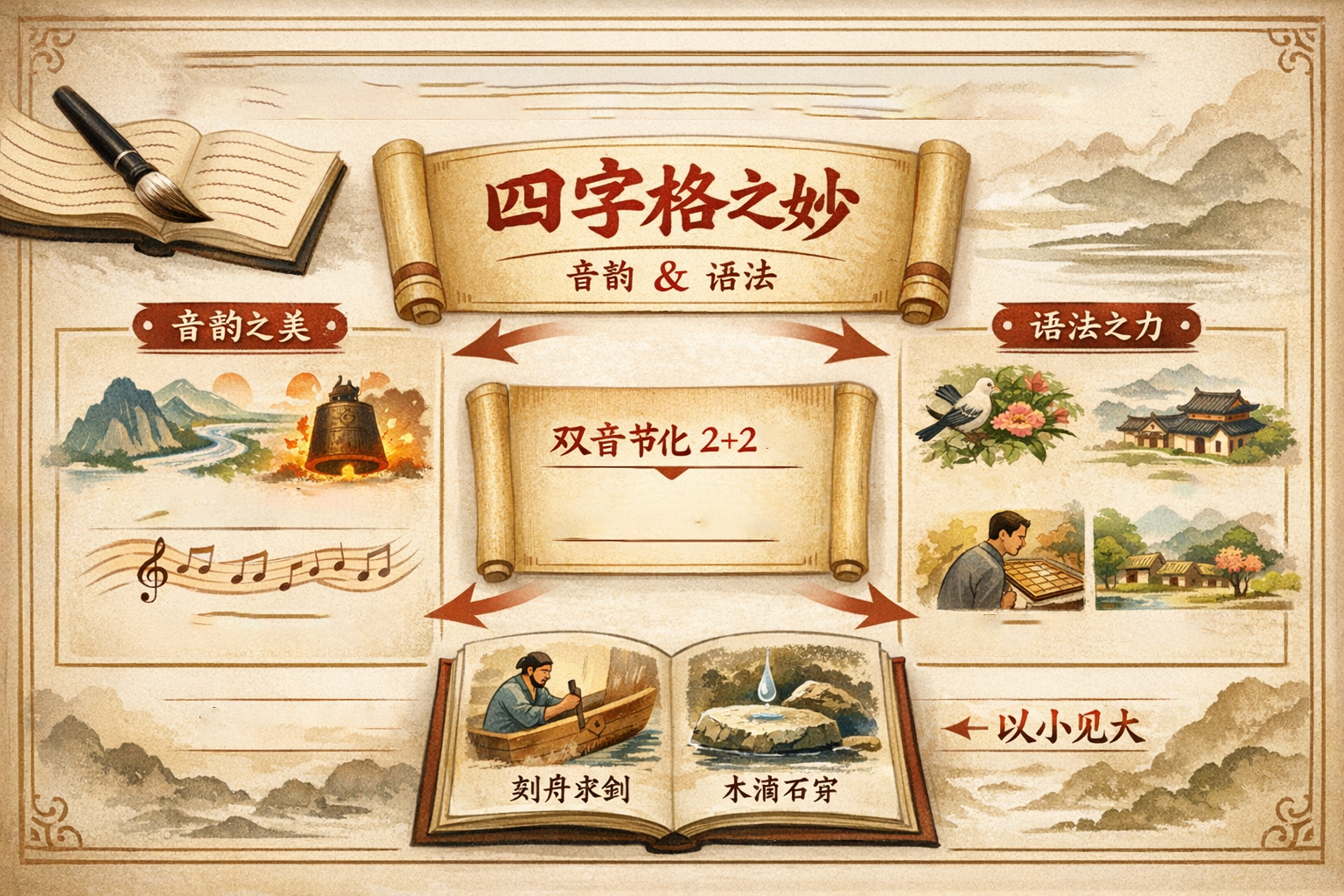
Analyzing from the internal texture of linguistics, the enduring success of the four-character structure is due to its perfect fit with Chinese phonological laws and grammatical characteristics. A significant trend in the development of Chinese vocabulary is "disyllabification." Monosyllabic words are often vague in meaning and short in pronunciation, while trisyllabic words can seem slightly dragging; only disyllabic words are the most stable. The four-character phrase is precisely the perfect combination of two disyllabic words (a 2+2 structure), forming a natural symmetry and balance in hearing.
Phonologically, the four-character structure easily constructs a rhythm of alternating level and oblique tones (Ping Ze). Chinese emphasizes tonal pairings like "level-level-oblique-oblique" or "oblique-oblique-level-level." Four characters constitute a complete metrical cycle. For instance, "mountains clear, waters beautiful" (shān qīng shuǐ xiù 山清水秀) rolls off the tongue smoothly, like pearls falling on a jade plate; "shaking heaven and moving earth" (jīng tiān dòng dì 惊天动地) sounds sonorous and powerful. This musicality makes Chinese idioms extremely easy to memorize and spread; even children can recite them effortlessly. In contrast, three or five characters often fail to form such neat tonal loops, while six or more characters appear verbose, losing the compactness required of classic Chengyu.
Grammatically, the four-character structure demonstrates amazing inclusivity and tension. In just four characters, one can accommodate complex grammatical relationships such as subject-predicate, verb-object, modifier-head, and coordination. "Birds sing, flowers scent" (niǎo yǔ huā xiāng 鸟语花香) is a coordination of two subject-predicate structures, depicting a vivid scene; "consider the overall situation" (gù quán dà jú 顾全大局) is a verb-object structure expressing an action strategy; "Peach Blossom Spring" (shì wài táo yuán 世外桃源) is a modifier-head structure constructing an ideal space. More wonderfully, the four-character idiom often breaks conventional grammar, using parts of speech flexibly to compress information. Within a tiny space, through clever word order, it can tell a complete story (like "carving a boat to seek a sword" kè zhōu qiú jiàn 刻舟求剑) or elaborate a complex causal logic (like "water drops pierce stone" shuǐ dī shí chuān 水滴石穿). This characteristic of "being concise yet comprehensive" greatly increases the information density of the Chinese language, representing the ultimate embodiment of the principle of linguistic economy.
Cultural Psychology: Symmetrical Aesthetics and the Meaning of Number 4 in China
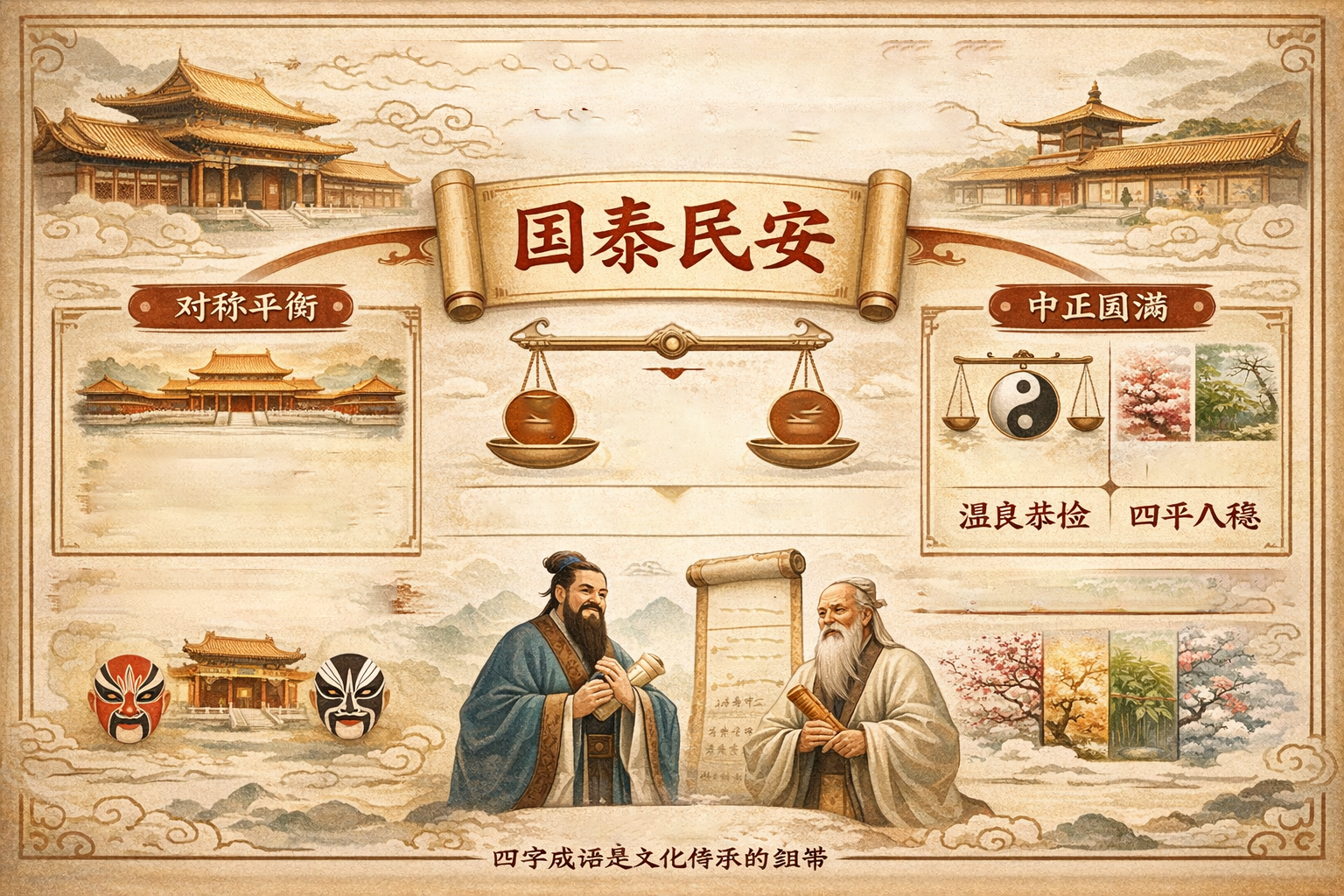
Language is a mirror of culture; the prevalence of the four-character structure profoundly reflects the psychological structure and aesthetic orientation of traditional Chinese culture. The Chinese people have always advocated "symmetry" and "balance." This aesthetic is not only embodied in the architectural layout of the Forbidden City and the facial makeup of Peking Opera but is also deeply imprinted on language expression. The natural front-and-back halves (2+2) of the four-character phrase constitute absolute visual and auditory symmetry. Whether it is "favorable weather" (fēng tiáo yǔ shùn 风调雨顺) or "the country is prosperous and the people are at peace" (guó tài mín ān 国泰民安), the two halves often complement and echo each other. This uniform sense of form gives the user a psychological sense of order and harmony.
Furthermore, the four-character structure aligns with the philosophical thoughts of Confucian "Moderation" (Zhōngyōng 中庸) and Daoist "Perfection." In traditional Chinese numerical concepts, while "four" has special connotations in certain contexts, structurally it represents stability (such as the four directions, four seasons, and four times). The four-character idiom is neither biased nor leaning, neither too long nor too short, giving a sense of "just right" perfection. It avoids the isolation of a single character, the thinness of two, the incompleteness of three, and the complexity of many, achieving a dynamic balance. This structural "centrality and peace" is precisely the realm of personality pursued by traditional Chinese scholar-officials.
On a deeper level, four-character idioms are the vehicle for the Chinese psychology of "revering the ancient." Chinese culture values historical experience, believing that truth is often contained in past allusions. Using a Chengyu is actually an act of cultural "quoting classics." When we say "smash the cauldrons and sink the boats" (pò fǔ chén zhōu 破釜沉舟), we are not just describing a determined attitude but also paying tribute to the heroic spirit of Xiang Yu; when we sigh that "the old man lost his horse" (sài wēng shī mǎ 塞翁失马), we are borrowing ancient wisdom to comfort current gains and losses. Every four-character phrase is a miniature historical theater; using them confirms one's identity as a cultural inheritor. This intergenerational transmission of collective memory elevates the four-character structure beyond a mere lexical function, making it a bond that sustains national emotion and cultural identity.
Functional Evolution: From Ancient Classics to Modern Internet Slang
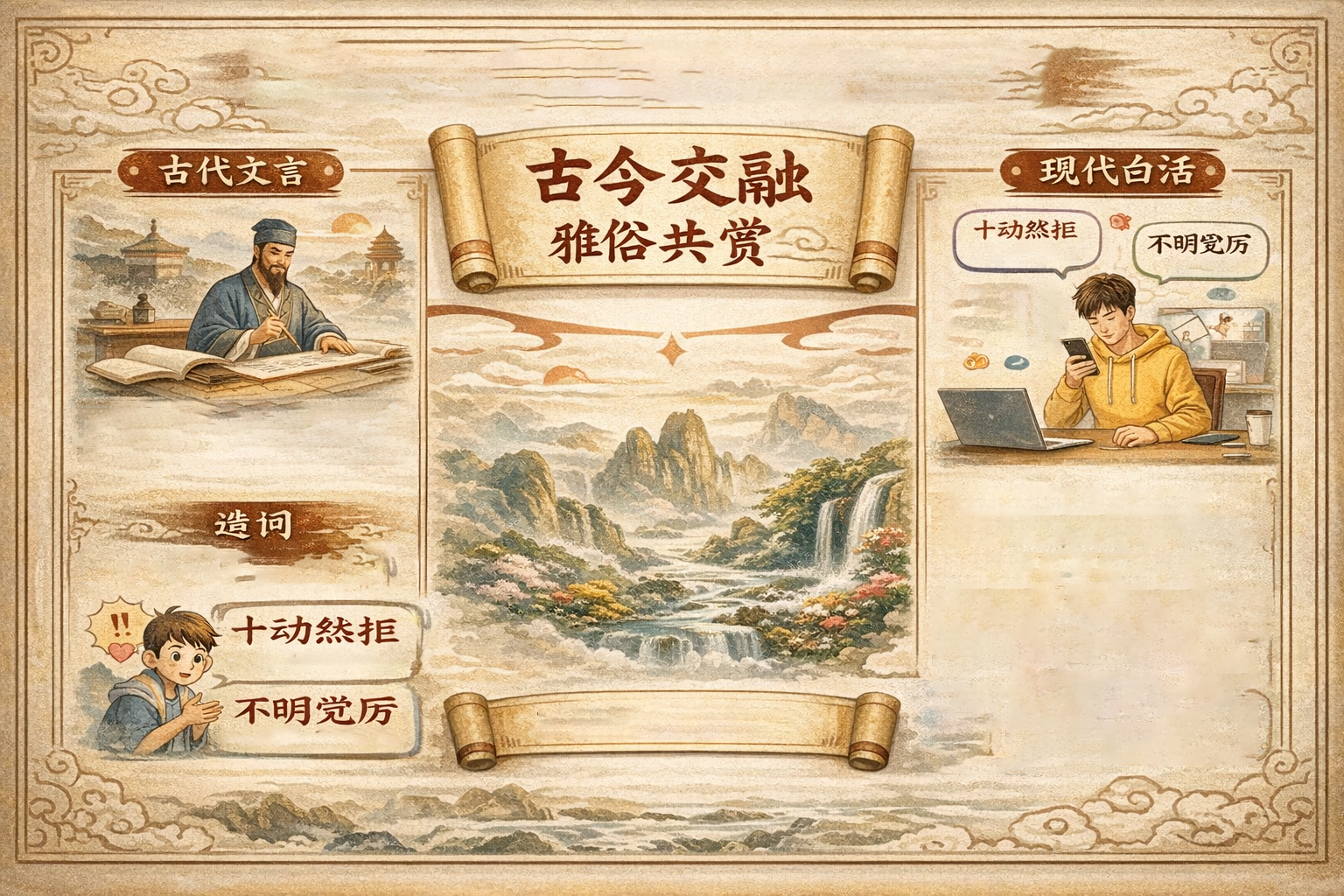
Four-character phrases are not exhibits in a museum; they possess strong adaptability and vitality, successfully bridging Classical Chinese and vernacular, the ancient and the modern. In ancient times, idioms were mostly used in written language, exclusive to literati; however, with the rise of the Vernacular Movement, a large number of four-character Chengyu sank into the spoken domain, becoming vocabulary enjoyed by both the refined and the common people. Today, whether in street gossip or news broadcasts, four-character phrases are ubiquitous. They can be used in solemn political reports, such as "stay true to our original aspiration" (bù wàng chū xīn 不忘初心) and "forge ahead relentlessly" (dǐ lì qián xíng 砥砺前行), as well as in relaxed internet banter, demonstrating amazing stylistic span.
Even more astonishing is that the word-formation mechanism of the four-character structure remains active in contemporary times. Facing rapidly changing social phenomena, modern people still subconsciously follow the "four-character" thinking pattern to create new words. In the internet age, new four-character phrases like "ten moves then refuse" (shí dòng rán jù 十动然拒 - moved by ten actions then rejected), "unclear but feel awesome" (bù míng jué lì 不明觉厉 - don't understand but feel it's amazing), and "life is hard, don't expose" (rén jiān bù chāi 人艰不拆 - life is already hard, don't tear it apart) have emerged. Although not as standardized as traditional Chengyu, they prove that the "2+2" rhythm is still the most natural word-forming instinct of modern Chinese. These new words spread rapidly and may even, after being sifted by time in the future, settle into new classic idioms.
Rhetorically, the continuous use of four-character phrases is a unique source of momentum in Chinese rhetoric. In speeches, writing, or debates, consecutively using four-character idioms can create a momentum like a landslide, establishing a solemn, urgent, or grand atmosphere. For example, when describing scenery, linking phrases like "layered peaks and ridges" (céng luán dié zhàng 层峦叠嶂), "lush greenery" (yù yù cōng cōng 郁郁葱葱), "flying waterfalls and flowing springs" (fēi pù liú quán 飞瀑流泉), and "birds singing and flowers fragrant" (niǎo yǔ huā xiāng 鸟语花香) instantly constructs a three-dimensional picture in the reader's mind. This sense of rhythm and imagery brought by the four-character structure is unattainable by words of other lengths. It allows Chinese, when expressing complex emotions and grand narratives, to remain concise yet magnificent, showcasing the unique artistic charm of the Chinese language.
Conclusion: The Enduring Power of Chinese Four-Character Idioms
In summary, the reason there are so many four-character phrases in Chinese is the result of the combined effects of historical accumulation, linguistic laws, cultural aesthetics, and practical functions. From the chanting of the Book of Songs to the popularity of the internet, the four-character structure has always been the most solid cornerstone of the Chinese language. It builds rhythm with the stability of disyllables, echoes aesthetics with symmetrical structures, and carries culture with the thickness of allusions. These four characters are not only the essence of language but also the crystallization of Chinese wisdom. They will continue to tell ancient yet ever-new Chinese stories in the years to come, serving as a vital tool for anyone learning Chinese or studying East Asian culture.
Frequently Asked Questions (FAQ)
1. Are all Chinese four-character phrases considered "Chengyu" (idioms)?
No, not exactly. While the terms are often used interchangeably, there is a distinction. Chengyu specifically refers to fixed expressions with historical origins, classical allusions, or established meanings derived from ancient texts (e.g., wò xīn cháng dǎn 卧薪尝胆). However, the four-character structure is broader. It also includes modern descriptive phrases, grammatical combinations, and even contemporary internet slang (like bù míng jué lì 不明觉厉) that follow the "2+2" rhythm but lack the deep historical roots of traditional Chengyu. The structure is the vessel; Chengyu is the classic content within it.
2. Why is the number "four" so significant in Chinese language structure?
The preference for four characters is a result of linguistic stability and cultural aesthetics. Linguistically, Chinese has evolved towards "disyllabification" (two-syllable words). A four-character phrase creates a perfect 2+2 symmetry, which aligns with the natural breathing rhythm and creates a complete tonal cycle (alternating level and oblique tones). Culturally, the number four represents stability and balance (four directions, four seasons), resonating with the Confucian ideal of the "Golden Mean" (Zhōngyōng 中庸). It is seen as "just right"—neither too short to be vague nor too long to be verbose.
3. Can modern people still create new four-character idioms today?
Absolutely. The mechanism for creating four-character phrases is still highly active. As shown in the article, the internet age has spawned numerous new four-character terms to describe modern phenomena, such as shí dòng rán jù (十动然拒 - rejected after ten moves) or rén jiān bù chāi (人艰不拆 - life is hard, don't expose it). While these may not yet have the status of classical Chengyu, they prove that the "2+2" thinking pattern remains the most natural instinct for word formation in modern Chinese. Over time, the most popular of these may solidify into future classics.
4. How do four-character idioms help in learning Chinese?
Four-character idioms are powerful tools for learners because they offer high information density. Learning one Chengyu often teaches you a historical story, a moral lesson, and complex grammar simultaneously. Phonetically, their rhythmic 2+2 structure and tonal balance make them easier to memorize and recite than irregular sentences. Furthermore, mastering Chengyu allows learners to express complex emotions and sophisticated ideas concisely, helping them sound more native and culturally fluent in both writing and formal speech.
5. Where did the tradition of four-character phrases originally come from?
The tradition traces back to the pre-Qin period, specifically the Shijing (Book of Songs), where four-line poetry established the foundational "two-two" rhythm of Chinese. This rhythm was further refined during the Hundred Schools of Thought era by philosophers like Confucius and Mencius, who used concise four-character statements to summarize profound truths. The format was finally crystallized and standardized during the Han Dynasty through historical records and poetic Fu, evolving from a poetic meter into the fixed lexical units we use today.