Why Do Chinese People “Eat” Medicine but “Drink” Chinese Herbal Medicine?
Have You Been Tricked by “Common Sense” About Taking Medicine in Chinese?
Table of Contents
- Introduction: Have You Been Tricked by “Common Sense” About Taking Medicine in Chinese?
- Form Determines the Verb — TCM Decoction vs. Western Pills
- Historical Evolution — From Herbal Soup to Modern Pharmaceuticals
- A Cross-Cultural Curiosity — How Different Languages Say "Take Medicine"
- The Superpower of the Chinese Verb “Eat” (吃)
- One Small Word, A Whole World of Life
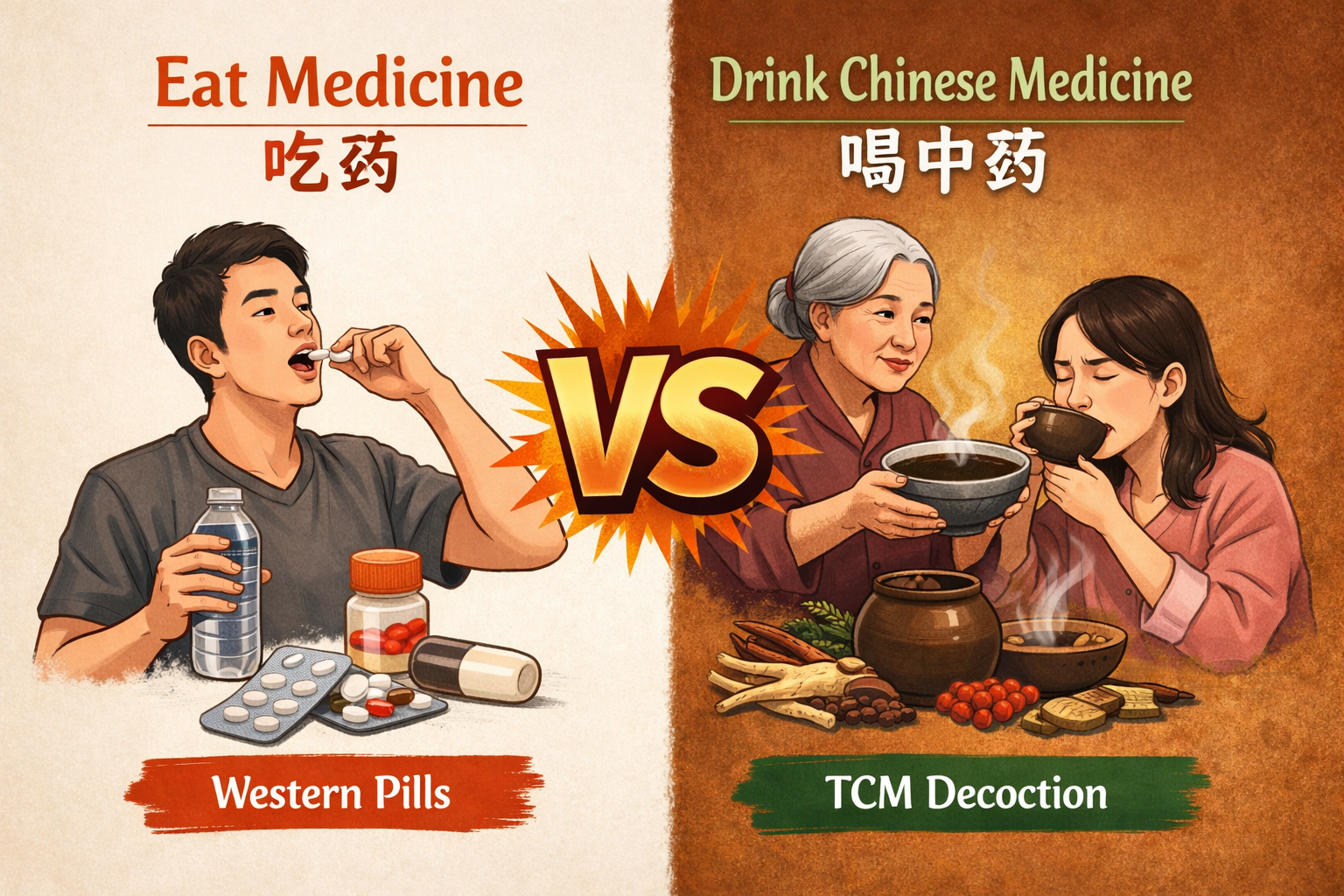
In many Chinese households, there are two familiar scenes that almost everyone recognizes when discussing how to take medicine.
The first scene usually takes place in the kitchen or at the dining table. An older family member holds a steaming bowl filled with a dark liquid that smells strong and bitter. With a serious look, they say, “Drink this bowl of Chinese medicine (喝中药) while it’s hot.” The medicine is often unpleasantly bitter, but under the watchful eyes of the elders, you lift the bowl and slowly drink it down.
The second scene feels much more modern. A younger person sits at the table, opens a bottle of water, pours two small white pills into their hand, tosses them into their mouth, and swallows them with a sip of water. The action is quick and routine. Then they casually remind someone nearby, “Remember to eat your Western medicine (吃西药) on time.”
Both scenes involve the same purpose: treating illness. Yet the verbs are different. One medicine is “drunk,” while the other is “eaten.” This confusion often leads people to search: Why do Chinese people drink TCM but eat Western medicine?
Is it because Traditional Chinese Medicine (TCM) belongs to ancient culture and must therefore be “drunk,” while Western medicine represents modern science and should be “eaten”? Or is this simply a casual habit of the Chinese language with no deeper meaning?
Most people never question it because it feels like common sense. But the moment you pause and think about the logic behind Chinese verbs, something interesting appears.
The truth is that the distinction is not really Chinese medicine versus Western medicine. The real difference lies in the physical form of the medicine.
Liquids are drunk. Solids are eaten.
This small linguistic difference reflects two deeper stories. One is the historical evolution of medicine itself, from herbal decoctions to modern pharmaceutical tablets. The other lies in the precise logic of Chinese verbs, which often correspond directly to physical actions.
In other words, a tiny everyday phrase quietly carries the imprint of both history and language. Let’s explore the difference between drinking and eating medicine step by step.
Form Determines the Verb — TCM Decoction vs. Western Pills
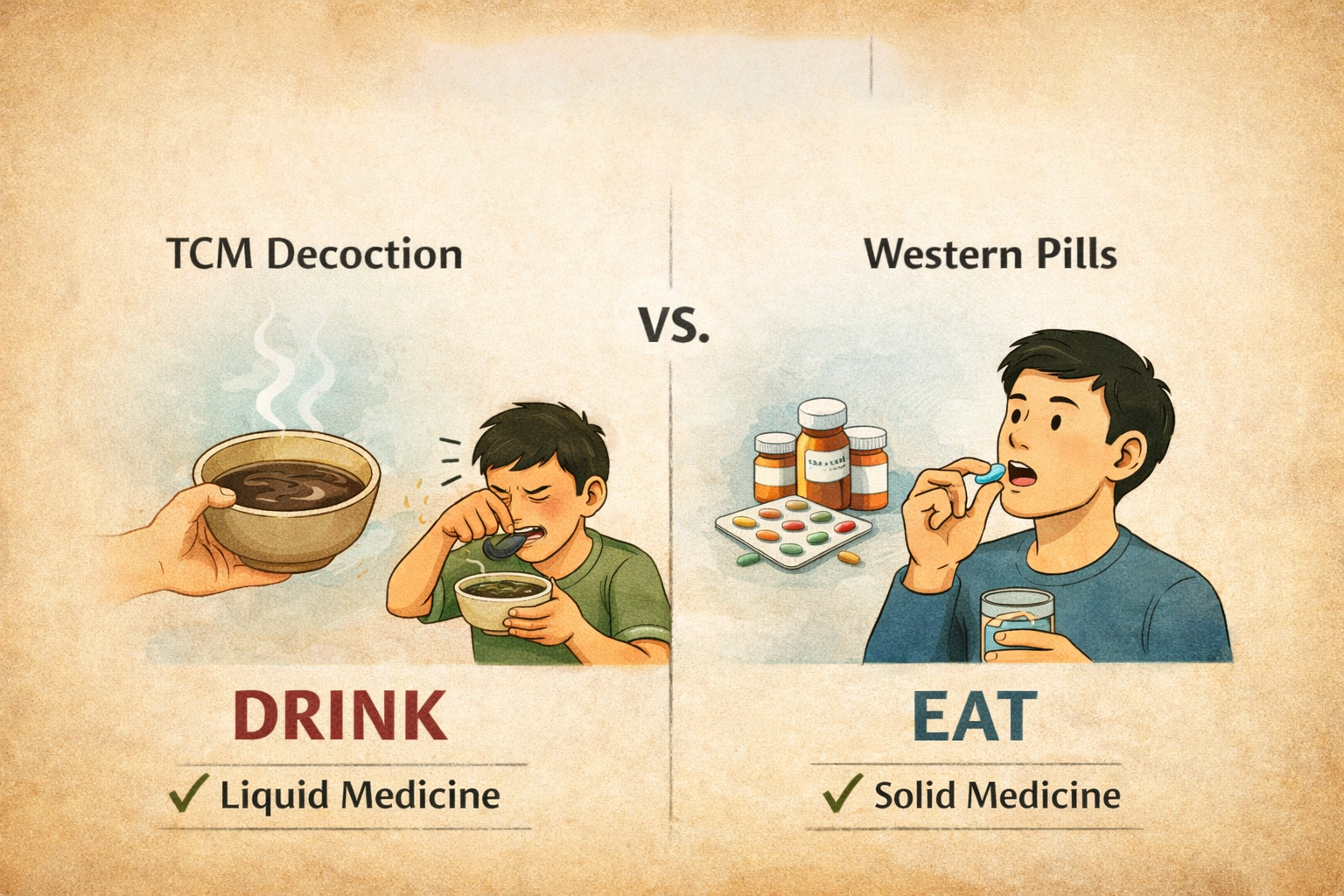
If we reduce the question of “eating medicine” versus “drinking medicine” to its most basic level, the answer becomes surprisingly simple: your mouth decides the verb.
In Chinese, the verbs “eat” (吃) and “drink” (喝) correspond to very clear physical actions. This is a key point in understanding Chinese grammar regarding medicine.
- "Eat" usually refers to solid food entering the body. The action often involves chewing and swallowing, or at least handling something solid with the mouth and teeth. Rice, bread, fruit, meat, and solid medicine forms all belong to the world of "eating."
- "Drink," on the other hand, refers to liquids. Water, soup, tea, coffee, milk, and liquid medicine require no chewing. They simply flow into the mouth and are swallowed.
Because of this difference, when the physical form of something changes, the verb naturally changes as well.
Traditional Chinese Medicine is most commonly prepared as a decoction (汤剂). A decoction is made by boiling herbs in water for a long time, producing a concentrated medicinal soup. The result is a bowl of dark liquid that must be consumed in liquid form. This is why the phrase "drink herbal medicine" is so iconic.
Many Chinese people have childhood memories of drinking such medicine. A steaming bowl sits on the table, filling the room with a bitter smell, while an adult insists, “Drink it quickly before it gets cold.” Holding your nose, you swallow it down in a few painful gulps.
This vivid sensory experience has deeply connected TCM decoctions with the verb “drink.”
Modern Western medicine, however, usually appears in a completely different form. Thanks to pharmaceutical technology, most drugs today are produced as tablets, capsules, or powders. They are small, portable, and precisely measured.
To take them, you simply place a pill in your mouth and swallow it with water. Naturally, the verb becomes “eat.” This explains why people often ask about the difference between taking pills and drinking soup.
But if we test this idea with a few counterexamples, the pattern becomes even clearer.
- Traditional Chinese medicine also includes many solid forms, such as herbal pills (丸剂). Famous examples include Liuwei Dihuang Pills or Angong Niuhuang Pills. No one would say “drink Liuwei Dihuang Pills.” The natural expression is to “eat Chinese medicine pills.”
- Western medicine also includes liquid forms, such as cough syrup, fever medicine, or children’s liquid drops. In these cases, you would clearly say “drink Western medicine syrup,” not “eat medicine.”
These examples reveal a simple truth: The verb for taking medicine in Chinese depends on the state of matter, not the origin of the drug.
Language does not favor any medical system. It simply describes how the medicine physically enters the body.
In other words, culture may shape habits, but the tongue and teeth never lie. Liquids are drunk, solids are eaten. Chinese simply reflects that basic reality.
Historical Evolution — From Herbal Soup to Modern Pharmaceuticals
If we travel back several centuries, we would discover that the balance between “drinking medicine” and “eating medicine” looked very different.
Before the rise of modern pharmaceutical manufacturing, most medicines around the world existed in a very simple form: boiled liquid remedies.
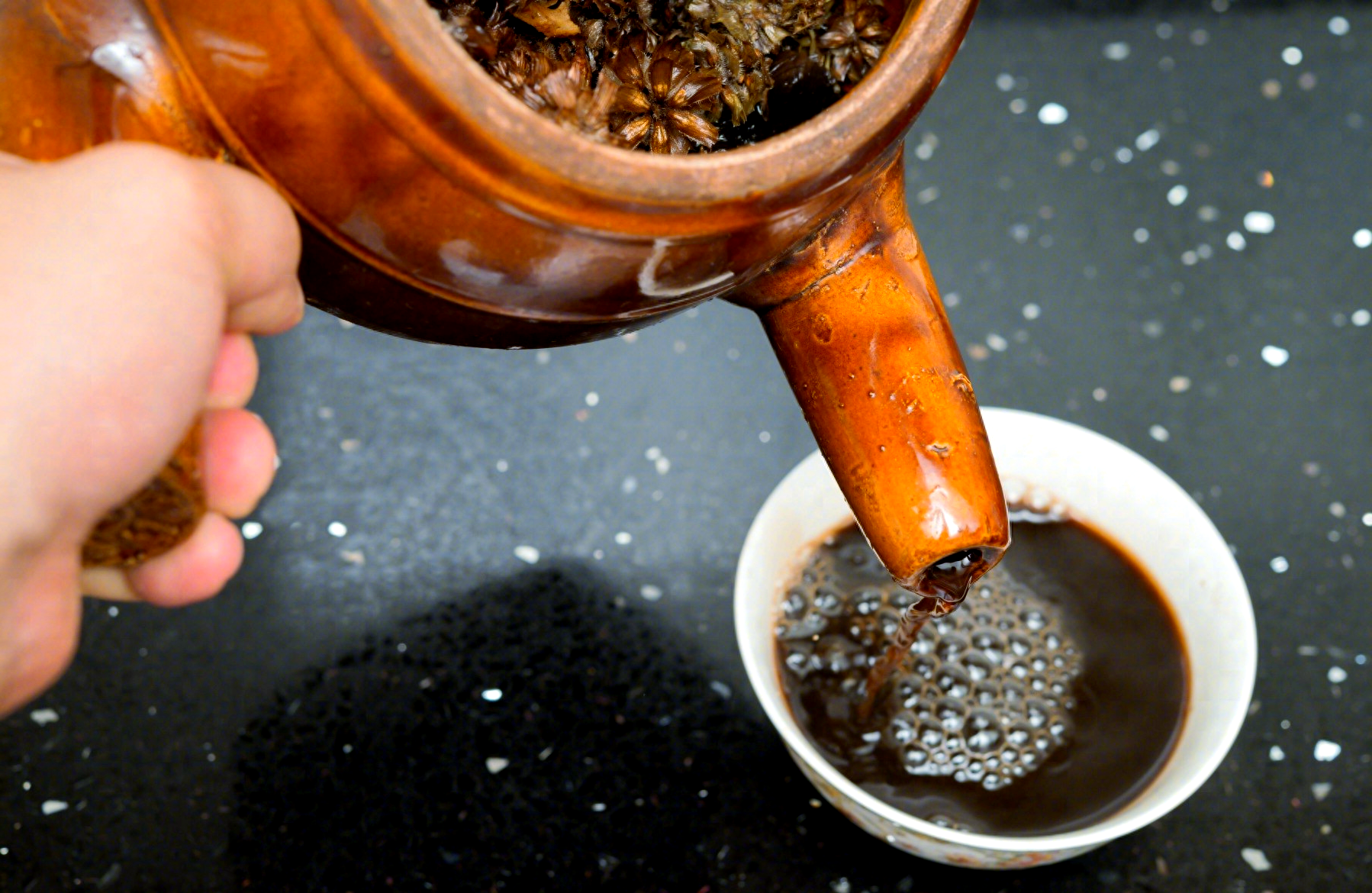
In Traditional Chinese Medicine history, the most common treatment was the herbal decoction. A doctor prescribed a list of herbs, and the patient would bring them home and boil them in water for an hour or more. The result was a pot of medicinal liquid.
This liquid was usually divided into several bowls and consumed throughout the day. Because of this, classical Chinese texts often used phrases such as “drink medicine” (饮药) or “take decoction.” The verb “drink” was naturally the dominant way to describe taking TCM.
Early Western medicine shared similar practices. Many traditional remedies were prepared through soaking, boiling, or fermentation, resulting in liquids that people had to drink.
The real turning point arrived with the development of modern pharmaceutical technology.
As chemistry advanced, scientists learned to isolate active ingredients from plants and minerals. These ingredients could then be compressed into tablets, sealed inside capsules, or turned into powders.
These new forms had several advantages: precise dosage, longer shelf life, and greater convenience. Gradually, solid Western medicine became the dominant form.
As a result, the phrase “eat medicine” (吃药) began to appear more frequently in everyday speech. Over time, it even became a generic expression for taking medicine in modern Chinese.
Sometimes people may say “I’ve already eaten my medicine,” even if the medicine was actually a syrup. In such cases, “eat” simply means “to take medicine,” without emphasizing the physical form. This generalization is a key feature of modern Chinese usage of "eat".
However, Traditional Chinese Medicine preserved many of its ancient practices. Herbal decoctions are still widely used, and patients often prepare them at home.
The process itself carries a sense of ritual: washing the herbs, soaking them, simmering them slowly, and finally pouring the dark liquid into a bowl. Because of this long tradition, the image of “drinking Chinese medicine” remains deeply rooted in people’s minds.
As a result, many people assume that TCM is for drinking and Western meds are for eating. In reality, this impression is simply the cultural echo of historical change and the evolution of medicine forms.
A Cross-Cultural Curiosity — How Different Languages Say "Take Medicine"
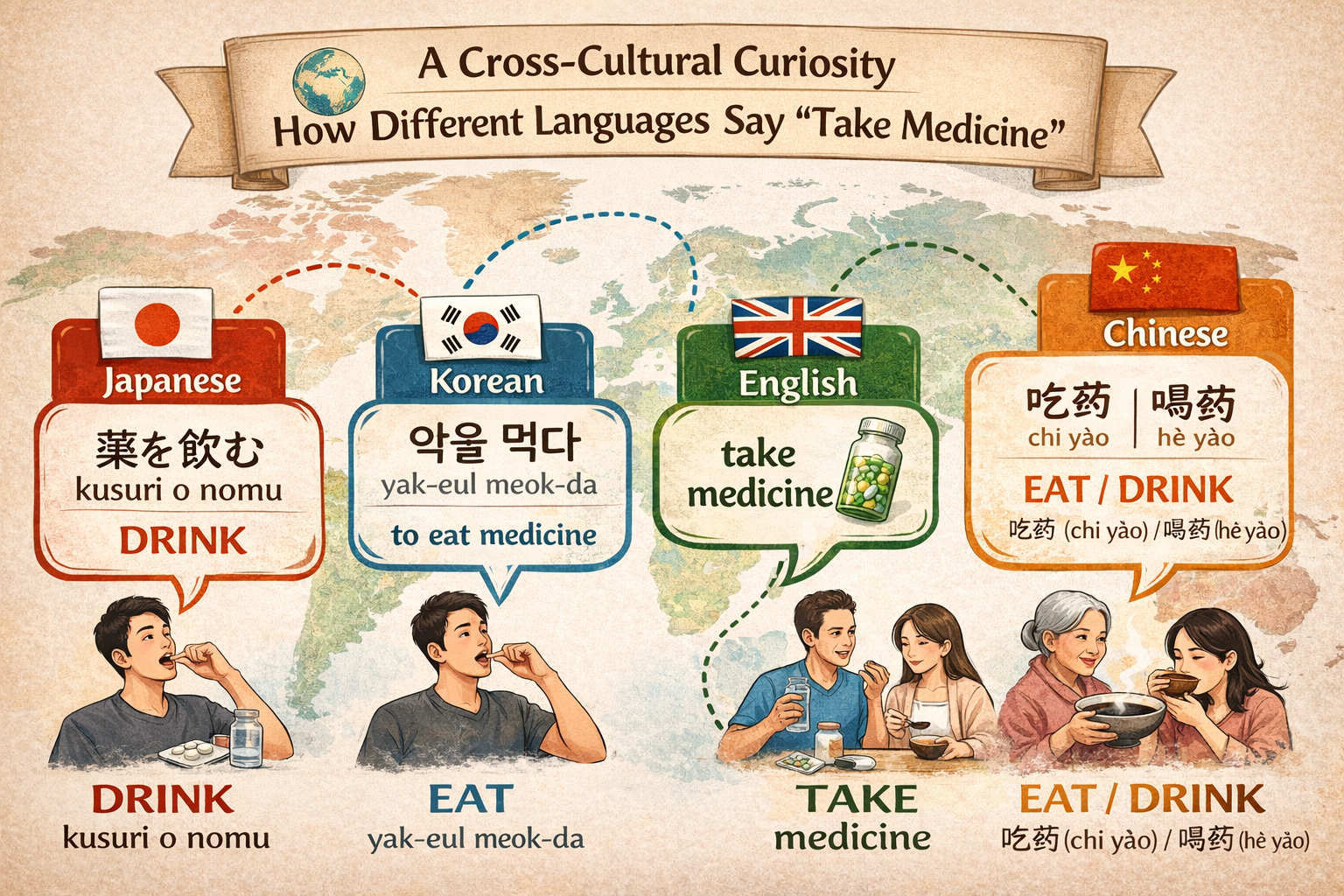
When we look beyond Chinese, we discover that other languages have taken very different approaches to the same question: How to express "taking medicine" globally?
Let’s begin with Japanese.
In Japanese, people typically say 薬を飲む (kusuri o nomu), which literally means “to drink medicine.” Interestingly, this verb is used regardless of whether the medicine is a pill or a liquid.
In other words, Japanese uses “drink” as a general verb for swallowing medicine. From a historical perspective, this usage may reflect an older stage of Chinese influence. Classical Chinese also used the verb “drink” more broadly for medicinal intake, and that linguistic habit may have been preserved in Japanese.
Korean offers another perspective.
In Korean, the common expression is 약을 먹다 (yak-eul meok-da), which literally means “to eat medicine.” The verb “eat” functions similarly to its modern Chinese counterpart. It can refer to pills, liquids, or medicine in general.
In this sense, Korean and Chinese share similar logic in using “eat” as a primary verb for medication.
English, however, takes a completely different approach.
Instead of choosing between “eat” and “drink,” English typically uses the neutral phrase “take medicine.”
The verb “take” works like a universal key. It avoids specifying the physical action entirely. Whether the medicine is a tablet, capsule, syrup, or powder, the same verb works perfectly. This is why English learners often find the Chinese distinction between 吃 and 喝 confusing.
From a cross-linguistic perspective, these three systems represent three different strategies:
- Japanese prefers “drink.”
- Korean prefers “eat.”
- English avoids the distinction altogether by using “take.”
Chinese, however, follows a different path. Rather than simplifying everything into one verb, it distinguishes between situations based on liquid vs. solid medicine.
Liquids are “drunk.” Solids are “eaten.”
Although this may seem slightly more complicated, it actually aligns very closely with our physical intuition. The language simply mirrors the actions we perform in everyday life, offering a unique insight into Chinese linguistic precision.
The Superpower of the Chinese Verb “Eat” (吃)
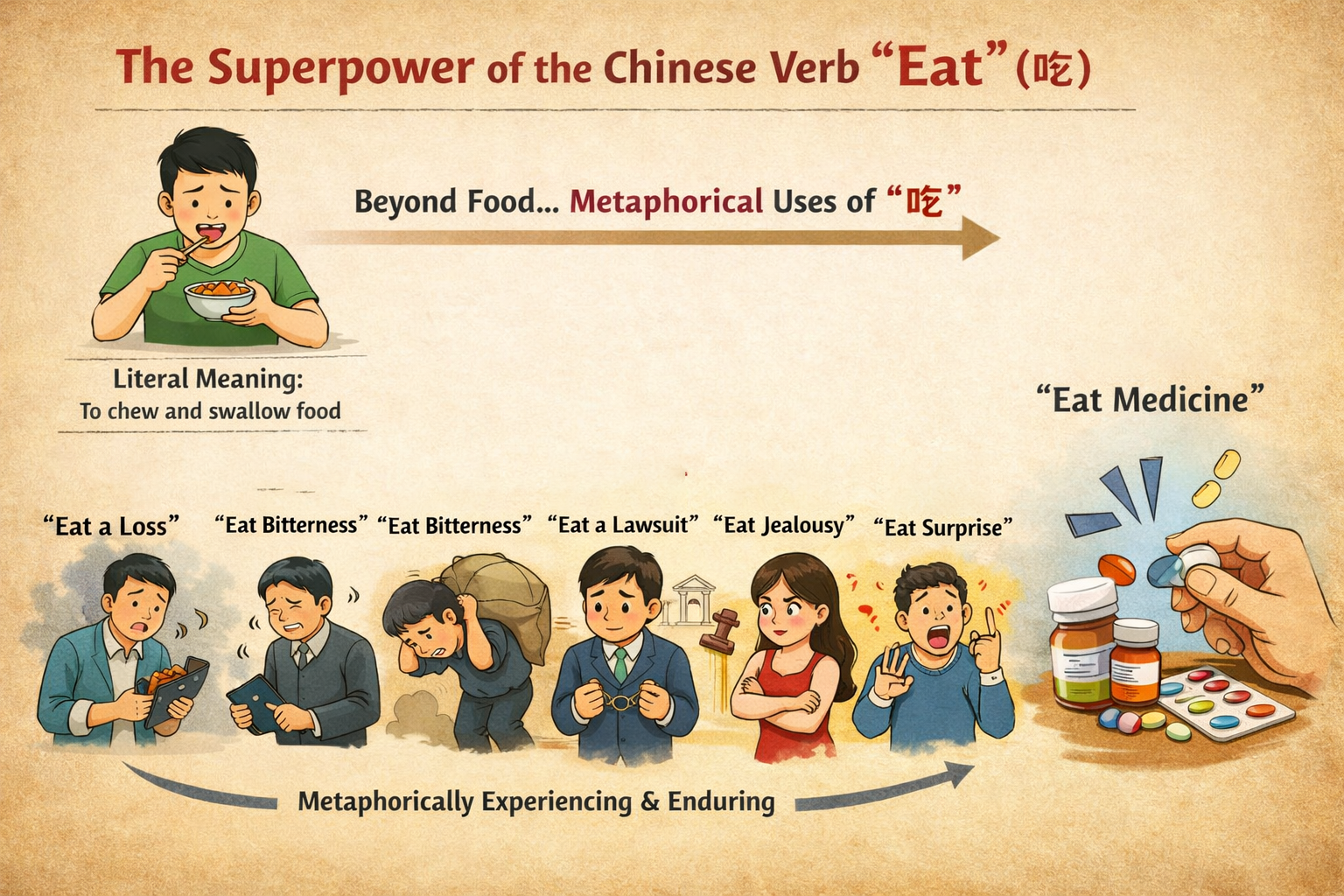
If we look more closely at Chinese vocabulary, we will notice something fascinating about the verb “eat” (吃).
At its most basic level, “eat” refers to putting food into the mouth, chewing it, and swallowing it. But in everyday Chinese, the verb has expanded far beyond food itself. This is known as the metaphorical use of "eat" in Chinese.
For example, Chinese speakers often say:
- 吃亏 (eat a loss / suffer a loss)
- 吃苦 (eat bitterness / endure hardship)
- 吃官司 (eat a lawsuit)
- 吃醋 (eat jealousy)
- 吃惊 (eat surprise)
In these expressions, no actual food is involved. Nobody literally chews “loss” or “surprise.”
Instead, the verb “eat” has gradually evolved into a metaphorical action. It can describe experiencing, enduring, or receiving something.
When someone “eats bitterness,” they experience hardship. When someone “eats a loss,” they accept a disadvantage. When someone “eats surprise,” they suddenly encounter unexpected news.
Within this cognitive framework, “eating medicine” becomes easy to understand.
When medicine enters the body, it begins to influence the body’s condition. In a sense, the body is accepting and absorbing the medicine’s effects. Therefore, the verb “eat” naturally extends to this situation, especially for solid forms of medication.
In contrast, the verb “drink” (喝) remains much more concrete.
It is closely tied to liquids such as water, tea, soup, or milk. When people say “drink,” they often imagine taste, temperature, and the physical sensation of liquid entering the body.
This is why the phrase “drink herbal medicine” often evokes such a vivid image: a steaming bowl of dark liquid, a strong bitter smell, and someone reluctantly swallowing it.
In comparison, “eat” continues to expand its metaphorical territory, while “drink” stays loyal to the world of liquids. Two simple verbs, yet they reveal the remarkable flexibility of the Chinese language.
One Small Word, A Whole World of Life
When we return to the original question—Why drink TCM but eat Western medicine?—the answer becomes clear.
Traditional Chinese Medicine is not inherently meant to be “drunk,” and Western medicine is not inherently meant to be “eaten.” The deciding factor is simply the physical form of the medicine.
- Liquids (like TCM decoctions) are drunk.
- Solids (like Western pills) are eaten.
This distinction is not a strict grammatical rule but a natural reflection of daily life. Language grows out of ordinary experiences and gradually becomes habit.
History has also played its role. Ancient medicine was mostly liquid, so “drinking medicine” once dominated everyday speech. Modern pharmaceutical technology introduced tablets and capsules, making “eating medicine” far more common today.
At the same time, cross-cultural comparisons reveal how different languages solve the same problem in different ways. Some choose “drink,” some choose “eat,” and some avoid the distinction entirely.
Next time you feel unwell and look at the medicine in your hand, take a moment to notice its form.
If it is a bitter bowl of herbal soup, you will drink it and taste the wisdom of centuries of traditional healing.
If it is a convenient tablet, you will eat it and benefit from the precision of modern science.
Whether we eat it or drink it, these tiny verbs all come from everyday life. Understanding the logic behind Chinese medicine verbs helps us appreciate the nuance of the language.
Of course, the best outcome would be a world where we rarely need to use either of them.
FAQ
Why do Chinese people say “eat medicine” instead of “take medicine”?
In Chinese, the verb 吃 (chī, “eat”) is commonly used for taking solid medicine such as pills or capsules. The word “eat” in Chinese has expanded beyond food and can also mean to accept or absorb something into the body, which is why people say 吃药 when taking medicine.
Why do people say “drink Chinese herbal medicine”?
Traditional Chinese Medicine is often prepared as a decoction, which is a liquid made by boiling herbs in water. Because it is consumed as a liquid, Chinese speakers naturally use the verb 喝 (hē, “drink”) instead of 吃 (eat).
Can you say “drink medicine” in Chinese?
Yes. In Chinese, “drink medicine” is used when the medicine is liquid, such as herbal decoctions, cough syrup, or liquid medicine for children. If the medicine is in liquid form, the verb 喝 (drink) is the correct choice.
Is the difference between 吃 and 喝 related to Chinese medicine and Western medicine?
Not exactly. The difference mainly depends on the physical form of the medicine. Solid medicines like pills are usually described with 吃 (eat), while liquid medicines like herbal decoctions or syrups are described with 喝 (drink), regardless of whether they are traditional or Western.
Do other languages also distinguish between eating and drinking medicine?
Different languages handle this differently. Japanese often uses the verb meaning “drink” for all medicine, Korean commonly uses the verb meaning “eat,” and English usually uses the neutral phrase “take medicine.” Chinese is unique in that it often distinguishes between liquid and solid forms.