The Meaning and Cultural Significance of the Chinese Character "易"
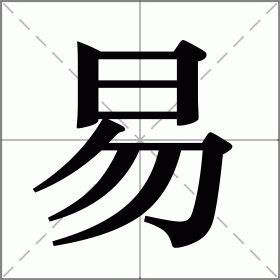
Simplified: 易
Traditional: 易
Pinyin: yì
Meaning: change; easy; exchange
The Chinese character "易" (yì) is deceptively simple in form yet profound in meaning. It centrally represents the concepts of change, ease, and exchange. Mastering this character is crucial not only for daily communication but also for accessing one of the deepest layers of Chinese thought, as it is the namesake of the ancient classic, the I Ching (Book of Changes).
Basic Meaning of "易"
The origin of "易" is a subject of academic discussion, with several plausible theories. It may have derived from a pictograph of a lizard (noted for changing color), or it might have symbolized the pouring of liquid from one vessel to another, representing transformation. While its precise pictorial origin is debated, what is certain is that its core meanings have been "change" and "exchange" since ancient times. The sense of "easiness" is a fundamental and natural extension—what changes or moves fluidly is perceived as not difficult.
Common Combinations with "易"
With the meaning of "Easy":
- 容易 (róng yì) - easy, simple
- 轻易 (qīng yì) - easily, lightly
- 简易 (jiǎn yì) - simple, uncomplicated
With the meaning of "Change":
- 变易 (biàn yì) - change, transformation
- 易容 (yì róng) - to disguise (change one's appearance)
- 易经 (Yì Jīng) - The Book of Changes
With the meaning of "Exchange":
- 交易 (jiāo yì) - transaction, business deal
- 贸易 (mào yì) - trade, commerce
- 易手 (yì shǒu) - to change hands
These combinations show how "易" forms the basis of words describing simplicity, transformation, and commercial activity.
Extended Meanings of "易"
Beyond its core meanings, "易" extends into several important uses:
- Accessibility: As in 平易近人 (píng yì jìn rén), meaning amiable and approachable
- Readability: Used in contexts like 易懂 (yì dǒng), meaning easy to understand
Cultural and Symbolic Significance
The true weight of "易" in Chinese culture is immense and largely stems from one text:
- The Book of Changes (易经, Yì Jīng): This is one of the most important works in the entire Chinese canon. Its primary subject is "Change" (易), which it presents as the fundamental, constant law of the universe. The book provides a system for understanding the patterns of change in nature, society, and one's own life
- A Philosophical Pillar: The ideas in the I Ching profoundly influenced both Confucianism and Daoism. Understanding "易" as "change" is therefore key to understanding much of Chinese philosophy
- A Dual Perspective: The character embodies a pragmatic duality: the abstract, philosophical concept of cosmic change, and the very concrete, daily concepts of ease and trade
Example Sentences
- 这个应用程序很容易使用。
(This application is very easy to use.) - 国际贸易促进了全球经济的发展。
(International trade promotes the development of the global economy.) - 他的态度突然发生了变化。
(His attitude suddenly changed.) - 《易经》是中国文化的瑰宝。
(The I Ching is a treasure of Chinese culture.)
Related Vocabulary
| Chinese | Pinyin | English |
|---|---|---|
| 易 | yì | change / easy / exchange |
| 容易 | róng yì | easy |
| 交易 | jiāo yì | transaction |
| 贸易 | mào yì | trade |
| 变易 | biàn yì | change, transformation |
| 易经 | Yì Jīng | The Book of Changes |
| 简易 | jiǎn yì | simple |
FAQ: Common Questions About the Chinese Character "易"
Q1: What is the connection between the meanings "change," "easy," and "exchange"?
A: The core idea is fluidity and transformation. "Change" is the primary concept. When change happens smoothly and without obstruction, it is perceived as "easy." "Exchange" is a social and commercial form of change—the fluid transfer of goods or ideas. They are all facets of the same underlying principle.
Q2: What is the difference between "容易" and "简单"?
A: Both can be translated as "simple" or "easy." However, "容易" strongly emphasizes the aspect of ease in doing or accomplishing something (e.g., 容易学 - easy to learn). "简单" focuses more on structural simplicity and lack of complexity (e.g., 简单的说明 - a simple explanation).
Q3: Why is the Book of Changes so important?
A: The I Ching is not just a divination text; it is a comprehensive philosophical system that views the universe as a dynamic, interconnected whole governed by cyclical patterns of change. It has been used for millennia as a guide to ethics, statecraft, strategy, and personal development.
Q4: What is a reliable way to remember this character?
A: Anchor your memory in its cultural significance. Remember that this character is the "Change" in the Book of Changes. When you encounter it, use a simple decision tree: Does the context suggest:
- Lack of difficulty? -> Think "easy."
- Transformation or alteration? -> Think "change."
- A business deal or swap? -> Think "exchange."