Beyond HSK: 5 Conversational Chinese Tips to Speak Like a Native and Master Social Etiquette

Table of Contents
- 1. Soften the Blow: The Art of Misunderstanding in Chinese
- 2. The Power of Particles: Mastering Chinese Modal Particles
- 3. The "Soft No": How to Say No Politely in Chinese
- 4. Master the "Vibe" Check: How to Give Better Chinese Compliments
- 5. The Magic Multi-Tool: The Meaning of "辛苦了 (Xīnkǔ le)"
- 6. Conclusion: The "60/40" Rule of Chinese Fluency
- 7. FAQ
Imagine this: You've spent hundreds of hours on flashcards, your grammar is flawless, and you've finally aced the HSK 5. You walk into a coffee shop in Shanghai or a meeting room in Beijing, confident and ready. You say something that is technically perfect, but instead of a flowing conversation, there's a micro-second of silence. The native speaker looks a bit startled, or perhaps gives you a polite but slightly strained smile.
What went wrong? You've likely fallen into the "Textbook Trap." If you want to move beyond HSK and truly master conversational Chinese, you must understand that the language is High-Context. This means that Chinese social etiquette, the "face" (面子) you give to others, and the subtle "softness" of your delivery often carry more weight than dictionary definitions. When we translate English logic directly into Chinese—like using a flat "I don't want" or "I don't know"—we often sound accidentally blunt or robotic.
To transform from a student to a fluent Chinese speaker, you need to master the art of social lubricants. In this guide, we'll explore 5 practical shifts that will help you speak Chinese like a native, protect your listener's "face," and turn your skills from "technically correct" to "culturally fluent."
Soften the Blow: The Art of Misunderstanding in Chinese
When learning Chinese phrases, many students focus solely on literal translations. In many Western cultures, saying "I don't understand" is a neutral statement of fact—it simply identifies a gap in communication. However, in the Chinese communication style, a direct "我不明白 (Wǒ bù míngbái)" or "我不懂 (Wǒ bù dǒng)" can carry an unintended edge. To a native speaker, it might sound like a subtle accusation: "You aren't being clear," or "You're not explaining this well."
The Cultural Logic: Saving "Face" (面子) Chinese is a "listener-responsible" language in social settings. If there is a breakdown in communication, pointing it out directly can make the speaker "lose face." To keep the conversation harmonious, the most natural way to express confusion in Chinese is through Self-Deprecation—placing the "blame" for the misunderstanding on yourself rather than the speaker.
The Pro Strategy: The "Inattentive Ear" vs. The "Slow Brain" Instead of flagging the message as unclear, suggest that your own senses or processing speed just couldn't keep up. This is a key skill for anyone looking to speak Chinese fluently in social situations.
The "Inattentive Ear" Approach: Try this: "不好意思,我刚才没太听清。" (Bù hǎoyìsi, wǒ gāngcái méi tài tīngqīng.) Why it works: Even if you heard every syllable but didn't grasp the logic, saying you "didn't hear clearly" is a polite white lie. It gives the speaker an easy out to repeat themselves without feeling like they failed to be articulate.
The "Slow Brain" Approach: Try this: "不好意思,我没太跟上您的思路。" (Bù hǎoyìsi, wǒ méi tài gēnshàng nín de sīlù.) Why it works: This is the ultimate face-saving phrase. You are acknowledging that the speaker's thoughts are sophisticated or fast, and you are simply trying to "keep up."
The Result: By shifting the "fault" to yourself, you remove the tension. The speaker will usually be happy to explain again, often using simpler terms, all while feeling respected rather than criticized. This small shift is what separates a student from a natural Chinese speaker.
The Power of Particles: Mastering Chinese Modal Particles
If grammar is the skeleton of a language, Chinese modal particles (语气助词) are its soul. Mastering these is a massive shortcut for anyone wondering how to sound more natural in Chinese.
In English, you can change the meaning of a sentence by shifting your vocal pitch. However, because Mandarin is a tonal language, your pitch is busy defining the words themselves. To express emotion, attitude, or "softness," speakers rely on tiny characters at the end of sentences. Without them, your conversational Chinese can sound like a series of rigid commands—what we call "Machine Chinese."
The "Command" vs. The "Consultation": Using 吧 (ba) Imagine you are inviting a friend out. This is where using 'ba' in Chinese changes everything:
- ● The Textbook Version: "明天去吃饭。" (Míngtiān qù chīfàn.)
- ● The Vibe: "Tomorrow, go eat." It sounds cold and declarative.
- ● The Natural Version: "明天去吃饭吧?" (Míngtiān qù chīfàn ba?)
- ● The Vibe: "Shall we go eat tomorrow?" The particle 吧 (ba) acts as a "softener." It signals that you are making a suggestion, a key move in polite Chinese conversation.
The "Interrogation" vs. The "Interest": The Magic of 呢 (ne) When asking questions, the difference is equally stark:
- ● The Interrogation: "你在干什么?" (Nǐ zài gàn shénme?) — "What are you doing?" (Sounds like an interrogation).
- ● The Curious Interest: "你在干什么呢?" (Nǐ zài gàn shénme ne?) — "Hey, what are you up to?"
- ● The Role of 呢 (ne): This adds a "bouncy" quality. It's a top Chinese particle tip for sounding curious and friendly rather than demanding.
Stating the Obvious: How to use 嘛 (ma) If you want to truly speak Chinese like a native, try using 嘛 (ma). It's used when stating something obvious in a friendly way. For example: "就是嘛!" (Jiùshì ma!) — "Exactly!"
Pro Tip: Think of these as linguistic social buffers. If you're worried your sentence sounds too "hard," adding a "ba" or a "ne" is the quickest way to fix the vibe and improve your Chinese speaking skills.
The "Soft No": How to Say No Politely in Chinese

In many Western cultures, a direct "I can't make it" is seen as honest and respectful of the other person's time. But when learning Chinese etiquette, you'll quickly find that a flat "我不能去 (Wǒ bùnéng qù)" acts like a conversational brick wall. To a native speaker, this sounds incredibly "hard" (太硬), often carrying an accidental tone of personal rejection.
The Cultural Logic: Understanding Mianzi (Face) To speak Chinese like a local, you must master the "External Obstacle" strategy. When you say "I can't," it sounds like a personal choice. To refuse elegantly and preserve Mianzi (Face), you should suggest that you want to attend, but external circumstances beyond your control are standing in the way. This is a cornerstone of Chinese business etiquette and social harmony.
Essential Vocabulary for a Polite Refusal To master the "Soft No," keep these two common Chinese phrases in your linguistic belt: 恐怕 (Kǒngpà): This translates to "I'm afraid that..." It functions as a crucial "red flag" that softens the blow before the refusal even happens. 不太方便 (Bù tài fāngbiàn): This is perhaps the most useful phrase in conversational Chinese. "Not very convenient" is a polite, vague umbrella that covers everything from being busy to simply not wanting to go.
The Natural Upgrade: A Face-Saving Sentence Instead of a blunt "I can't go," layer your sentence to sound like a fluent Chinese speaker: "实在抱歉,那天我恐怕去不了,不太方便。"(Shízài bàoqiàn, nàtiān wǒ kǒngpà qù bù liǎo, bù tài fāngbiàn.) Breakdown:
- ● 实在抱歉 (Deeply sorry): Establishes sincere intent.
- ● 恐怕 (I'm afraid): Signals upcoming "No."
- ● 不太方便 (Not convenient): Provides a face-saving exit without needing uncomfortable details.
Pro Tip: The "Vague Reason" Rule In China, a polite refusal is often followed by the phrase "有点事" (Yǒudiǎn shì - I have some things to do). This is a top Chinese communication tip: you don't need to explain what the things are—the vagueness itself is the politeness. It signals that you value the relationship enough to provide a "soft landing."
Master the "Vibe" Check: How to Give Better Chinese Compliments
If you rely solely on your HSK vocabulary, your default setting for a compliment is probably "很好 (Hěn hǎo)". While technically correct, using "很好" to describe everything—from a friend's new haircut to a home-cooked meal—can make you sound like a "grading machine." To truly master conversational Chinese, you need to move beyond generic praise.
The Cultural Logic: Praise the Choice, Not Just the Object In Chinese social dynamics, the most effective Chinese compliments are those that acknowledge a person’s judgment or suitability. This shows you are paying attention to the person, not just the object.
The Upgrade: From General to Specific Praise To praise someone in Chinese and sound sincere, shift your focus. This is a subtle but powerful Chinese speaking tip.
Complimenting Taste:
- ● Textbook: "你的衣服很好。" (Nǐ de yīfú hěn hǎo.) — "Your clothes are very good." (Sounds like a robot).
- ● Natural: "你眼光真好!" (Nǐ yǎnguāng zhēn hǎo!) — "You have such great taste!"
- ● Why it works: You are praising their 眼光 (yǎnguāng)—their aesthetic judgment. This is a high-value compliment in Chinese culture.
Complimenting Suitability:
- ● Natural: "你今天这身挺衬你的。" (Nǐ jīntiān zhè shēn tǐng chèn nǐ de.)
- ● Why it works: The word 衬 (chèn) means "to complement" or "to bring out." You're saying that outfit makes them look better, which is much more flattering than praising the clothes alone.
The "Native" Grammar Hack: Using "挺...的" (Tǐng...de) Structure If you want to instantly sound less like a textbook, here is a bit of advanced Chinese grammar for daily life: replace the intensifier 很 (hěn) with 挺...的 (tǐng...de):
- ● Textbook: "这道菜很好吃。" (Zhè dào cài hěn hǎochī.)
- ● Natural: "这道菜挺好吃的。" (Zhè dào cài tǐng hǎochī de.)
- ● The Difference: While "很" can feel like a formal declaration, "挺...的" has a casual, cozy "snap" to it. It's the secret to sounding like a native Chinese speaker in relaxed settings.
The Magic Multi-Tool: The Meaning of "辛苦了 (Xīnkǔ le)"

If there is one phrase that acts as a "Fast Pass" to sounding like a native Chinese speaker, it is "辛苦了 (Xīnkǔ le)". For many English speakers, the go-to response for any service is a standard "谢谢 (Xièxiè)". While "Thank you" is never wrong, it focuses on the result or the benefit you received. "辛苦了," however, is one of the most important common Chinese expressions because it pivots the focus toward the other person's effort, sweat, and time. It turns a simple transaction into a moment of deep empathy.
The Cultural Logic: Acknowledging the "Bitterness" To understand Chinese culture, you must understand the word "辛苦" (Xīnkǔ), which literally means "bitter toil." By using this phrase, you are telling the other person: "I see your hard work, and I do not take your labor for granted." In a society that highly values diligence, this is the ultimate Chinese social lubricant.
When to Use This Essential Chinese Phrase: You can use "辛苦了" in almost any situation where someone has performed a task for you. It's a versatile tool for daily Chinese conversation:
- ● In a Business Context: When a colleague finishes a report late: "文件收到了,辛苦了!" (The file is received, thank you for your hard work!)
- ● With Service Providers: When a delivery driver (wàimài) arrives in the rain: "这么大雨送过来,辛苦了!"
- ● In Social Settings: When a friend helps you move or practice Mandarin: "今天陪我弄了这么久,真是辛苦了!"
The Result: From "Foreigner" to "Insider" When you say "谢谢," you are a polite guest. When you say "辛苦了," you sound like a "Zīshēn" (资深 - veteran) who truly understands Chinese social norms. It creates an instant bond of mutual respect that a simple "thank you" can't reach.
Pro Tip: Pair it with a small nod. This is a subtle piece of Chinese body language that transforms the phrase into a powerful gesture of recognition.
Conclusion: The "60/40" Rule of Chinese Fluency
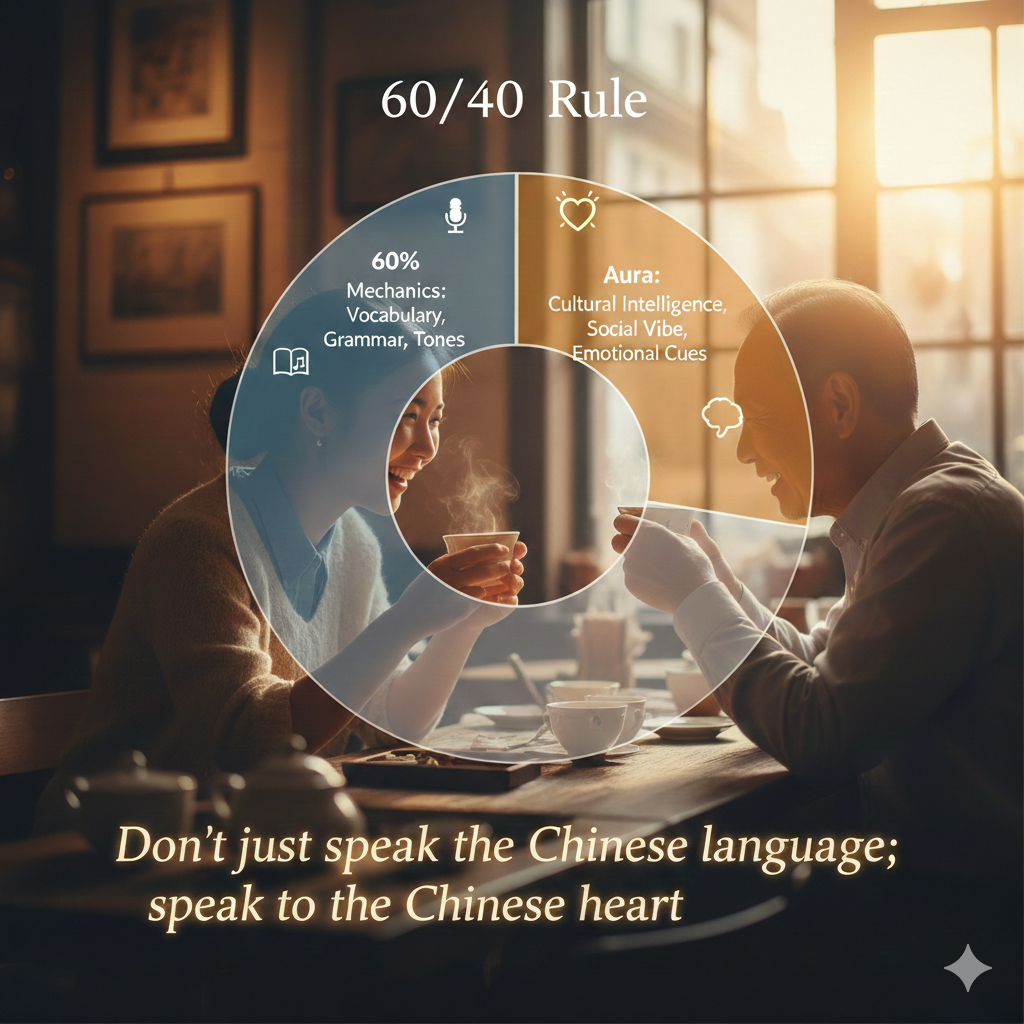
Mastering the language is a journey that goes far beyond the brute-force memorization of flashcards or the clinical pursuit of an HSK certificate. While those are necessary foundations, true fluency in Chinese isn't just about what you say—it's about how you make people feel.
To truly connect with people and speak Chinese naturally, we suggest following the 60/40 Rule, a proven Chinese language learning strategy:
- ● 60% is the "Mechanics": The vocabulary, grammar, and tones you’ve worked so hard to build.
- ● 40% is the "Aura": The cultural intelligence, the social "vibe," and the subtle emotional cues you bring to the conversation.
By replacing blunt, literal translations with these nuanced phrases, you aren't just changing your words—you are practicing the art of Harmony (和谐 - héxié), which is the heartbeat of Chinese social interaction. You are showing your listeners that you respect their "face," value their effort, and understand the unspoken rules of the culture.
Next time you find yourself about to reach for a standard, textbook phrase, stop for a second. Try one of these five conversational Chinese tips instead. You'll be surprised at how quickly the atmosphere shifts—from a stiff, formal interview into a warm, natural, and human conversation.
Don't just speak the Chinese language; speak to the Chinese heart (中国心).
FAQ
Q: Why does my fluent HSK Chinese sometimes sound "robotic" or "blunt" to native speakers?
A: This is usually due to the "Textbook Trap." While HSK teaches you the mechanics of the language, it often skips the "social lubricants" necessary for high-context communication. In Chinese culture, social harmony and "Face" (面子) are prioritized. Without using modal particles or indirect phrasing, technically perfect grammar can sound like a series of cold, rigid commands.
Q: How can I express that I don't understand something without being rude?
A: Instead of using a direct "我不懂" (Wǒ bù dǒng), which can imply the speaker isn't being clear, use Self-Deprecation. Try phrases like "I didn't hear clearly" (没听清) or "I couldn't quite keep up with your thoughts" (没跟上您的思路). By taking the "blame" for the misunderstanding, you protect the speaker's Face (面子) and maintain a positive vibe.
Q: What is the most polite way to say "No" in Chinese social or business etiquette?
A: Master the "External Obstacle" strategy. In China, a direct "I can't go" is often seen as "too hard" (太硬). To decline gracefully, use phrases like 恐怕 (Kǒngpà - I'm afraid) or 不太方便 (Bù tài fāngbiàn - Not convenient). This suggests that you want to participate, but circumstances beyond your control are stopping you, which preserves social harmony.
Q: How do modal particles like 'ba', 'ne', and 'ma' improve my Chinese fluency?
A: Modal particles are the "soul" of conversational Chinese. Because Mandarin is tonal, it uses these end-of-sentence particles to express emotion and attitude instead of pitch shifts. Adding 吧 (ba) turns a command into a suggestion, while 呢 (ne) adds a friendly, curious quality to questions. They act as linguistic buffers that make your speech sound softer and more native.
Q: When is it better to use "辛苦了" (Xīnkǔ le) instead of "谢谢" (Xièxiè)?
A: Use "辛苦了" (Xīnkǔ le) when you want to acknowledge someone's effort, time, and hard work, rather than just the result you received. While "Xièxiè" is a standard thank you, "Xīnkǔ le" shows deep empathy and cultural intelligence. It signals that you are a cultural insider who respects the value of diligence in Chinese society.