
Qílín: The Legendary Creature of Chinese Myth and Culture
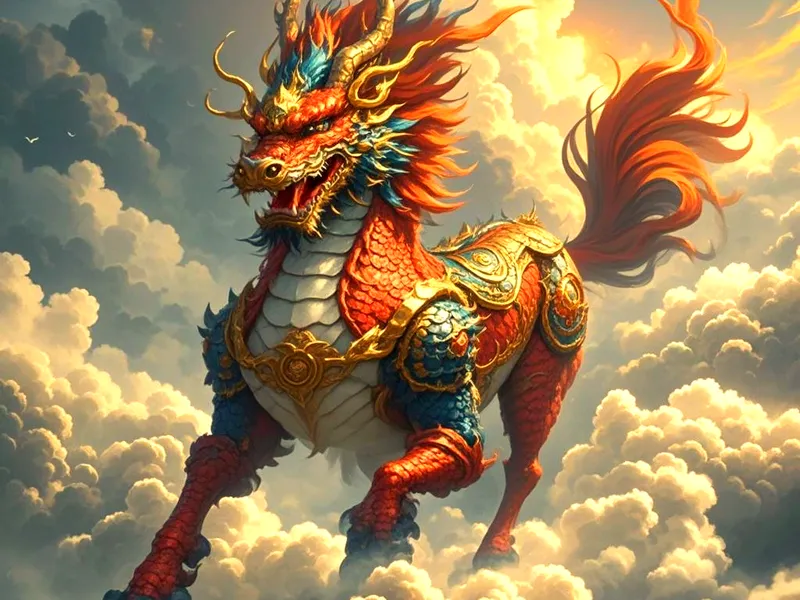
The Qílín (麒麟, Qílín) is one of the most fascinating and revered mythical creatures in Chinese culture. Often referred to as the Chinese unicorn, the Qílín symbolizes peace, prosperity, and divine favor. Its appearance in art, literature, and folklore spans thousands of years, reflecting the moral, spiritual, and aesthetic values of Chinese civilization. This article explores the Qílín in depth, from its origins and physical description to its cultural significance and modern interpretations.
Origins and Mythical Description
The Qílín’s origins trace back to ancient Chinese mythology, appearing in texts as early as the Zuo Zhuan (左传) and Shan Hai Jing (山海经, Classic of Mountains and Seas). Described as a hybrid creature, it combines elements of a dragon, horse, deer, and ox. Its body is often covered with scales, resembling a dragon, and it may have a single horn like a unicorn. The Qílín is known for its gentle nature—it never harms living beings and is considered a symbol of benevolence and righteousness.
Legends often describe the Qílín as appearing only during times of peace and prosperity or at the birth or death of a wise ruler. It is believed that the creature walks so lightly that it does not trample grass or harm insects. This quality symbolizes moral purity and respect for life, reflecting Confucian values that shaped much of Chinese society.
The Qílín is often depicted with fire-like mane or flames around its body, further emphasizing its supernatural nature. Its ability to fly or walk on clouds in some stories shows its connection to the heavens, making it a bridge between the human and divine realms.
Qílín in Chinese Culture and Literature
Throughout Chinese history, the Qílín has held a prominent place in culture, literature, and imperial symbolism. It is frequently mentioned in classical poetry and folklore as a harbinger of good fortune and divine approval. For instance, Confucian scholars often cited the Qílín appearing at the birth of Confucius, marking him as a person of extraordinary virtue.
In literature, the Qílín is not just a fantastical creature but also a moral symbol. Its presence in stories often reinforces themes of justice, wisdom, and benevolence. The creature’s non-violent nature and its association with good governance reflect the ideal qualities of rulers in Chinese thought.
During the Ming (1368–1644) and Qing (1644–1912) dynasties, Qílín imagery appeared in imperial art, on ceramics, paintings, and textiles. It was considered an auspicious symbol, often gifting Qílín statues to foreign dignitaries or placing them near the emperor’s palace to invite peace and prosperity.
Artistic Representations of the Qílín
The Qílín has inspired countless artists across centuries. In painting, the creature is often portrayed with vivid colors, blending dragon-like scales, deer-like hooves, and a lion-like head. Artists emphasize its elegance, strength, and grace, reflecting its moral symbolism.
In sculpture, Qílín statues are commonly seen in temples, palaces, and even private gardens. Carved from wood, jade, or stone, these sculptures are often paired with other symbolic animals, such as dragons and phoenixes, creating a trio of auspicious symbols. In traditional Chinese architecture, Qílín figures may guard entrances, believed to ward off evil spirits and attract blessings.
Modern interpretations have extended into popular culture, including movies, animation, and video games. Even today, the Qílín continues to inspire creativity, blending ancient symbolism with contemporary design.
The Qílín in Modern Times and Global Influence
The Qílín is more than a historical or mythical curiosity; it remains a living part of Chinese identity. In contemporary China, Qílín images are used in celebrations, such as the Lunar New Year, and in gifts symbolizing harmony, prosperity, and moral excellence. Businesses and cultural institutions often adopt Qílín logos to convey trustworthiness and high standards.
Internationally, the Qílín has attracted attention as a unique mythological creature. While sometimes compared to the Western unicorn, the Qílín’s rich symbolism and deep cultural roots set it apart. It represents a combination of moral ideals, natural beauty, and divine favor, making it a powerful cultural ambassador. Scholars study it not only for its mythical attributes but also for what it reveals about Chinese civilization, ethics, and artistic heritage.
ConclusionThe Qílín (麒麟, Qílín) embodies more than mythical wonder—it is a symbol of virtue, harmony, and divine blessing. From its gentle appearance in ancient texts to its prominent role in art, literature, and modern culture, the Qílín has endured as a powerful representation of Chinese ideals. Understanding the Qílín allows both Chinese and international audiences to appreciate how mythology, morality, and creativity intertwine in one of the world’s oldest cultures.
Whether as a guardian in imperial courts, a subject of artistic expression, or a modern cultural icon, the Qílín continues to inspire awe, respect, and imagination across generations.