
Chinese Is Easy to Understand but Hard to Use: Here’s Why

Contents ▼
Introduction: When Understanding Chinese Is No Longer Problem
For many of us, the most confusing stage of learning Chinese does not come at the beginning. It comes later.
We can follow conversations. We understand podcasts. We read articles with only occasional lookups. Native speakers speak to us naturally. By most visible standards, our Chinese seems to be working.
And yet, when it is our turn to speak or write, something feels off. Our sentences get shorter. Our tone becomes careful. We hesitate over structures we have seen again and again. We fall back on safe phrasing. The Chinese we produce feels thinner than the Chinese we understand.
Because this happens after so much apparent progress, it is easy to assume the problem is us. It isn't. Chinese often becomes easy to understand long before it becomes easy to use. The gap between comprehension and expression is something many serious learners run into, often without warning. Understanding what this gap really is is the first step toward learning how to move through it.
Why Chinese Is Easy to Understand but Hard to Use
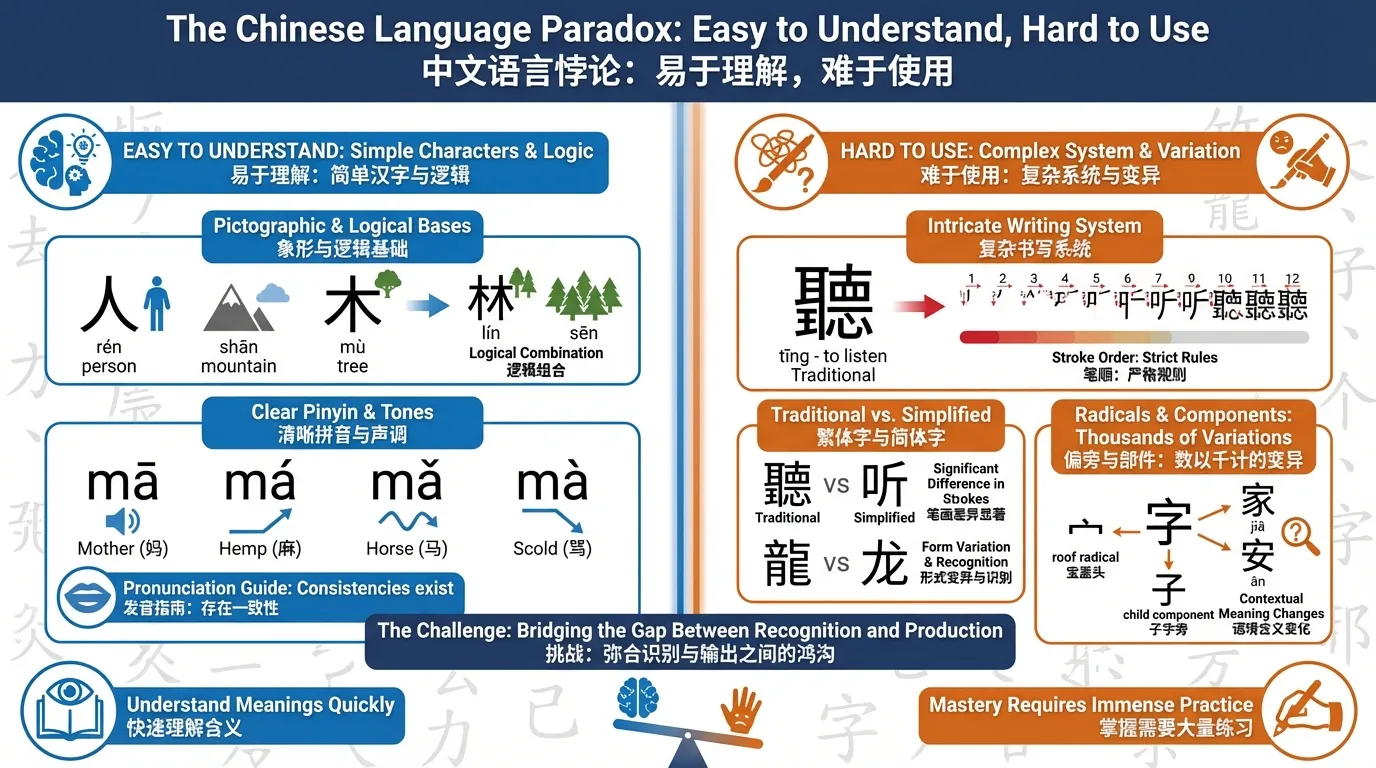
At first, this contradiction is easy to miss. Chinese looks simple on the surface. There are no verb conjugations, no plural endings, no grammatical gender. Sentence patterns repeat. Once you get used to them, many things feel predictable. Compared to many European languages, the grammar feels surprisingly light.
This is often why early progress comes fast. So when using Chinese later starts to feel difficult, the confusion can be unsettling. If the language is “simple,” why does speaking or writing still feel heavy? Part of the answer is that understanding a language and using a language are not the same skill.
Understanding Chinese mostly asks you to recognize meaning. You hear a sentence and know what it means. You read a paragraph and follow the logic. Using Chinese asks you to choose:
- ● What structure fits here?
- ● What tone sounds natural?
- ● How direct is too direct?
- ● What can stay unsaid, and what cannot?
That difference stays invisible at lower levels. But the more advanced you become, the more clearly you start to feel it.
Understanding Chinese Is a Passive Skill

Listening and reading are built on recognition. When you hear Chinese, your brain does not need to produce language. It only needs to notice familiar sounds, structures, rhythms. Something clicks, and meaning appears. Context quietly does a lot of the work. Familiar topics smooth out uncertainty. Even when parts are unclear, the overall message still feels complete.
Several things make understanding Chinese feel easier than using it:
- ● Context narrows possible meanings
- ● Common sentence patterns repeat again and again
- ● Much input is naturally simplified or graded
- ● You are not responsible for precision
Even advanced materials still support the listener or reader. Speakers slow down without realizing it. Writers explain more than they strictly need to. Cultural signals help guide interpretation. And most importantly, understanding does not require commitment. You do not have to choose a tone. You do not have to decide how direct to be. You do not risk sounding rude, vague, childish, or overly formal. You simply follow along.
This is why many learners reach a stage where Chinese suddenly feels accessible. The brain becomes efficient at decoding meaning. But decoding meaning is not the same as creating it.
Using Chinese Requires Decisions, Not Just Knowledge
Speaking and writing reverse process. Instead of recognizing meaning, you have to create it in real time. There is no sentence waiting for you. There is only a blank space and a situation that demands a response.
Every sentence in Chinese quietly asks questions that most textbooks never really prepare you for:
- ● How direct should this sound here?
- ● How certain do I want to appear?
- ● Is this phrasing too strong for this relationship?
- ● Should I soften it, hedge it, or leave part of it unsaid?
These are not vocabulary problems. They are social and pragmatic decisions. Chinese places a great deal of weight on implication, positioning, and register. Often, what matters most is not the information itself, but how it is framed and what it signals about you.
When you speak Chinese, you are constantly choosing:
- ● Between bluntness and subtlety
- ● Between efficiency and politeness
- ● Between clarity and face-saving
Native speakers make these choices without noticing them. Advanced learners have to make them consciously, sentence by sentence. This is where the fatigue comes from. The difficulty is not that you do not know enough Chinese. It is that you know too much to speak carelessly.
Understanding Chinese vs Using Chinese: A Structural Gap

At lower levels, comprehension and production tend to rise together. Simple sentences are easy to understand and easy to reproduce. Mistakes are expected and often overlooked. Communication works as long as intent is visible, even if form is rough.
At advanced levels, this balance quietly breaks. Understanding continues to improve through exposure. Listening becomes smoother. Reading accelerates. Meaning arrives faster and with less effort. But using Chinese does not follow the same curve. Without the right conditions, production slows, then plateaus.
This creates a structural gap:
- ● Comprehension grows through volume
- ● Production grows through pressure
Most learners invest heavily in one and unknowingly starve the other. They listen more. They read more. They collect vocabulary. Their understanding deepens and stabilizes. But their output becomes cautious. Sentences shorten. Choices narrow. Expression stays within familiar, low-risk territory.
This is not a lack of discipline or motivation. It is a mismatch between the activity being practiced and the skill that needs to grow.
Why This Problem Appears After Intermediate Levels
As beginners, we struggle because almost everything is unfamiliar. As intermediate learners, we struggle because progress slows and improvement becomes harder to notice. At advanced levels, the struggle changes shape. The problem is no longer technical. It becomes situational. Chinese stops being about whether something is correct and starts becoming about whether it is appropriate.
You are no longer asking:
- ● What does this mean?
You are asking:
- ● Is this how I should say it here?
This shift explains a familiar contradiction. Some days, Chinese feels natural and fluid. Conversations move forward without friction. Words arrive when needed. Other days, everything feels fragile. You hesitate. You second-guess. Sentences that worked yesterday suddenly feel risky. Nothing about your Chinese has disappeared. What has changed is the environment. The social stakes rise. The margin for imprecision narrows. Choices begin to carry weight.
Many learners describe this experience as the Chinese plateau. But it is not a plateau of knowledge. It is a plateau of usage.
Why Practice Often Fails to Fix Problem
When this gap appears, most of us respond in the same way. We practice more. We join conversation classes. We rehearse dialogues. We repeat role-play scenarios. We memorize advanced sentence patterns. We tell ourselves that more output will eventually unlock fluency. And yet, something stubborn remains. The gap does not close. Why? Because much of what is labeled as speaking practice quietly removes the very difficulty we are trying to overcome.
Common patterns start to appear:
- ● Conversations follow scripts with predictable outcomes
- ● Topics are polite, safe, and disagreement-free
- ● Feedback focuses on grammar rather than positioning
- ● The environment carries no real social consequences
These activities are not useless. But they are incomplete. They build comfort without building control. They allow us to speak without forcing us to choose. As a result, we become fluent performers in class settings, while real conversations still feel unstable. We know the words. We hesitate over the moment.
Why Chinese Speaking Feels Risky

Using Chinese feels risky—because it actually is. Every sentence carries social weight. Tone can subtly change meaning, and register mistakes can signal distance, immaturity, or unintended confidence. Most advanced learners sense this long before they can explain it clearly. So we adjust. We hedge. We simplify. We avoid structures that might sound slightly off. We choose safer phrasing, even when we know more expressive options exist.
This creates a paradox: the more Chinese we understand, the more cautious our Chinese becomes. Not because we are afraid of making mistakes, but because we are aware of what mistakes mean. At this stage, the problem is not fear. It is awareness without control—a tension that shadows every conversation and every written sentence.
Why Input Alone Cannot Solve Advanced Chinese Speaking Problems
High-quality input is essential. There is no way around it. But input alone does not teach usage. Understanding how native speakers phrase ideas does not automatically grant the ability to do the same. Listening and reading build intuition, but intuition alone is potential, not performance. Without opportunities to make imperfect choices, receive feedback on tone, stance, or positioning, and experience misunderstanding or subtle resistance, Chinese remains something we recognize rather than something we command.
We can follow conversations smoothly. We can admire how others phrase things. But when it is our turn, we hesitate. Words we know well become difficult to deploy. Usage is not absorbed passively—it is negotiated actively, moment by moment.
What Actually Helps Chinese Move From Understanding to Use
There is no shortcut. But there is a pattern. Advanced learners who break through the usage barrier share common experiences. They:
- ● Speak in situations where outcomes truly matter
- ● Express opinions, not just information
- ● Experience disagreement and challenge
- ● Receive feedback that goes beyond grammar
These conditions introduce pressure. Pressure exposes gaps that safe practice always hides. This is why immersion environments, unscripted discussions, and real responsibilities accelerate progress. Not because they are comfortable. But because they are honest.
Advanced Chinese Learning Is About Calibration
At higher levels, learning Chinese is no longer about simply adding knowledge. It is about calibrating judgment. You already know many ways to express an idea. The challenge lies in choosing the right one for the moment—balancing tone, nuance, and social expectations.
This requires:
- ● Exposure to subtle differences and context
- ● Willingness to sound imperfect
- ● Feedback that addresses intent, positioning, and style, not just form
Progress becomes slower—but deeper. Every choice you make refines your ability to speak and write with precision.
Why Feeling Stuck Is Actually a Sign of Progress
Feeling stuck is often a signal that you have reached the edge of your current competence. In earlier stages, learning rewards accumulation: more vocabulary, more grammar, more exposure. At advanced stages, it rewards refinement: sharper judgment, subtle expression, and the courage to make decisions under pressure.
The frustration you feel is not a signal to quit. It is a signal that the nature of the task has changed. Understanding Chinese was the first mountain. Using Chinese is the next, steeper climb—one that challenges your control, your subtlety, and your ability to navigate social nuance.
Conclusion: Understanding Is Beginning, Not the Goal

If you understand Chinese but struggle to use it, you are not behind. You are exactly where serious learners end up. The difficulty you feel is not a failure. It is cost of precision. Every hesitation, every choice you second-guess, and every carefully crafted sentence is part of learning process.
Chinese does become easier to use—but not by accident. It becomes easier through pressure, real exposure, and the willingness to risk imperfection while aiming for mastery. Understanding opens the door. Using Chinese is what happens when you step through it—actively, deliberately, and with growing confidence.
FAQ
Q: Why does Chinese feel easier to understand than to speak?
A: Chinese comprehension relies primarily on recognition—listening and reading allow you to match patterns, guess meaning from context, and follow familiar structures. Speaking and writing, however, require decision-making: choosing tone, phrasing, politeness, and subtle nuance. This gap between passive understanding and active use explains why advanced learners often feel fluent but struggle to express themselves.
Q: What is the “Chinese plateau”?
A: The Chinese plateau refers to a stage where comprehension continues to improve but productive skills stagnate. Learners can understand more than ever, yet speaking or writing feels difficult or cautious. It is not a lack of ability, but a structural gap between recognition and production that emerges at higher levels.
Q: Can more practice alone solve advanced Chinese speaking problems?
A: Not always. Repeating scripted dialogues or safe conversations often improves confidence but does not address decision-making under pressure. Effective practice requires unscripted communication, feedback on tone and positioning, and real stakes that force learners to make active choices.
Q: How can I bridge the gap between understanding and using Chinese?
A: Bridging the gap involves creating pressure situations where your output matters. Speak in real contexts, express opinions, engage in disagreement, and seek feedback beyond grammar. Immersion programs, unscripted discussions, and responsibilities in Chinese accelerate progress by forcing conscious decision-making.
Q: Is feeling stuck a sign of failure?
A: No. Feeling stuck often indicates that you have reached the edge of your competence and are now in the stage of refinement. Early learning rewards accumulation; advanced learning rewards judgment, nuance, and control. The frustration is a natural signal that the task has changed, not that you are failing.