
Why “Qíshí” (其实) Is a Risk Word
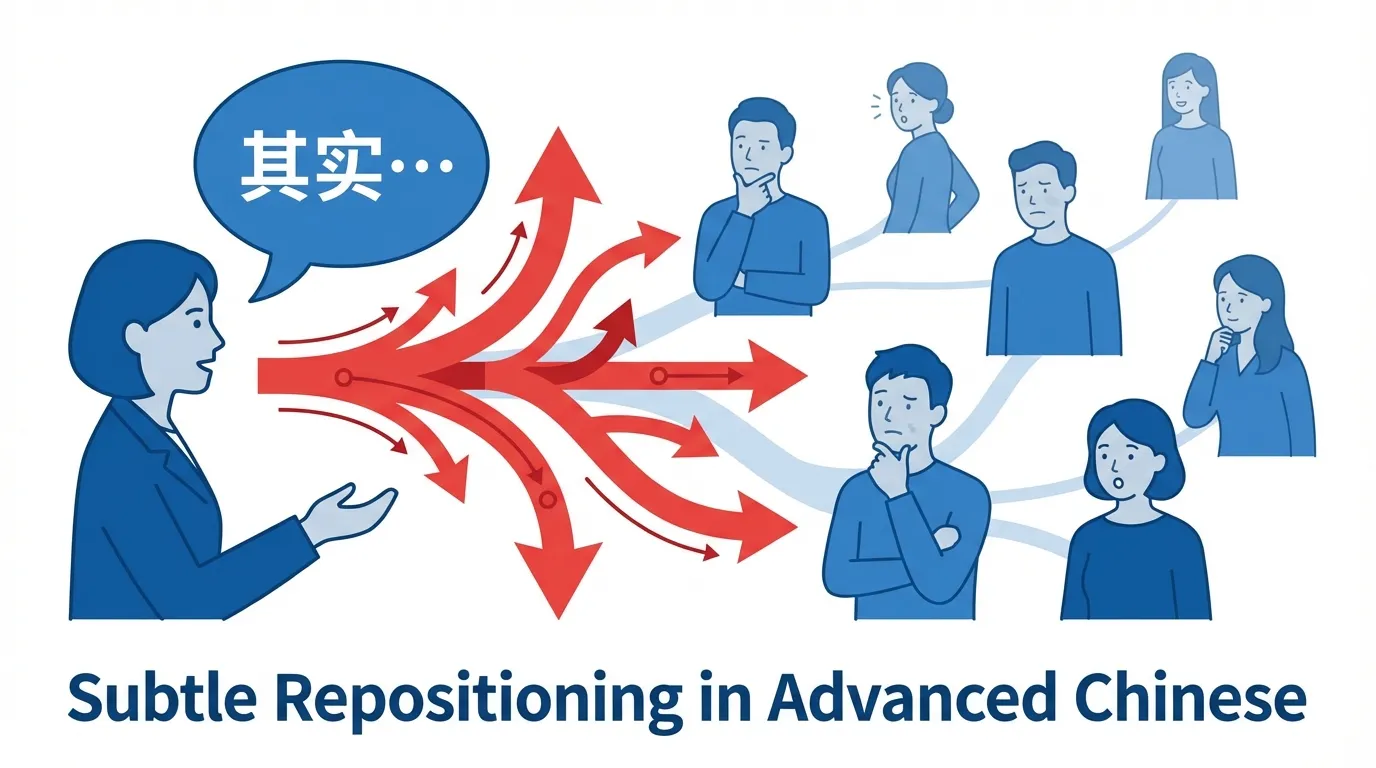
How One Common Chinese Expression Quietly Escalates Meaning
1. Introduction: Directional Words
In Chinese learning, “其实” (qíshí, actually / in fact) seems harmless. Textbooks often present it as a clarification tool. Learners use it to sound natural, and teachers encourage it to introduce explanations. At advanced levels, however, “其实” is not neutral. It is a directional word. Once spoken, it subtly pushes the conversation somewhere you may not intend. That is why “其实” is a risk word.
2. Why Learners Love “其实”
For CSL learners, “其实” seems to solve multiple problems at once:
- ● Buys time
- ● Softens disagreement
- ● Introduces contrast
- ● Feels conversational and native
It often appears in phrases like:
- ● 其实我觉得…
- ● 其实不是这样…
- ● 其实问题不大…
At intermediate levels, this feels like progress. At advanced levels, nuance adds positioning, not just meaning.
3. What “其实” Signals Before Meaning Arrives
Native speakers hear something before your sentence finishes:
- ● What you’ve said so far is incomplete
- ● A correction is coming
- ● The current framing is insufficient
Even if your tone is gentle, “其实” preloads contrast.
4. "其实" Is Not Explanation. It Is Reframing
Using "其实" effectively requires awareness of conversational nuance, similar to how "我觉得" strengthens or weakens your statement.
Compare:
- ● 这个问题比较复杂。
- ● 其实这个问题比较复杂。
The second sentence signals:
- ● Someone simplified too much
- ● An earlier assumption was flawed
- ● The speaker sees something others missed
It repositions the conversation rather than just explaining.
5. Why “其实” Often Sounds Stronger Than Intended
Strength in advanced Chinese is measured by implication, not volume. “其实” can sound stronger than learners expect because it:
- ● Challenges the current narrative
- ● Marks intellectual distance
- ● Implies corrective authority
Even politely, the direction is unmistakable.
6. Native Speakers Use “其实” Sparingly
- ● Use it less often, at moments of real contrast, and accept tension
- ● Learners often use it as filler, to sound thoughtful, or when uncertain
Overusing “其实” can make your Chinese sound:
- ● Argumentative when you don’t intend
- ● Corrective when you mean cooperative
- ● Intellectually restless
7. When "其实" Becomes Dangerous
It also interacts with moments of pause and silence—see why silence in Chinese has direction—where timing and restraint can outweigh words.
Situations:
- 1. Disagreement with higher-status speakers
- 2. Responding to emotional statements
- 3. Alternative view not fully formed
- 4. When silence would be safer
Once spoken, “其实” cannot be taken back.
8. One-Sentence Takeaway
“其实” does not simply add information—it changes the direction of the conversation. Knowing when to use it—and when to leave it out—is a mark of advanced Chinese communication.
FAQ
Q: What does 其实 signal in conversation?
A: 其实 signals contrast, correction, or repositioning. It’s not a neutral clarification word; native speakers often perceive it as preloading a shift in meaning.
Q: Why can 其实 escalate a conversation?
A: 其实 quietly changes the direction of dialogue. In sensitive or hierarchical contexts, it can make your words seem corrective or argumentative even when polite.
Q: How do native speakers use 其实 differently from learners?
A: Native speakers use 其实 sparingly, at moments of real contrast, and accept the tension it creates. Learners often overuse it as filler or softening, which can backfire.
Q: When should I avoid saying 其实?
A: Avoid 其实 when responding to higher-status speakers, emotional statements, or when your alternative view isn’t fully formed. Silence may be safer than repositioning.
Q: Can 其实 ever be useful?
A: Yes. When you intentionally want to introduce nuance, contrast, or clarification in a controlled context, 其实 can be appropriate. The key is conscious, not habitual, use.