
The Meaning and Cultural Significance of the Chinese Character 输
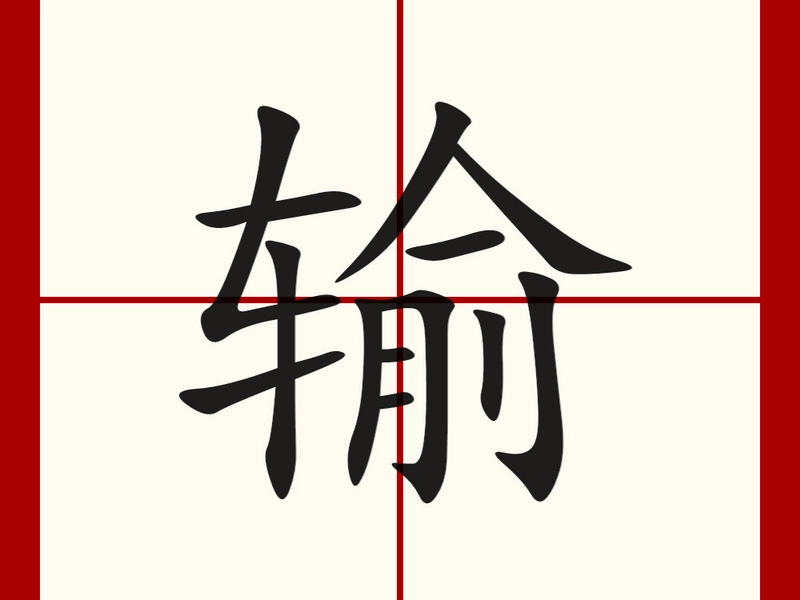
Simplified: 输
Traditional: 輸
Pinyin: shū
Meaning: to transport; to lose; to be defeated; to contribute
The Chinese character 输 (shū) represents the dual concepts of transportation and defeat. It captures both the physical movement of objects from one place to another and the metaphorical "loss" or "transfer" of advantage in competitive situations. Understanding 输 provides insight into Chinese perspectives on commerce, competition, and the dynamics of gain and loss.
Basic Meaning of 输
The character 输 is a pictophonetic character composed of two elements: the radical 车(車, chē) meaning "cart" or "vehicle," and 俞 (yú), which serves primarily as a phonetic component but also carries connotations of agreement and passage. The character originally depicted the transportation of goods by vehicle, representing the concrete action of moving things from one location to another. This fundamental meaning of "transfer" or "convey" naturally extended to the abstract concept of "losing" in competitions - essentially "transferring" victory to one's opponent.
Common Combinations with 输
Transportation Meaning:
- 运输 (yùn shū) - transportation; transit
- 输出 (shū chū) - to export; output
- 输入 (shū rù) - to import; input
- 输送 (shū sòng) - to transport; to convey
Competition Meaning:
- 输赢 (shū yíng) - loss and gain; victory and defeat
- 认输 (rèn shū) - to admit defeat
- 输球 (shū qiú) - to lose a ball game
- 输家 (shū jiā) - loser
Technical & Medical Usage:
- 输血 (shū xuè) - blood transfusion
- 输电 (shū diàn) - transmission of electricity
- 输液 (shū yè) - intravenous drip
These combinations demonstrate how 输 spans practical, competitive, and technical domains, maintaining its core concept of "transfer" throughout.
Extended Meanings of 输
Beyond its core meanings, 输 extends into several important domains:
- Economic Transfer: Used in international trade contexts
- Energy Conveyance: Applies to power transmission systems
- Medical Procedures: Describes fluid transfer in treatments
- Digital Data: Used in computing for data input/output
- Social Contribution: Can mean to contribute or donate (though less common)
Cultural and Symbolic Significance
In Chinese culture, 输 reflects important philosophical and social values:
- Competitive Spirit: The concept of "输赢" (winning and losing) reflects the competitive nature of Chinese society, particularly in academics, business, and sports.
- Face Culture: "认输" (admitting defeat) involves complex social dynamics related to "face" - knowing when to gracefully accept defeat is considered a sign of maturity and wisdom.
- Commercial Heritage: The transportation meaning connects to China's historical role in trade along the Silk Road and its modern position as a global trading power.
- Balance Perspective: The saying "胜不骄,败不馁" (don't be arrogant in victory, don't be discouraged in defeat) reflects the balanced attitude toward winning and losing.
- Technical Progress: Modern usage in terms like "输出" and "输入" demonstrates China's engagement with technology and global systems.
Example Sentences
Transportation Context:
- 我们需要把货物运输到港口。
(We need to transport the goods to the port.) - 中国输出很多电子产品。
(China exports many electronic products.)
Competition Context:
- 这场比赛我们输了。
(We lost this match.) - 他拒绝认输。
(He refused to admit defeat.)
Technical Context:
- 病人需要立即输血。
(The patient needs an immediate blood transfusion.) - 确保正确输入密码。
(Make sure to input the password correctly.)
Related Vocabulary
| Chinese | Pinyin | English |
|---|---|---|
| 输 | shū | to transport; to lose |
| 运输 | yùn shū | transportation |
| 输出 | shū chū | to export; output |
| 输入 | shū rù | to import; input |
| 输赢 | shū yíng | winning and losing |
| 认输 | rèn shū | to admit defeat |
| 输血 | shū xuè | blood transfusion |
| 输家 | shū jiā | loser |
FAQ: Common Questions About the Chinese Character 输
Q1: How can one character mean both "transport" and "lose"?
A: The connection lies in the concept of "transfer." Originally, it meant physically transferring goods via vehicles. This extended metaphorically to transferring victory to an opponent in competitions, hence "losing." Both meanings involve something moving away from its original position or owner.
Q2: What's the difference between 输 and "败" for "losing"?
A: Both can mean "to lose," but 输 is more colloquial and commonly used in everyday contexts like games and sports. "败" is more formal and literary, often used in written language or fixed expressions. 输 focuses on the result, while "败" can emphasize the process of being defeated.
Q3: How is 输 used in modern technology contexts?
A: In computing and technology, "输出" means output and "输入" means input. These terms are used for data transfer, programming, and describing computer operations, maintaining the character's core meaning of "transfer."
Q4: What's an effective way to remember this character?
A: Remember that 输 contains "车" (vehicle) - think of goods being transported away in a vehicle. For the "losing" meaning, imagine your victory being "transported away" to your opponent. The vehicle radical provides a concrete anchor for both abstract and concrete meanings.