
The Meaning and Cultural Significance of the Chinese Character "胜"
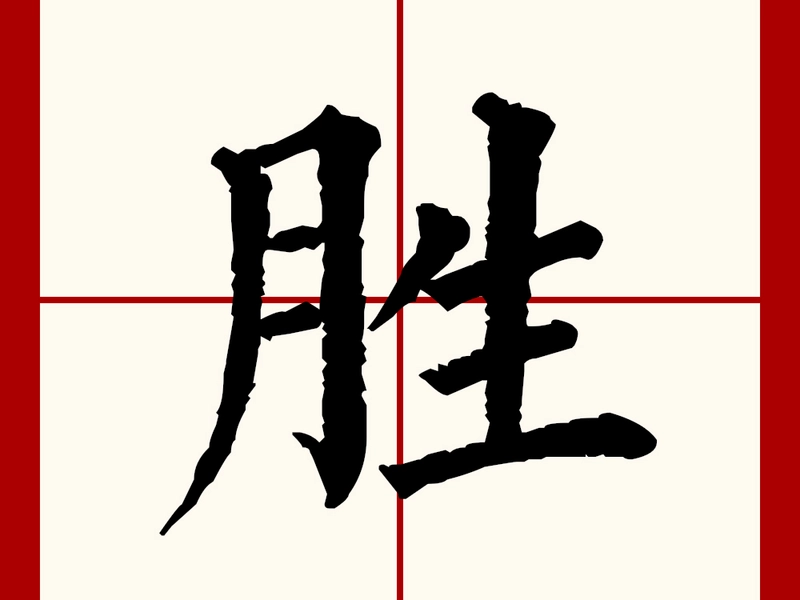
Simplified: 胜
Traditional: 勝
Pinyin: shèng (victory), shēng (a peptide)
Meaning: victory; to surpass; excellence; capacity to bear
The Chinese character "胜" (shèng) embodies the fundamental concept of victory, excellence, and superiority. It represents not only success in competition but also the qualities of being outstanding and capable. Understanding "胜" provides crucial insight into Chinese values surrounding achievement, merit, and the pursuit of excellence in personal, social, and competitive contexts.
Basic Meaning of "胜"
The character "胜" in its traditional form "勝" reveals its rich etymology. It is composed of two primary elements: the radical 力 (lì), meaning "strength" or "power," and 朕 (zhèn), which in ancient Chinese was the royal "We" used by emperors, but originally depicted a boat with two hands managing sails, representing control and capability. This combination powerfully conveys the idea of applying strength to achieve control and mastery. The modern simplified form "胜" replaces the complex "朕" with "生" (shēng, life), creating a more accessible character while preserving the core concept of vital force prevailing.
Common Combinations with "胜"
Victory & Success:
- 胜利 (shèng lì) - victory; triumph
- 获胜 (huò shèng) - to win; to achieve victory
- 胜仗 (shèng zhàng) - victorious battle
- 胜负 (shèng fù) - victory and defeat
Excellence & Superiority:
- 优胜 (yōu shèng) - superior; excellent
- 胜于 (shèng yú) - to surpass; to be better than
- 名胜 (míng shèng) - famous scenic spot
- 胜境 (shèng jìng) - wonderful place
Capacity & Endurance:
- 胜任 (shèng rèn) - competent; qualified
- 不胜 (bù shèng) - cannot bear; unable to endure
Chemical Terminology:
- 肽胜 (tài shèng) - peptides (in biochemistry)
These combinations demonstrate how "胜" spans competitive success, qualitative excellence, and practical capability across various domains.
Extended Meanings of "胜"
Beyond its core meanings, "胜" extends into several important domains:
- Scenic Excellence: Describes places of exceptional beauty and significance
- Competence Assessment: Indicates qualification and capability
- Quantitative Superiority: Used in mathematical and comparative contexts
- Moral Triumph: Represents victory of principle over expediency
- Aesthetic Excellence: Describes supreme beauty and artistry
Cultural and Symbolic Significance
In Chinese culture, "胜" carries profound philosophical and social significance:
- Military Philosophy: The concept of "胜" is central to Chinese military thought, particularly in Sun Tzu's "The Art of War," which emphasizes that supreme excellence consists of winning without fighting.
- Meritocratic Values: "胜任" (competence) reflects the Confucian emphasis on placing qualified individuals in positions of responsibility based on merit rather than birth.
- Tourism and Heritage: "名胜古迹" (famous scenic spots and historical sites) represents the cultural value placed on preserving and appreciating places of natural and historical significance.
- Moderation Wisdom: The saying "胜不骄,败不馁" (not arrogant in victory, not discouraged in defeat) reflects the cultural emphasis on maintaining balance and perspective regardless of outcomes.
- Educational Aspiration: The pursuit of "优胜" (excellence) in academic and professional contexts demonstrates the cultural value placed on continuous improvement and outstanding achievement.
Example Sentences
Victory Context:
- 我们队在比赛中获得了胜利。
(Our team achieved victory in the competition.) - 胜败乃兵家常事。
(Victory and defeat are common affairs in warfare.)
Excellence Context:
- 杭州以西湖名胜闻名于世。
(Hangzhou is world-famous for the West Lake scenic spot.) - 她的英语水平胜于多数同学。
(Her English level surpasses that of most classmates.)
Capacity Context:
- 他完全胜任这份工作。
(He is fully competent for this job.) - 美景不胜收。
(The beautiful scenery is too much to take in at once.)
Related Vocabulary
| Chinese | Pinyin | English |
|---|---|---|
| 胜 | shèng | victory; excellence |
| 胜利 | shèng lì | victory |
| 胜任 | shèng rèn | competent |
| 名胜 | míng shèng | scenic spot |
| 优胜 | yōu shèng | superior |
| 胜于 | shèng yú | to surpass |
| 胜负 | shèng fù | victory and defeat |
| 获胜 | huò shèng | to win |
FAQ: Common Questions About the Chinese Character "胜"
Q1: What's the difference between "胜" and "赢" for "winning"?
A: While both can mean "to win," "胜" often carries a more formal or literary tone and emphasizes the victorious outcome itself, while "赢" is more colloquial and often implies gaining something concrete from the victory. "胜" focuses on the state of being victorious, while "赢" focuses on the act of winning.
Q2: How is "胜任" used in employment contexts?
A: "胜任" describes someone who has the qualifications, skills, and capacity to handle a particular job or responsibility. It's commonly used in resumes, job descriptions, and performance evaluations to indicate professional competence.
Q3: Why do scenic spots use "胜" in their names?
A: "胜" in "名胜" indicates that a place is "victorious" or "superior" in its natural beauty, historical significance, or cultural value. It marks these locations as having triumphed in their aesthetic or historical qualities, making them worth visiting and preserving.
Q4: What's an effective way to remember this character?
A: Remember that "胜" combines "月" (originally "肉" representing the physical) with "生" (life/vitality) in its simplified form - suggesting the vitality and strength needed to achieve victory. For the traditional form, think of "力" (strength) combined with "朕" (imperial control) - the power to control outcomes. The character represents the application of life force and strength toward achieving excellence.