China’s Four Famous Towers
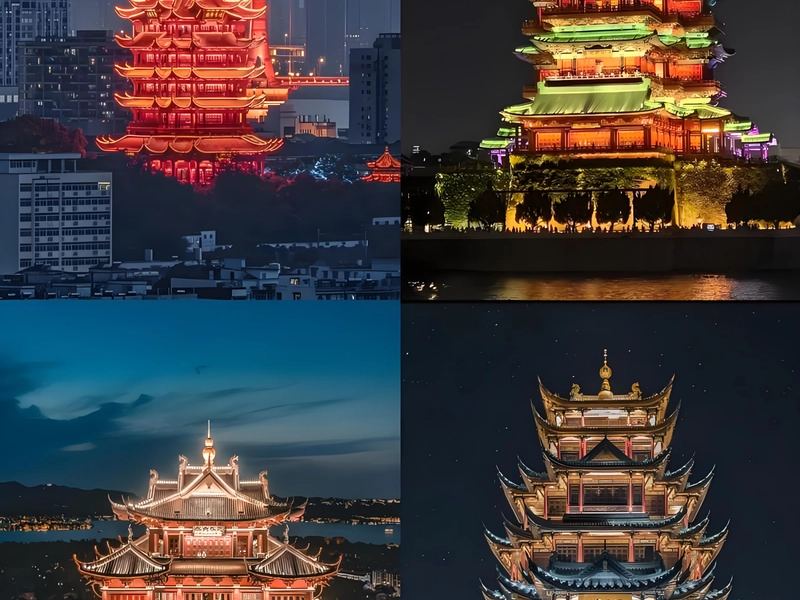
What Are the “Four Famous Towers” of China?
Throughout China’s long history, a “tower” (楼, lóu) was never merely an architectural structure set amidst cities or landscapes—it symbolized cultural spirit and scholarly reflection. Traditionally built along rivers or atop hills, towers were multi-storied structures serving diverse purposes: enjoying scenic vistas, hosting banquets and social gatherings, observing military movements, or storing treasures. Over time, the poetry of literati and the accumulation of history transformed these towers into cultural icons, embodying reflections on life, ideals, and historical consciousness. Ascending a tower was more than viewing the land; it was a spiritual experience: gazing at rivers and mountains, one contemplated the past and present, while standing against the wind, the heart embraced the vastness of heaven and earth. Since the Han and Tang dynasties, motifs such as “ascending heights to ponder history” and “standing by water to express emotions” have become staples of Chinese literature, cementing towers as emblematic spaces of the scholar’s life.
The title “Four Famous Towers” (四大名楼, Sì Dà Míng Lóu) is not official but reflects cultural consensus shaped by generations of literati and public opinion. The towers traditionally included are: Huanghelou (Yellow Crane Tower) in Wuhan, Hubei; Tengwangge (Tengwang Pavilion) in Nanchang, Jiangxi; Yueyanglou (Yueyang Tower) in Yueyang, Hunan; and Guanque Lou (Stork Tower) in Yongji, Shanxi. Each tower has unique characteristics, yet all rose to prominence through literature:
-
Huanghelou (Yellow Crane Tower) became immortal through Cui Hao’s poem Yellow Crane Tower:
“The ancient man has ridden the yellow crane away; here only the Yellow Crane Tower remains(昔人已乘黄鹤去,此地空余黄鹤楼;Xī rén yǐ chéng huáng hè qù, cǐ dì kōng yú huáng hè lóu).”
The poem transformed the tower into a timeless symbol of parting and transcendence. Today, visiting Yellow Crane Tower combines architectural grandeur with literary heritage, offering a deep cultural experience along the Yangtze River. -
Tengwangge (Tengwang Pavilion) achieved fame through Wang Bo’s Preface to Tengwang Pavilion:
“The setting sun and the lone wild goose fly together; the autumn waters merge with the endless sky(落霞与孤鹜齐飞,秋水共长天一色;Luò xiá yǔ gū wù qí fēi, qiū shuǐ gòng cháng tiān yī sè).”
Capturing the grandeur of the Gan River in autumn, Wang Bo’s words elevate the pavilion into a literary and cultural icon. Visiting Tengwang Pavilion today allows travelers to admire both the architectural splendor and the historical resonance of Jiangxi’s renowned tower. -
Yueyanglou (Yueyang Tower) was immortalized by Fan Zhongyan’s Memorial to Yueyang Tower:
“Be the first to worry about the world’s troubles and the last to enjoy its joys(先天下之忧而忧,后天下之乐而乐;Xiān tiān xià zhī yōu ér yōu, hòu tiān xià zhī lè ér lè).”
These lines symbolize the scholar’s concern for the nation and Confucian ideals. A visit to Yueyang Tower offers not only scenic enjoyment but also reflection on moral responsibility and the enduring values of Chinese culture. -
Guanque Lou (Stork Tower) became renowned through Wang Zhihuan’s Climbing Stork Tower:
“To enjoy a grander sight, climb one more floor(欲穷千里目,更上一层楼;Yù qióng qiān lǐ mù, gèng shàng yī céng lóu).”
Elevating the act of viewing from height into a life philosophy, the poem blends ambition and perseverance. Visiting Stork Tower allows appreciation of both the natural landscape and the historical-literary heritage of Shanxi.
It is important to note that the Four Towers are not fixed; historical texts and local traditions sometimes include other towers, such as Penglai Pavilion or Heming Lou. This flexibility reflects Chinese culture’s inclusiveness and the enduring role of literature in conveying moral and philosophical ideals. These towers are far more than scenic landmarks—they are vessels of human thought, history, and artistic spirit.
Literature has been the soul of these towers. Without Cui Hao, Huanghelou might have been forgotten; without Wang Bo, Tengwangge’s brilliance might not have endured; without Fan Zhongyan, Yueyanglou might not have symbolized concern for the nation; without Wang Zhihuan, Guanque Lou’s perspective might never have inspired generations. As the saying goes: “Literature immortalizes the tower, and the tower is known by literature.”
The true charm of the Four Great Towers lies not in their physical height or grandeur, but in the spiritual elevation that literature has bestowed. They are monuments where history, human creativity, and moral reflection converge. Each visit is a cultural journey across time, a dialogue with the minds of scholars and poets from centuries past. Travelers can explore the Four Great Towers through curated itineraries, experiencing the architectural beauty, literary legacy, and enduring spirit that define these timeless Chinese icons.
The Grandeur and Cultural Legacy of Famous Towers
Huanghelou (Yellow Crane Tower, Wuhan, Hubei) — The Embodiment of Transcendence and Parting
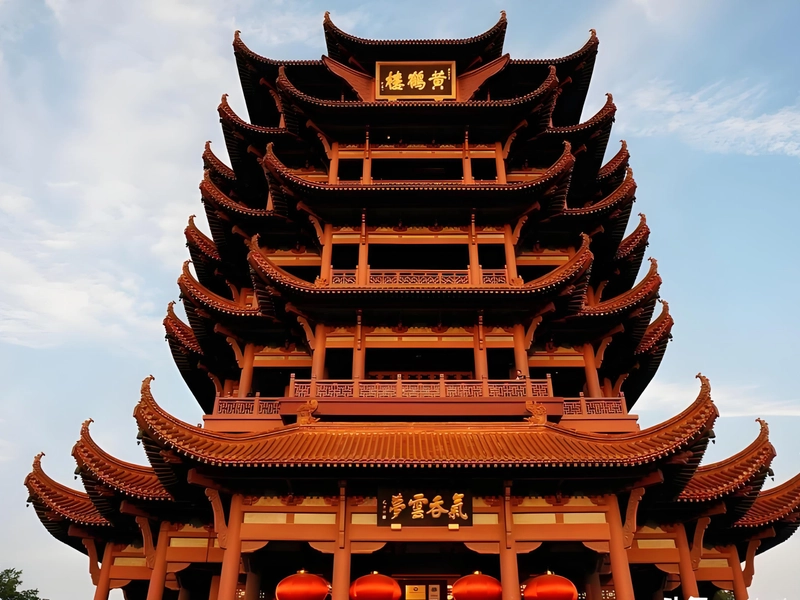
Huanghelou stands atop She Mountain in Wuhan, Hubei, overlooking the mighty Yangtze River and the three towns of Jiangcheng. Its commanding location has earned it the historical reputation as “the foremost tower over all rivers and mountains.” Originally constructed during the Three Kingdoms period, the tower has witnessed centuries of construction, destruction, and restoration, becoming an enduring symbol of Wuhan. From its heights, the river flows eastward, dotted with sails and shrouded in mist, creating a scene that blends natural grandeur with poetic imagination.
The tower’s architecture exemplifies classical Chinese craftsmanship. Featuring upturned eaves, multi-storied layers, and red railings with green tiles, Huanghelou embodies the elegance of southern design while retaining the grandeur of northern style. Inside, historical calligraphy, stone inscriptions, and paintings testify to its centuries-long role as a venue for literary gatherings, banquets, and cultural exchange. From the tower, visitors can immerse themselves in both the aesthetic beauty of the landscape and the intellectual atmosphere of its past.
Huanghelou’s cultural significance is inseparable from literature. Tang dynasty poet Cui Hao immortalized the tower in verse:
“The ancient man has ridden the yellow crane away; here only the Yellow Crane Tower remains(昔人已乘黄鹤去,此地空余黄鹤楼;Xī rén yǐ chéng huáng hè qù, cǐ dì kōng yú huáng hè lóu).
The yellow crane has gone and will not return; for a thousand years the white clouds float idly by(黄鹤一去不复返,白云千载空悠悠;Huáng hè yī qù bù fù fǎn, bái yún qiān zǎi kōng yōu yōu).”
Li Bai also left an unforgettable line when bidding farewell to a friend:
“My old friend departs westward from Huanghelou; in the misty third month, he goes down to Yangzhou(故人西辞黄鹤楼,烟花三月下扬州;Gù rén xī cí huáng hè lóu, yān huā sān yuè xià Yángzhōu).”
Through these verses, the tower became both a symbol of transcendence and a witness to human emotion, merging mythology, nature, and literary imagination.
Beyond poetry, Huanghelou carries profound historical and humanistic memory. Legends of immortals riding a yellow crane imbue the site with mythic aura, while generations of scholars have climbed its heights, inscribed poetry, and reflected on life and the passage of time. During the Ming and Qing dynasties, it served as a hub for cultural exchange, where tea, conversation, and intellectual gatherings flourished. The inscriptions and steles preserved within the tower render it a three-dimensional chronicle of Wuhan’s history, blending architecture, literature, and memory.
Modern restorations have preserved Huanghelou’s traditional aesthetic while integrating subtle lighting to enhance its grandeur. At night, the tower glows like a crane about to take flight, bridging past and present. Visitors can experience not only the panoramic view of the Yangtze and surrounding mountains but also the cultural resonance embedded in every beam, inscription, and poem.
Today, Huanghelou stands as one of the Four Great Towers of China, offering a journey through history, literature, and architecture. Beyond sightseeing, it invites reflection on human emotion, scholarly spirit, and the enduring legacy of Chinese civilization, making it a pinnacle of cultural and architectural achievement.
Yueyanglou (Yueyang Tower, Yueyang, Hunan) — The Embrace of Nation and the World
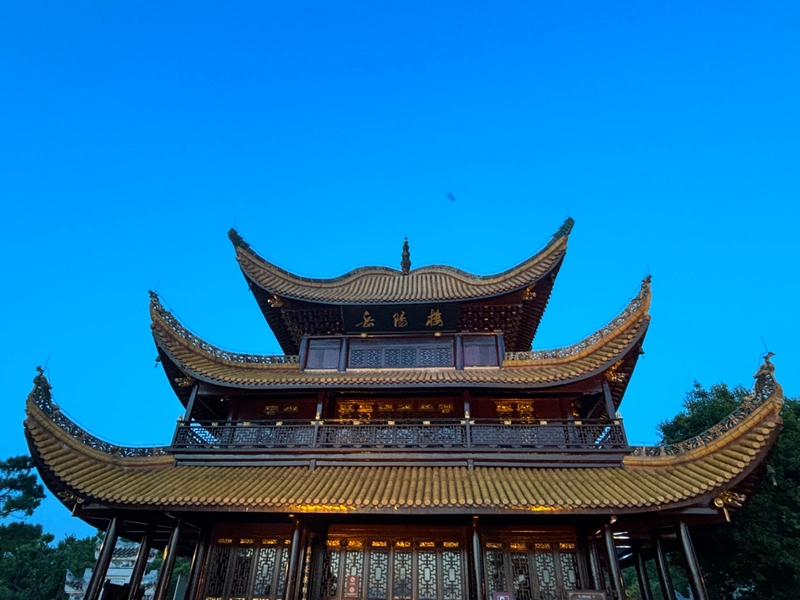
Yueyanglou stands atop the western city wall of Yueyang, Hunan, with the majestic Junshan Island behind it and the expansive Dongting Lake stretching before it. Known for centuries as “Dongting commands all waters; Yueyang commands all towers,” this ancient Chinese tower was first constructed during the Three Kingdoms period. While its scenic views are breathtaking, the tower also served strategic purposes, including military observation and guarding vital waterways. Over time, it has become a renowned destination for those exploring China’s historical landmarks and classical architectural masterpieces.
The tower’s design exemplifies the skill of ancient craftsmen. With a helmet-shaped roof, layered flying eaves, and intricately joined wooden brackets, Yueyanglou radiates solemnity and elegance. Remarkably, the entire structure was built without nails, relying solely on mortise-and-tenon joinery, a hallmark of classical Chinese architecture. From its heights, Dongting Lake seems to merge with the sky, mist curling endlessly, while Junshan Island is reflected in the calm waters—creating a scene where natural beauty and humanistic spirit converge.
The enduring fame of Yueyanglou is inseparable from the Northern Song literati Fan Zhongyan’s Memorial to Yueyang Tower. Through his reflections upon ascending the tower, Fan articulated grand political ideals and profound humanistic concern:
“Rejoice not in external gains, nor grieve in personal loss; when in the halls of power, worry for the people; when in distant lands, worry for the ruler(不以物喜,不以己悲。居庙堂之高则忧其民,处江湖之远则忧其君; Bù yǐ wù xǐ, bù yǐ jǐ bēi. Jū miàotáng zhī gāo zé yōu qí mín, chǔ jiānghú zhī yuǎn zé yōu qí jūn)。”
Be the first to worry about the world’s troubles and the last to enjoy its joys(先天下之忧而忧,后天下之乐而乐; Xiān tiānxià zhī yōu ér yōu, hòu tiānxià zhī lè ér lè).”
These words transformed Yueyanglou from a scenic lookout into a symbol of patriotism, moral virtue, and scholarly spirit. Climbing the tower allows visitors to admire Dongting Lake and Junshan Island while reflecting on historical responsibility and the enduring values of Chinese culture.
Whereas Huanghelou emphasizes transcendence and farewell, Yueyanglou embodies national and societal significance. From its heights, the misty waves inspire contemplation of historical currents and human responsibility. Across generations, scholars have inscribed poems and writings on its walls, turning the tower into a living repository of literary heritage and cultural memory.
Throughout history, Yueyanglou has hosted countless scholars, poets, and officials. During the Ming and Qing dynasties, it became a hub of intellectual exchange, where poetry, tea, and conversation flourished. Visitors today can still sense Fan Zhongyan’s ideals resonating amid the scenery, experiencing the tower not merely as an architectural monument but as a “three-dimensional chronicle” of China’s cultural and historical legacy.
Modern restorations have preserved Yueyanglou’s Qing dynasty aesthetic. Red lacquered beams and green-tiled eaves convey solemn elegance, while the stone carving of Fan Zhongyan’s memorial shines with clarity. Every visitor leaves inspired by the tower’s architectural brilliance and historical significance.
As one of the Four Great Towers of China, Yueyanglou remains a must-visit site for travelers seeking a journey that blends scenic charm, literary heritage, and classical Chinese architecture. Experiencing the tower offers a unique passage through centuries of Chinese civilization, connecting visitors to the enduring spirit of scholars, poets, and artisans who shaped its legacy.
Tengwang Pavilion (Nanchang, Jiangxi) — The Tower of Literary Elegance and Cultural Splendor
.webp)
Tengwang Pavilion rises majestically along the Gan River in Nanchang, Jiangxi, with Tengwang Pool to the north and the flowing Gan River to the south. Celebrated for centuries as “the foremost tower of the Western River,” it was first built during the Yonghui period of the Tang dynasty by Prince Li Yuanying, brother of Emperor Taizong. Beyond its scenic vistas, the pavilion originally served to display royal prestige, host banquets and literary gatherings, entertain officials, and provide a platform for ceremonial observation. Its location harmonizes natural beauty with cultural and political symbolism, where flowing waters, misty waves, and soaring architecture create a timeless scene. Today, Tengwang Pavilion remains a destination for those exploring China’s historical towers and traditional landmarks.
The structure exemplifies classical craftsmanship. This seven-story tower features overlapping flying eaves, red railings, green tiles, and intricately carved beams and painted rafters. Its design combines southern elegance with northern grandeur, reflecting both refinement and imposing scale. From its heights, the Gan River stretches like a silver ribbon, Tengwang Pool mirrors the surrounding hills, and each season offers a unique spectacle: spring with waters extending to the horizon, summer with leafy shadows swaying in the breeze, autumn with the setting sun reflected on the river, and winter with mist hovering over the calm surface. The pavilion’s architecture and vistas together create a space where both heart and mind are elevated.
The fame of Tengwang Pavilion is inseparable from Tang dynasty poet Wang Bo’s Preface to Tengwang Pavilion. During a banquet, Wang Bo wrote:
“The setting sun and the lone wild goose fly together; the autumn waters merge with the endless sky(落霞与孤鹜齐飞,秋水共长天一色;Luò xiá yǔ gū wù qí fēi, qiū shuǐ gòng cháng tiān yī sè).”
In just a few words, he captured the grandeur of the Gan River and the tranquility of autumn. The preface, filled with majestic diction and uplifting spirit, immortalized both the pavilion and the young poet, establishing Tengwang Pavilion as a lasting symbol of literary and cultural achievement. Over centuries, scholars have inscribed poems, carved couplets, and held gatherings here, intertwining human talent with architectural beauty.
Tengwang Pavilion embodies a rich cultural legacy. It celebrates youthful ambition, the pursuit of excellence, and reverence for nature. Scholars across generations have left traces of thought, artistry, and intellectual exchange, making the tower not merely a building but a living testament to the spirit of the literati. Historical anecdotes of poets, officials, and scholars further enrich its significance, while the repeated cycles of destruction and reconstruction have refined its style and reinforced its cultural weight.
The current structure, completed in 1989, preserves the Tang-style and Song-era imperial layout. By day, visitors enjoy expansive river views and the serene reflections of Tengwang Pool; by night, the illuminated eaves and carved beams glow like crimson clouds over the Gan River, evoking scenes from Wang Bo’s timeless verse. Tengwang Pavilion thus offers more than sightseeing—it is an immersive experience of literature, history, and architectural artistry.
As one of China’s Four Great Towers, Tengwang Pavilion stands as both a cultural landmark and a spiritual emblem. Visiting the tower allows one to witness centuries of artistic, literary, and architectural heritage, connecting the past to the present and celebrating the enduring elegance of Chinese civilization.
Guanque Lou (Stork Tower, Yongji, Shanxi) — The Elevation of Philosophy and Vision
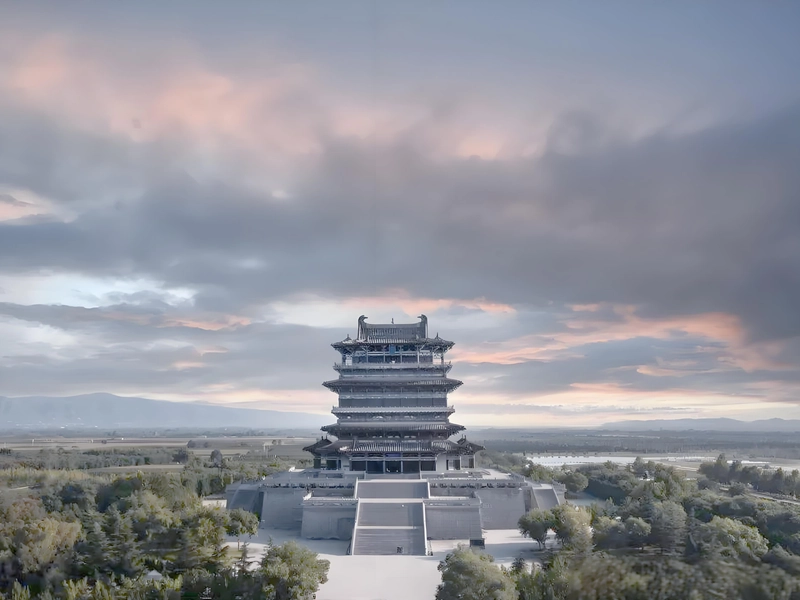
Guanque Lou is located along the Yellow River in Yongji, Shanxi, named after the storks and sparrows that once frequently perched atop it. Its origins trace back to the early Tang dynasty. The tower was initially constructed not only for military observation and defense of key passages along the Yellow River but also as a cultural site where local officials and scholars could enjoy the scenery, host banquets, and conduct literary gatherings. Positioned on a high riverbank with panoramic views extending to the Zhongtiao Mountains and the vast expanse of the Yellow River, Guanque Lou offered both strategic advantage and cultural significance—a lofty platform for defense, reflection, and intellectual inspiration.
Architecturally, Guanque Lou is magnificent and imposing. Several stories high, with upturned eaves, carved beams, and painted rafters, its layered structure conveys immense grandeur. From the tower, the Yellow River flows eastward with powerful waves crashing on the banks, while the sky and river merge into a vast, awe-inspiring landscape. Ancient visitors, gazing from the tower, felt the majesty of nature and the “chill of high places,” inspiring reflection and introspection. Guanque Lou’s fame stems not only from its physical height but also from its cultural and spiritual elevation, making it a standout among the Four Famous Towers of China.
The tower’s enduring renown is inseparable from Tang dynasty poet Wang Zhihuan’s masterpiece Climbing Stork Tower (登鹳雀楼):
“The sun sets behind the mountains, the Yellow River flows into the sea(白日依山尽,黄河入海流; Bái rì yī shān jìn, Huáng Hé rù hǎi liú).
To enjoy a grander sight, climb one more floor(欲穷千里目,更上一层楼; Yù qióng qiān lǐ mù, gèng shàng yī céng lóu).”
The poem’s first lines depict the natural grandeur of the Yellow River and the setting sun, while the final lines convey a profound philosophical message: one must strive continuously for higher perspectives in life. Wang Zhihuan skillfully combined the visual drama of the tower with life philosophy, making Guanque Lou not only an ideal viewpoint for Yellow River sightseeing but also a symbol inspiring ambition, personal growth, and broader vision. The phrase “geng shang yi ceng lou” (更上一层楼) has since become a timeless maxim motivating students, scholars, and officials alike to pursue excellence and progress.
Culturally, Guanque Lou embodies the spirit of aspiration and transcendence. In Chinese tradition, ascending a high place symbolizes ambition and self-improvement. Guanque Lou captures this upward, enterprising ethos: in study, career, or personal development, “climbing one more floor” encourages perseverance and the pursuit of higher goals. Unlike Huanghelou’s poetic melancholy, Yueyanglou’s focus on worldly affairs, or Tengwangge’s literary elegance, Guanque Lou emphasizes vision, optimism, and spiritual elevation.
Historically, Guanque Lou served as a stage for literature and a repository of cultural memory. Tang and Song scholars frequently ascended the tower to observe the Yellow River and compose poetry, leaving inscriptions and calligraphy. During the Ming and Qing dynasties, the surrounding area became a site for literary gatherings, lectures, and scholarly discourse. Its steles and carved inscriptions create a “three-dimensional cultural chronicle,” where poetry, history, and human aspiration converge, making the tower both a historical landmark and a center of cultural heritage in Shanxi.
Today’s Guanque Lou is a modern reconstruction faithful to its traditional style. From the tower, the Yellow River flows endlessly, its waves and the wind echoing through the structure, as if Wang Zhihuan’s gaze from a thousand years ago still resonates. At night, the illuminated pavilion, with overlapping eaves and carved beams mirrored in the river, appears like a crane about to soar. Guanque Lou is not only a key site in Yellow River sightseeing but also an iconic Chinese historical tower, symbolizing ambition, cultural spirit, and the pursuit of excellence. Visitors climbing the tower today can experience panoramic views, reflect on centuries of literary and cultural legacy, and feel inspired by Wang Zhihuan’s timeless call to reach ever higher.
Comparison and Extension: Cultural Core of the Four Famous Towers
Cultural Reflections — The Spiritual Essence of the Four Towers
The “Four Famous Towers” of China are not merely architectural marvels—they are embodiments of Chinese culture, literary spirit, and intellectual legacy. Each tower conveys a unique cultural temperament, like four radiant pearls along the river of Chinese civilization, reflecting one another and shining brilliantly. Their charm lies not only in architectural form and scenic beauty but also in their intimate connection with literature, historical events, and scholarly ideals, forming a distinct cultural core that continues to inspire visitors today.
Huanghelou — The Romance and Melancholy of Poetry
Huanghelou (Yellow Crane Tower) is celebrated through poetry, renowned for its romanticism and emotional depth. Since its construction in the Three Kingdoms period, the tower has symbolized the literati’s pursuit of transcendence and emotional resonance with landscapes. Tang poet Cui Hao immortalized it in Yellow Crane Tower, while Li Bai bid farewell to his friend Meng Haoran from its heights, intertwining the tower with verse. Legends of immortals riding cranes add mythic charm, while farewells to friends imbue it with human melancholy. Climbing Huanghelou today offers visitors a dual experience: glimpses of a celestial realm and the poignant depth of historical sentiment. Its cultural core lies in the combination of romantic imagination and human emotion, reflecting the freedom of the ancient scholar’s spirit.
Yueyanglou — Thought and the Aspiration for Nation and People
Yueyanglou (Yueyang Tower) is distinguished by its intellectual and literary significance, immortalized through Northern Song scholar Fan Zhongyan’s Record of Yueyang Tower. Fan integrated the scenic grandeur of Dongting Lake with political ideals, proposing:
“Be not delighted by external gains, nor saddened by personal loss; when in court, worry for the people; when in exile, worry for the ruler. To worry before the world worries, to enjoy after the world enjoys(不以物喜,不以己悲;居庙堂之高则忧其民,处江湖之远则忧其君。先天下之忧而忧,后天下之乐而乐; Bù yǐ wù xǐ, bù yǐ jǐ bēi; Jū miàotáng zhī gāo zé yōu qí mín, chǔ jiānghú zhī yuǎn zé yōu qí jūn. Xiān tiānxià zhī yōu ér yōu, hòu tiānxià zhī lè ér lè).”
This brief text became a spiritual guide for scholars for generations, elevating Yueyanglou from a scenic lookout to a symbol of responsibility, duty, and patriotism. Ascending the tower allows visitors to admire Dongting Lake while contemplating national affairs and human destiny. Yueyanglou sightseeing offers a rich combination of history, literature, and Chinese cultural reflection, making it a must-visit for travelers exploring historical towers in Hunan. Its enduring appeal is rooted in the seamless integration of natural beauty, intellectual heritage, and moral philosophy.
Tengwangge — Literary Talent and Magnificent Expression
Tengwangge’s cultural essence lies in literary talent and artistic expression. Tang poet Wang Bo composed the Preface to Tengwang Pavilion spontaneously during a banquet, capturing the grandeur of the Gan River in autumn with vivid diction and parallel prose. The pavilion became a symbol of youthful ambition, scholarly elegance, and artistic brilliance. Its cultural spirit embodies the principle of “literature carrying ideals, fame carried by talent,” reflecting the openness and prosperity of the High Tang era. Over centuries, scholars visiting the pavilion have inscribed poems, held refined gatherings, and left traces of intellectual achievement, making Tengwang Pavilion a lasting symbol of culture and literary excellence. Today, visitors can experience Tengwang Pavilion sightseeing, combining traditional Chinese architecture with the historical and literary legacy of the Four Great Towers of China.
Guanque Lou — Philosophical Insight and Elevated Perspective
Guanque Lou emphasizes philosophy and expansive vision. Tang poet Wang Zhihuan’s Climbing Stork Tower conveys the idea of striving for higher goals through concise yet profound lines:
“The sun sets behind the mountains, the Yellow River flows into the sea. To enjoy a grander sight, climb one more floor(白日依山尽,黄河入海流。欲穷千里目,更上一层楼;Bái rì yī shān jìn, Huáng Hé rù hǎi liú. Yù qióng qiān lǐ mù, gèng shàng yī céng lóu).”
The first two lines depict the grandeur of nature, while the last two convey the philosophical message that life requires continuous pursuit of higher goals. Guanque Lou embodies the spirit of aspiration, broad-mindedness, and self-transcendence. Scholars and visitors alike are inspired to reflect on life, expand their horizons, and embrace the pursuit of excellence. Historically, the tower has served as a stage for literary creation and intellectual exchange, with inscriptions, poems, and calligraphy left by Tang and Song literati. Today’s Guanque Lou remains a prominent cultural landmark, offering visitors both stunning Yellow River views and a deep connection to Chinese historical towers and traditional culture.
The Four Towers in Panorama — A Complete Vision of Scholarly Spirit
Together, the Four Great Towers of China offer a panoramic view of the ancient literati’s spirit:
- Huanghelou conveys romance and emotional depth, celebrating human sentiment and poetic imagination.
- Yueyanglou embodies responsibility, patriotism, and reflection on societal and moral ideals.
- Tengwangge showcases literary talent, artistic expression, and intellectual brilliance.
- Guanque Lou inspires philosophical insight, ambition, and the pursuit of elevated perspective.
These towers are not merely architectural or literary achievements; they form a cultural and spiritual symphony. Visitors ascending these historic towers engage with centuries of Chinese civilization, connecting with the emotional, intellectual, artistic, and philosophical legacies of scholars, poets, and architects. Experiencing the Four Great Towers today allows travelers to explore Chinese historical towers, appreciate traditional Chinese architecture, and immerse themselves in the rich literary and cultural heritage that has shaped China’s enduring legacy.
Introduction to Other Famous Towers in China
Beyond the classic “Four Famous Towers,” China is home to numerous other historic towers, each uniquely positioned by rivers, lakes, or mountains. These towers carry rich cultural symbolism, historical stories, and regional charm, reflecting the humanistic spirit embedded in Chinese architecture.
Penglai Pavilion (Shandong) — A Celestial Realm Between Sea and Sky
.webp)
Penglai Pavilion sits on the Shandong Peninsula, surrounded on three sides by the sea and backed by lush hills, earning the reputation as “the Immortal Capital on the Sea.” According to legend, it was the departure point of the Eight Immortals crossing the sea, giving the pavilion a mythic aura. From its vantage point, visitors can gaze at endless waves, ethereal clouds, and sea mirages, experiencing a scene that blends natural beauty with celestial imagination.
Historically and culturally, Penglai Pavilion has inspired countless scholars and poets. They composed verses merging the imagery of immortals with reflections on life, leaving inscriptions and steles that preserve centuries of maritime culture and literary heritage. Today, Penglai Pavilion remains both a scenic lookout and a symbol of mythology, legend, and artistic imagination.
Daguan Tower (Yunnan) — Life Reflected Through Couplets and Scenery
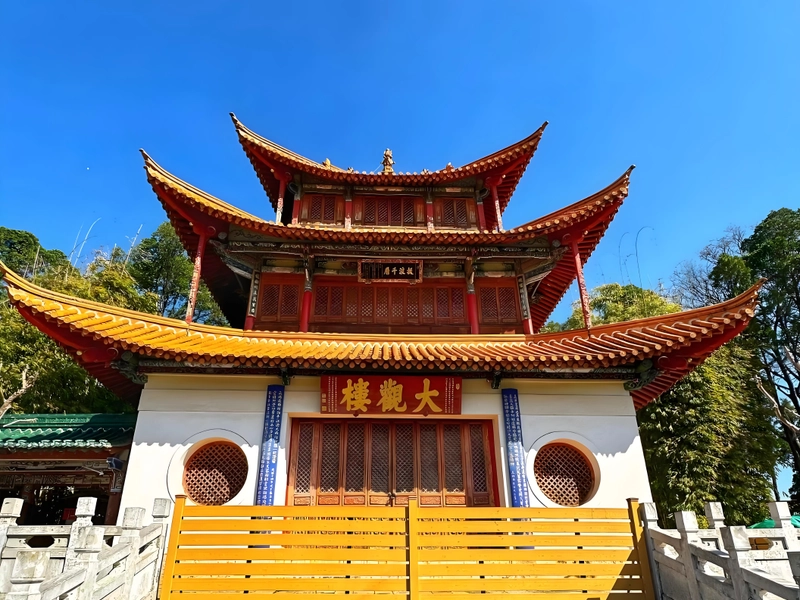
Daguan Tower, located by Dianchi Lake in Kunming, Yunnan, is renowned for the “Longest Couplet on Daguan Tower.” The upper line celebrates the scenic beauty of the lake, while the lower line reflects on life’s vicissitudes and history, intertwining natural grandeur with human sentiment. From the tower, visitors enjoy panoramic views of rippling waters and the rolling Western Hills, capturing the essence of Southwest China’s landscapes.
More than a scenic spot, Daguan Tower embodies the regional culture and historical memory of Yunnan. Generations of scholars have used it as inspiration for poetry, blending personal reflection with the surrounding scenery. As a cultural landmark, Daguan Tower demonstrates how architecture, nature, and literature converge to create a platform for intellectual and emotional expression.
Diversity of Other Historic Towers
In addition to Penglai Pavilion and Daguan Tower, China boasts many other historic towers, such as Yuewang Tower in Xiangyin, Hunan; Lanting Tower in Shaoxing, Zhejiang; and the Imperial Kiln Tower in Jingdezhen, Jiangxi. Some commemorate historical events, others preserve literary sentiment, and many reflect local traditions and regional spirit. Across centuries, these towers have served not merely as architectural structures but as carriers of cultural memory, literary expression, and spiritual symbolism. They provide vistas for poetry, storytelling, and reflection, enriching the broader tapestry of Chinese tower culture.
China’s towers, from the Four Famous Towers to lesser-known landmarks, are living testimonies of the nation’s architectural ingenuity, literary brilliance, and cultural depth. Visiting these historic towers offers travelers a unique opportunity to explore ancient Chinese architecture, literary heritage, and the humanistic spirit embedded in every structure. Each tower tells a story, connects the past with the present, and exemplifies the enduring cultural legacy of China.
Tower Remains, but Men Gone
The “Four Famous Towers” stand majestically across China’s land and history, serving not merely as exquisite architectural marvels but as symbols of the spirit of Chinese culture. Unlike ordinary tourist attractions, these towers carry the weight of historical memory and the pulse of cultural life—they are “living fossils” of Chinese civilization. Every brick, every eave, bears the imprint of its era, conveying the voice of a people.
Yellow Crane Tower embodies romance and longing through the legend of the crane and the scenic beauty of the Yangtze River city, serving as a spiritual high platform for scholars to seek transcendence, immerse themselves in landscapes, and express their feelings for absent friends. Today’s Yellow Crane Tower sightseeing allows visitors to experience this fusion of natural beauty and human sentiment.
Yueyang Tower, overlooking the vast expanse of Dongting Lake and immortalized by Fan Zhongyan’s maxim, “Be the first to worry for the world, and the last to enjoy its pleasures,” reflects a boundless sense of duty and care for one’s country, condensing the ideals, responsibilities, and moral pursuits of the literati. A Yueyang Tower travel experience offers both sightseeing and contemplation of historical and cultural values.
Tengwang Pavilion, adorned with the ornate parallel prose of the High Tang, Wang Bo’s literary genius, and the autumnal scenery of the Gan River, radiates youthful ambition and artistic confidence, becoming a cultural emblem where literature and architecture converge. Visitors can enjoy Tengwang Pavilion tours, exploring the literary heritage and grandeur of Nanchang.
Guanque Tower, with its concise poetic lines and the majestic Yellow River, embodies philosophical reflection and the spirit of striving forward, symbolizing the human pursuit of excellence and the continual transcendence of one’s own limits. Experiencing Guanque Lou Yellow River view inspires reflection, ambition, and a broadened perspective.
Viewed collectively, the Four Towers reveal distinct cultural cores: Yellow Crane Tower emphasizes emotion, Yueyang Tower emphasizes duty, Tengwang Pavilion emphasizes literary brilliance, and Guanque Tower emphasizes reason. Together, they present a panoramic view of the spirit of ancient Chinese scholars—the depth of feeling, the loftiness of ideals, the clarity of wisdom, and the breadth of vision. It is precisely this multidimensional spiritual resonance that allows the “Four Famous Towers” to shine through centuries of wind and rain.
The enduring charm of these towers lies not only in their masterful architectural forms but also in the poetry and prose that have endowed them with soul across the ages. They carry not only literature and art but also the spiritual essence and values of the Chinese nation: reverence for the past without being trapped by it, empathy for the world without self-pity, striving forward without recklessness, and openness without emptiness. This spirit has allowed Chinese culture to retain its upward momentum and profound warmth throughout the long course of history.
In today’s rapidly modernizing era, preserving and inheriting these cultural treasures is not merely about safeguarding historical relics—it is about protecting the roots of the nation’s spirit. Every ascent to a tower and every distant gaze is a journey of dialogue with history; every recitation of poetry is an experience of cultural and spiritual renewal. Only by allowing these towers to continue “living” within our cultural life and by letting their timeless values flow through the nation’s veins can Chinese civilization once again achieve the spiritual elevation of “going up yet another level” atop the towers of the new era.
Related Vocabulary
| Term | Pinyin | English | Notes / Significance |
|---|---|---|---|
| 黄鹤楼 | Huánghè Lóu | Yellow Crane Tower | Wuhan, Hubei; symbolizes transcendence and farewell |
| 滕王阁 | Téngwáng Gé | Tengwang Pavilion | Nanchang, Jiangxi; represents literary elegance and cultural prestige |
| 岳阳楼 | Yuèyáng Lóu | Yueyang Tower | Yueyang, Hunan; embodies responsibility and patriotism |
| 鹳雀楼 | Guànquè Lóu | Stork Tower | Yongji, Shanxi; symbolizes vision and philosophical insight |
| 诗歌 | shīgē | Poetry | Central to the towers’ cultural significance |
| 长江 | Cháng Jiāng | Yangtze River | Adjacent to Yellow Crane Tower |
| 洞庭湖 | Dòngtíng Hú | Dongting Lake | Seen from Yueyang Tower |
| 赣江 | Gàn Jiāng | Gan River | Seen from Tengwang Pavilion |
| 黄河 | Huáng Hé | Yellow River | Seen from Guanque Lou |
| 诗人 | shīrén | Poet | Cui Hao, Wang Bo, Fan Zhongyan, Wang Zhihuan |
| 登楼 | dēng lóu | Ascend the tower | A metaphor for reflection, ambition, or elevated perspective |
| 遗址 | yízhǐ | Historical Site | Each tower preserves centuries of history and inscriptions |
FAQ
1. Where can I see China’s famous towers?
The Four Famous Towers—Yellow Crane Tower (Wuhan), Tengwang Pavilion (Nanchang), Yueyang Tower (Yueyang), and Stork Tower (Yongji)—are spread across China and are must-visit cultural landmarks.
2. Why are these towers so special?
They’re famous not just for their architecture, but also because historic poets and scholars wrote about them, turning each tower into a symbol of culture, history, and philosophy.
3. What makes Yellow Crane Tower worth visiting?
It’s famous for its romantic legends and poetry, offering panoramic views of the Yangtze River and a chance to experience the spirit of ancient Chinese scholars.
4. What can I see or feel at Yueyang Tower?
Beyond its beautiful views of Dongting Lake, Yueyang Tower inspires reflection on responsibility, patriotism, and the moral values highlighted by the scholar Fan Zhongyan.
5. What’s special about Tengwang Pavilion?
Tengwang Pavilion is known for its artistic elegance and literary fame, offering visitors a mix of stunning architecture, scenic river views, and centuries of cultural heritage.
6. Why should I visit Stork Tower?
Climbing Stork Tower is not just sightseeing—it’s about seeing the Yellow River from above and feeling the philosophical message of striving for higher goals, as expressed in Wang Zhihuan’s poetry.
7. Are there other towers worth visiting in China?
Yes! Besides the Four Famous Towers, China has many historic towers like Penglai Pavilion in Shandong or Daguan Tower in Yunnan, each with its own stories, poetry, and scenic beauty.