The Meaning and Cultural Significance of the Chinese Character “我” (I / Me)
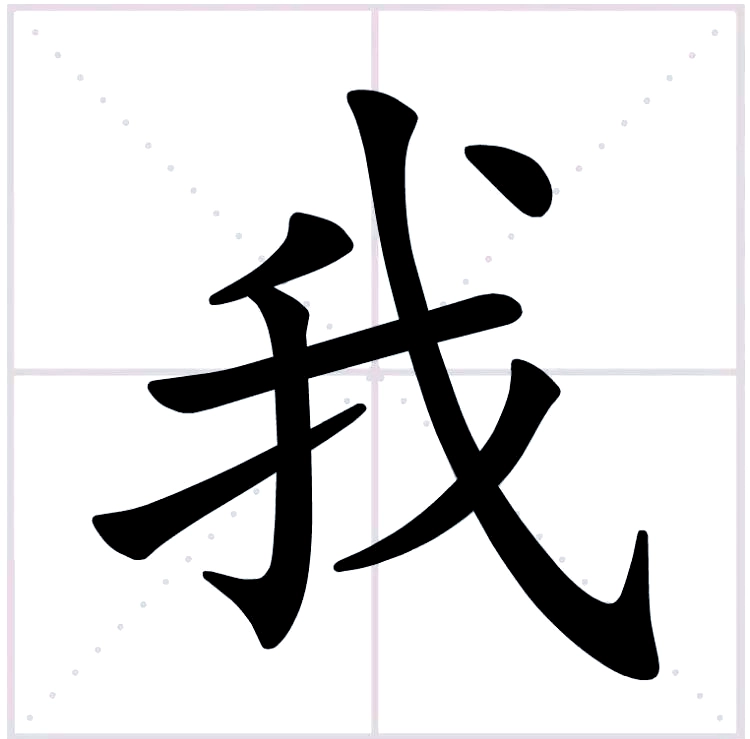
Simplified: 我
Pinyin: wǒ
Meaning: I / me / my / self
The Chinese character "我" (wǒ) is the first-person singular pronoun in modern Mandarin Chinese, representing the self from the speaker's own perspective. It is one of the most fundamental and frequently used characters, essential for all forms of communication. Understanding "我" goes beyond grammar, touching upon concepts of self-identity, expression, and the individual's role within collective culture.
Basic Meaning of "我"
The character "我" is a pictograph with a fascinating history. Its oracle bone script form depicted a hand holding a weapon with a serrated blade, likely a type of battle-axe or dagger-axe. This origin suggests its early association with power, warfare, and perhaps a collective "we" in a martial context. Over time, its meaning shifted from a collective or militaristic self to become the primary first-person singular pronoun "I" or "me." Its primary function is as a pronoun, referring to the speaker.
Common Combinations with "我"
- 我们 (wǒ men, we / us): The plural form, meaning "we" or "us."
- 我的 (wǒ de, my / mine): The possessive form.
- 我们的 (wǒ men de, our / ours): The plural possessive form.
- 自我 (zì wǒ, self / ego): Refers to the concept of the self, often in psychological or philosophical contexts.
- 忘我 (wàng wǒ, selfless / to forget oneself): A state of complete absorption or selflessness.
- 我方 (wǒ fāng, our side): Used in formal or competitive contexts to refer to one's own side.
- 唯我独尊 (wéi wǒ dú zūn, extremely self-important): An idiom describing someone who thinks they are the most important person.
These combinations show how 我 forms the core of self-reference, from simple possession to complex concepts of identity and selflessness.
Extended Meanings of "我"
Beyond its literal meaning, 我 has several extended and philosophical uses:
- The Philosophical Self: In philosophy and psychology, "我" represents the ego or the conscious self.
- Individual Identity: It signifies individual existence, will, and perspective.
- Contrast with the Collective: The concept of "自我" (the individual self) is often explored in relation to the collective whole.
- Self-Interest: Appears in words like "利我" (lì wǒ, beneficial to me), though "利己" is more common.
Cultural and Symbolic Significance
In Chinese culture, the concept and use of "我" reflect a complex interplay between the individual and the collective:
- The Self in a Collective Society: Traditional Chinese culture emphasizes the group (family, community, nation). Thus, the frequent use of "我们" (we) is very natural, while the prominent assertion of "我" (I) can sometimes be tempered in favor of group harmony.
- Modern Individualism: In contemporary society, the use of "我" to express personal opinion, desire, and identity has become increasingly prominent, reflecting influences of globalization and individualism.
- Spiritual and Philosophical Pursuits: The state of "忘我" (selflessness) is highly valued in contexts like artistic creation, dedication to a cause, or spiritual practice (e.g., in Daoism and Buddhism), where transcending the ego is seen as a noble goal.
- A Symbol of Assertion: The character's ancient martial origin hints at a core of strength and self-assertion, which remains a part of its character, used when stating one's position, rights, or beliefs.
Example Sentences
- 我是学生。
(I am a student.) - 我的家在北京。
(My home is in Beijing.) - 我们一起去吧。
(Let's go together.) - 他工作起来有一种忘我的精神。
(He has a selfless spirit when he works.) - 自我反省很重要。
(Self-reflection is very important.)
Related Vocabulary
| 中文 | Pinyin | English |
|---|---|---|
| 我 | wǒ | I / me |
| 我们 | wǒ men | we / us |
| 我的 | wǒ de | my / mine |
| 自我 | zì wǒ | self / ego |
| 忘我 | wàng wǒ | selfless |
| 我方 | wǒ fāng | our side |
| 大我 | dà wǒ | the greater self (collective) |
| 小我 | xiǎo wǒ | the small self (individual) |
FAQ: Common Questions About the Chinese Character "我"
Q1: Is "我" used differently for men and women?
A: No. "我" is a completely gender-neutral pronoun. It is used by speakers of any gender.
Q2: What is the difference between "我" and "自己" (zìjǐ)?
A: "我" is the personal pronoun "I/me." "自己" is a reflexive pronoun meaning "self." They are often used together for emphasis: "我自己做" (I will do it myself). "自己" can also be used in a general sense, not tied to a specific person.
Q3: How did a character for a weapon become "I"?
A: This is a common evolution in languages where a word for a collective group (perhaps a warrior group referring to themselves) gradually becomes generalized to the first-person singular. The exact path is debated by linguists, but the weapon origin is widely accepted.
Q4: How can learners remember "我"?
A: While its modern form is abstract, you can use a mnemonic: Think of the character as someone holding a weapon and saying, "This is my weapon, it belongs to me!" This links the ancient form to the modern meaning. For practical purposes, it is the most basic word for "I," used in virtually every conversation.