The Meaning and Cultural Significance of the Chinese Character “外” (Outside / External)
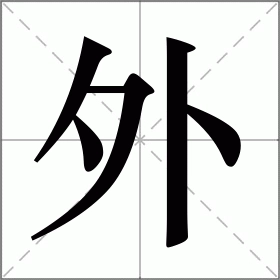
Simplified: 外
Pinyin: wài
Meaning: outside / external / foreign / beyond / other than
The Chinese character "外" (wài) represents the concept of the outside, the external, or that which is beyond a boundary. As the direct counterpart to "内" (nèi, inside), it is a fundamental character for expressing spatial relationships, defining social groups, and classifying everything from objects to ideas that originate from beyond a perceived center. Understanding "外" is crucial for grasping the Chinese perspective on everything from geography and family to knowledge and commerce.
Basic Meaning of "外"
The character "外" is composed of two parts: the left component 夕 (xī), which means "evening" or "dusk," and the right component 卜 (bǔ), which relates to "divination." One common interpretation is that it refers to conducting divination outside at night, an activity considered beyond the normal domestic sphere. Another theory suggests that "夕" represents the moon, seen as external and distant. This core idea of being outside, beyond, or external to a central point or boundary forms the basis for all its meanings.
Common Combinations with "外"
- 外国 (wài guó, foreign country): A country external to one's own.
- 外面 (wài miàn, outside / the exterior): The external surface or area.
- 外语 (wài yǔ, foreign language): A language from outside one's own culture.
- 另外 (lìng wài, besides / in addition): Refers to something "other" than what has been mentioned.
- 外交 (wài jiāo, diplomacy): The conduct of international relations between nations (external interaction).
- 外表 (wài biǎo, appearance / exterior): The outer surface or look of something.
- 意外 (yì wài, accident / unexpected): An event that happens "outside" of one's expectations.
- 外公 (wài gōng, maternal grandfather): Grandfather from the "external" (mother's) side of the family.
These combinations show how 外 is used to describe geography, language, appearance, family relations, and unforeseen events.
Extended Meanings of "外"
Beyond its literal meaning, 外 has several extended and abstract uses:
- Foreign and Non-Native: A prefix for anything perceived as originating from outside the cultural or national boundary (外国人, foreigner; 外来语, loanword).
- Maternal Relations: In traditional Chinese kinship terms, relatives from the mother's side are prefixed with "外" (e.g., 外公, maternal grandfather; 外婆, maternal grandmother), reflecting the patrilineal family structure where the mother was considered to have come from "outside" the father's clan.
- Informal or Unofficial: Denotes something that is not part of the formal or core structure (外号, wài hào, nickname).
- Beyond a Scope: Used to indicate exceeding a limit (此外, cǐ wài, besides this; 计划外, jì huà wài, outside the plan).
Cultural and Symbolic Significance
In Chinese culture, the distinction between "内" (internal) and "外" (external) is a foundational and pervasive concept:
- In-Group vs. Out-Group: This dichotomy is central to social relations. The family and close associates are "内," while strangers and outsiders are "外." This creates a strong sense of in-group loyalty and a initial caution towards out-groups.
- Historical Sino-Centric View: Traditionally, China viewed itself as the "Middle Kingdom" (中国, Zhōngguó), the civilized center of the world. All lands and peoples beyond its borders were "外," often perceived as barbaric or less civilized. This worldview has evolved but its linguistic legacy remains.
- Philosophy of Conduct: The proverb "外圆内方" (wài yuán nèi fāng, round outside, square inside) encapsulates a key philosophy for social harmony. It advises one to be flexible, tactful, and adaptable in external dealings, while maintaining firm moral principles internally.
- Modern Globalization: In contemporary China, "外" has taken on new significance in the context of engagement with the world. Terms like "对外开放" (duì wài kāi fàng, opening up to the outside) and "外资" (wài zī, foreign capital) are cornerstones of modern economic policy.
Example Sentences
- 他来自外国。
(He comes from a foreign country.) - 孩子们在外面玩。
(The children are playing outside.) - 我会说一门外语。
(I can speak a foreign language.) - 另外,我还有一件事要告诉你。
(Besides, I have one more thing to tell you.) - 这是一个意外的事故。
(This was an unexpected accident.)
Related Vocabulary
| 中文 | Pinyin | English |
|---|---|---|
| 外 | wài | outside / external / foreign |
| 内 | nèi | inside / internal |
| 外国 | wài guó | foreign country |
| 外面 | wài miàn | outside |
| 外语 | wài yǔ | foreign language |
| 另外 | lìng wài | besides / in addition |
| 外交 | wài jiāo | diplomacy |
| 意外 | yì wài | accident / unexpected |
FAQ: Common Questions About the Chinese Character "外"
Q1: Why are maternal relatives called "外" (external) relatives?
A: This reflects the traditional patrilineal (tracing descent through the father) family system. When a woman married, she joined her husband's family, which was considered the core "内" (internal) line. Her birth family thus became the "外" (external) line from the perspective of her children.
Q2: What is the difference between "外面" (wàimiàn) and "外边" (wàibiān)?
A: They are largely interchangeable and both mean "outside." "外面" is slightly more common in standard Mandarin, while "外边" might be heard more in northern dialects. There is no significant difference in meaning.
Q3: How is "外" used in a business context?
A: It is extensively used. For example: 外资 (wài zī, foreign capital), 外贸 (wài mào, foreign trade), 外企 (wài qǐ, foreign enterprise). It clearly marks something as involving foreign investment, trade, or entities.
Q4: How can learners remember "外"?
A: Use a spatial and personal approach. It is the direct opposite of "内" (inside). Create a mental image of standing outside your house. Think of words you already know, like "外国" (foreign country), to anchor its meaning. Remember the family term "外公" to see its cultural application.