The Meaning and Cultural Significance of the Chinese Character “你” (You)
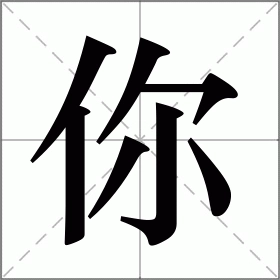
Simplified: 你
Pinyin: nǐ
Meaning: you (second person singular pronoun)
The Chinese character "你" (nǐ) is the standard and most common second-person singular pronoun in modern Mandarin Chinese. It is used to address a listener or reader in informal and neutral contexts. Understanding "你" is fundamental to basic communication, as it directly engages with others and reflects the nuances of social relationships in Chinese-speaking cultures.
Basic Meaning of "你"
The character "你" is composed of the radical 亻(人, rén), meaning "person," and 尔 (ěr), which in classical Chinese was used as a second-person pronoun (meaning "you"). Thus, the character literally combines "person" + "you" to solidify its meaning as the person being addressed. Its primary and almost exclusive function is as a pronoun, referring to the person one is speaking to.
Common Combinations with "你"
- 你们 (nǐ men, you all): The plural form of "you," used to address a group of people.
- 你的 (nǐ de, your): The singular possessive form.
- 你们的 (nǐ men de, your (plural)): The plural possessive form.
- 你好 (nǐ hǎo, hello): The most fundamental greeting in Chinese, literally meaning "you good."
- 你自己 (nǐ zì jǐ, yourself): The reflexive form.
- 迷你 (mí nǐ, mini): A phonetic loanword from English, using "你" for its sound "ni" to mean "mini" or "miniature."
These combinations show how 你 is the building block for addressing others, forming greetings, and indicating possession in everyday interaction.
Extended Meanings of "你"
Beyond its straightforward pronominal use, 你 functions in specific grammatical and contextual ways:
- Generic "You": Can be used in a general sense, similar to "one" in English (e.g., 这本书让你思考。 This book makes you think.)
- Rhetorical Address: Used in narratives or speeches to create a direct and engaging tone with the audience.
- Informal Address: Establishes a tone of familiarity and equality between the speaker and the listener.
Cultural and Symbolic Significance
In Chinese culture and communication, the use of "你" carries important social connotations:
- Indicator of Social Distance: The choice between "你" (nǐ) and the more formal "您" (nín) is crucial. "你" is used among peers, friends, family, and when addressing those of equal or lower social status, indicating informality and closeness.
- The Collective "You": The easy formation of "你们" (you all) reflects the language's capacity to shift seamlessly between individual and group address, which is important in a collectivist-oriented society.
- The Foundation of Politeness: While "你" itself is neutral, its use in the greeting "你好" is the cornerstone of polite, everyday interaction. The avoidance of using "你" too directly in commands (often using implied subjects or other structures) can also reflect a concern for harmony.
- Modern Neutrality: In contemporary society, especially among younger generations, "你" has become the default, neutral form of address in most situations outside of strictly formal or hierarchical contexts.
Example Sentences
- 你好! 我叫小红。
(Hello! My name is Xiaohong.) - 你的书在桌子上。
(Your book is on the table.) - 你们是从哪里来的?
(Where are you all from?) - 这件事你自己能做完吗?
(Can you finish this by yourself?)
Related Vocabulary
| 中文 | Pinyin | English |
|---|---|---|
| 你 | nǐ | you (singular, informal) |
| 您 | nín | you (singular, formal) |
| 你们 | nǐ men | you (plural) |
| 你的 | nǐ de | your (singular) |
| 你好 | nǐ hǎo | hello |
| 你自己 | nǐ zì jǐ | yourself |
| 迷你 | mí nǐ | mini |
FAQ: Common Questions About the Chinese Character "你"
Q1: When should I use "你" (nǐ) and when should I use "您" (nín)?
A: Use "您" (nín) to show respect to elders, superiors, teachers, customers, or in any formal situation, especially when first meeting someone. Use "你" (nǐ) with friends, classmates, family members, children, and peers. If in doubt in a casual setting, "你" is generally safe. Switching from "您" to "你" signifies a deepening of the relationship.
Q2: Is "你" used for both males and females?
A: Yes. "你" is completely gender-neutral and is used to address any single person, regardless of their gender.
Q3: How do I say "you" in the plural?
A: Simply add "们" (men) to form "你们" (nǐ men). This works for both informal and formal "you" (您们, nín men, is sometimes used but is less common; "各位" (gè wèi) is often preferred for formal address to a group).
Q4: How can learners remember "你"?
A: Break it down into its components: the person radical (亻) on the left, and 尔 (ěr) on the right. Remember that it's the standard, informal way to say "you" to one person. Practice it in the most essential phrase: "你好" (nǐ hǎo).