The Meaning and Cultural Significance of the Chinese Character “他” (He / Him / Other)
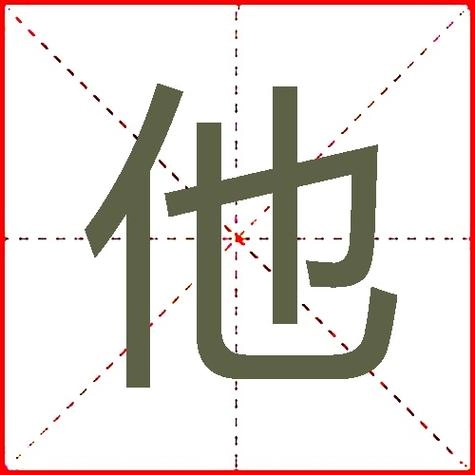
Simplified: 他
Pinyin: tā
Meaning: he / him / (in classical Chinese) other / another
The Chinese character "他" (tā) is the standard third-person singular pronoun in modern Mandarin, primarily used to refer to a male person not present in the conversation. It serves as a fundamental building block for narrative and description, allowing speakers to refer to individuals outside of the immediate dialog. Understanding "他" is essential for basic communication and also offers insight into the evolution and categorization of pronouns in Chinese.
Basic Meaning of "他"
The character "他" is composed of the radical 亻(人, rén), meaning "person," and 也 (yě), which primarily means "also." However, in "他," the component "也" is used phonetically to represent the sound "tā." Its core function is as a pronoun, referring to a male person (he/him). Historically, "他" had a broader meaning of "other" or "another," which is still reflected in the modern word "其他" (qí tā, other). The specialization of "他" as a masculine pronoun is a relatively modern development influenced by contact with Western languages.
Common Combinations with "他"
- 他们 (tā men, they / them): The plural form, used for a group of people that includes at least one male. It can also be used generically for a mixed-gender or gender-unknown group.
- 他的 (tā de, his): The masculine singular possessive form.
- 他们的 (tā men de, their): The plural possessive form (for a group including males).
- 其他 (qí tā, other / else): Literally "different other," this word preserves the classical meaning of "他" as "other."
- 他人 (tā rén, another person / others): Refers to other people.
- 他乡 (tā xiāng, a place far from home): Literally "other homeland," meaning a foreign or alien land.
- 利他 (lì tā, altruistic): Benefitting others, the opposite of "利己" (self-benefiting).
These combinations show how 他 is central to referring to others, both as specific individuals and in a general sense.
Extended Meanings of "他"
Beyond its core pronominal use, 他 functions in specific contexts:
- Generic Third Person: In some contexts, "他" can be used in a gender-neutral way, especially when the gender is unknown or irrelevant, though "它" or "TA" is increasingly common for this purpose.
- The "Other": Its classical meaning imbues it with a sense of that which is external, different, or not oneself.
- Deity or Supreme Being: In religious contexts, "他" (often capitalized as "祂" to denote divinity) can be used to refer to God or a deity.
Cultural and Symbolic Significance
In Chinese culture and language, the use and evolution of "他" reflect broader social and linguistic shifts:
- The Emergence of Gendered Pronouns: The creation of the feminine pronoun "她" in the early 20th century, also pronounced "tā," led to the specialization of "他" as exclusively masculine. This was part of a larger movement to modernize the Chinese language and align it with European linguistic norms.
- The Collective in Language: The fact that "他们" (they) can refer to a mixed-group group, with the masculine form taking precedence, reflects a traditional patriarchal bias in the language, though this is being challenged in modern usage.
- The Concept of the "Other": Words like "他人" and "他乡" highlight a cultural distinction between the self/in-group (己, 我) and the other/out-group (他). This echoes the Confucian focus on relationships and the distinction between those within one's social sphere and those outside it.
- Altruism vs. Self-Interest: The concept of "利他" (altruism) is a key virtue in both Confucian and Buddhist thought, positioning the well-being of "others" (他) as a moral ideal.
Example Sentences
- 他是我的老师。
(He is my teacher.) - 他的书很有趣。
(His book is very interesting.) - 他们明天去北京。
(They are going to Beijing tomorrow.) - 你还有其他问题吗?
(Do you have any other questions?) - 身在异国他乡,他非常想念家人。
(Being in a foreign land, he misses his family very much.)
Related Vocabulary
| 中文 | Pinyin | English |
|---|---|---|
| 他 | tā | he / him |
| 她 | tā | she / her |
| 它 | tā | it |
| 他们 | tā men | they / them (incl. male) |
| 他的 | tā de | his |
| 其他 | qí tā | other / else |
| 他人 | tā rén | another person / others |
| 利他 | lì tā | altruistic |
FAQ: Common Questions About the Chinese Character "他"
Q1: How do you distinguish between "他," "她," and "它" when they all sound the same?
A: In spoken Mandarin, they are indistinguishable. Context is everything. In written Chinese, the different radicals make the meaning clear: 亻(person) for "他" (he), 女 (woman) for "她" (she), and 宀 (roof/cover) for "它" (it, implying a non-human object or animal).
Q2: Can "他们" (tāmen) be used for a group of only females?
A: Traditionally, no. A group of only females should be referred to as "她们" (tā men). However, in practice, "他们" is sometimes used as a generic plural for a group when the gender composition is unknown or mixed. The use of "她们" is specific and emphasizes the female gender of the group.
Q3: What is the difference between "其他" and "别的"?
A: Both mean "other" or "else" and are often interchangeable. "其他" is slightly more formal and is often followed by a noun (e.g., 其他人). "别的" is more colloquial and can be used more freely (e.g., 别的都行 - Anything else is fine).
Q4: How can learners remember "他"?
A: Associate the person radical (亻) with the meaning. Since "他" is the default and most common third-person pronoun, you can remember it as the basic "he." Remember that "他的" means "his," and "他们" is the plural "they." Connect it to the word "其他" (other) to recall its classical meaning.