The Birth of the Nobel Prize: A Century-Spanning Legacy and Mandate
Before focusing on the brilliant achievements of the 2025 laureates, let us trace the origins of this globally preeminent honor. The Nobel Prize was born from the dramatic last will and testament of its founder, the Swedish chemist and inventor Alfred Bernhard Nobel.
A Final Wish
In 1895, Alfred Nobel signed his third and final will in Paris. He had amassed a vast fortune through his invention of dynamite and hundreds of other patents but was deeply troubled by the military use of his inventions. It is said that a mistakenly published obituary (calling him the "merchant of death") profoundly affected him, prompting him to consider the legacy he would leave behind. In his will, he made a startling decision: "The whole of my remaining realizable estate shall... constitute a fund, the interest on which shall be annually distributed in the form of prizes to those who, during the preceding year, shall have conferred the greatest benefit to humankind."

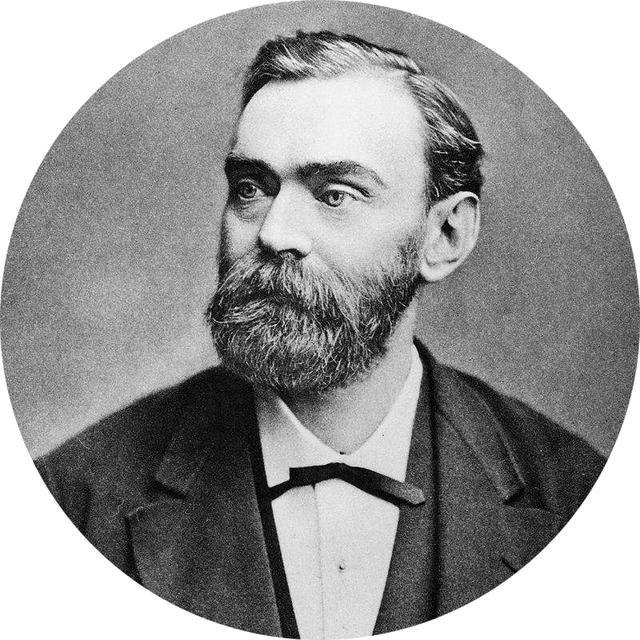
Alfred Nobel, founder of the Nobel Prize
The Establishment of Five Fields
Nobel explicitly specified five prize categories in his will:
Physics: To "the person who shall have made the most important discovery or invention within the field of physics."
Chemistry: To "the person who shall have made the most important chemical discovery or improvement."
Physiology or Medicine: To "the person who shall have made the most important discovery within the domain of physiology or medicine."
Literature: To "the person who shall have produced in the field of literature the most outstanding work in an ideal direction."
Peace: To "the person who shall have done the most or the best work for fraternity between nations, for the abolition or reduction of standing armies and for the holding and promotion of peace congresses."
It is worth noting that the Economics Prize was not established by Nobel's will. It was endowed by the Swedish Central Bank in 1968 on the occasion of its 300th anniversary. Its full title is "The Sveriges Riksbank Prize in Economic Sciences in Memory of Alfred Nobel," and it follows the same award criteria and processes as the original prizes.
Early Controversy and Realization
Nobel's will, made public after his death in 1896, sparked significant controversy and lengthy legal disputes. Thanks to the relentless efforts of his executor, Ragnar Sohlman, and with support from the Swedish royal family and scientific community, the Nobel Foundation was finally established in 1900, along with its statutes.
In 1901, the first Nobel Prizes were awarded ceremoniously in Stockholm and Oslo (Peace Prize), inaugurating this century-spanning honor.
4. A Lasting Legacy
Today, the Nobel Prize has spanned over 120 years. It is not only the highest honor bestowed upon its recipients but also a continuation of Alfred Nobel's personal idealism. It serves as an annual reminder to the world that human intellect, courage, and benevolence—manifested through relentless exploration and pursuit in science, literature, and peace—are the fundamental forces driving civilization forward.
The 2025 Nobel Prizes: All Laureates Announced
The 2025 Nobel Prizes were announced between October 6 and 13, with a total of 14 distinguished individuals from around the world receiving the six awards. This year's laureates have made groundbreaking contributions spanning quantum physics, immunology, materials chemistry, literature, the struggle for democracy, and economic growth theory, collectively showcasing humanity's exceptional efforts and enduring contributions to exploring the unknown, improving human welfare, and shaping civilization.
I. Nobel Prize in Physiology or Medicine

2025 Nobel Prize in Physiology or Medicine laureates
Laureates & Nationality:
Mary E. Brunkow: American molecular biologist (born 1961)
Fred Ramsdell: American immunologist (born December 4, 1960, in Elmhurst, Illinois, USA)
Shimon Sakaguchi: Japanese immunologist (born January 19, 1951, in Nagahama, Shiga, Japan)
Award Reason: The prize was awarded for their "pioneering discoveries in the field of peripheral immune tolerance." Their research systematically revealed the cellular mechanisms by which the immune system precisely distinguishes 'self' from 'non-self,' providing the cornerstone for understanding the root causes of autoimmune diseases. Specifically, the discovery of the FOXP3 gene mutation by Brunkow and Ramsdell in 2001 was central to understanding regulatory T cell function, while Sakaguchi was a pioneer in the field, laying the groundwork for the molecular mechanisms of immune tolerance.
Research Significance: Their work not only deepened fundamental understanding in immunology but also opened new avenues for clinical treatment. Therapies based on regulatory T cells offer revolutionary new approaches for treating autoimmune diseases, organ transplant rejection, and cancer immunotherapy.
II. Nobel Prize in Physics

2025 Nobel Prize in Physics laureates
Laureates & Nationality:
John Clarke: British physicist (born February 10, 1942, in Cambridge, UK)
Michel H. Devoret: French physicist (born 1953 in Paris, France)
John M. Martinis: American physicist (born 1958)
Award Reason: They were awarded the prize for "the discovery of macroscopic quantum mechanical tunnelling and energy quantisation in electrical circuits." Their seminal 1985 analysis of microwave pulses interacting with the quantized energy levels of Josephson junctions formed the foundation of superconducting quantum computing, providing the first verification of quantum mechanics principles on a macroscopic scale—a milestone for quantum technology.
Research Contributions: Professor Clarke made outstanding contributions to superconducting quantum interference devices (SQUIDs); Professor Devoret conducted pioneering work on macroscopic quantum tunneling and single-electron pumping; Professor Martinis was a key figure in advancing the experimental development of superconducting quantum computing.
III. Nobel Prize in Chemistry

2025 Nobel Prize in Chemistry laureates
Laureates & Nationality:
Susumu Kitagawa: Japanese chemist (born July 4, 1951, in Kyoto, Japan)
Richard Robson: Australian chemist (born June 4, 1937, in Glusburn, UK)
Omar M. Yaghi: American chemist (born February 9, 1965, in Amman, Jordan)
Award Reason: They were awarded for "the development of metal-organic frameworks" (MOFs). MOFs are a class of porous crystalline materials with tunable structures. Kitagawa first successfully synthesized them in 1990; Robson laid the theoretical foundation and synthesis methodology; Yaghi vastly expanded their scope of practical applications.
Research Impact: MOF materials, with their extremely high surface areas and customizable pore structures, show immense potential for applications in energy and environmental fields such as natural gas storage, carbon dioxide capture, efficient catalysis, and drug delivery.
IV. Nobel Prize in Literature

László Krasznahorkai, 2025 Nobel Prize in Literature laureate
Laureate & Nationality: László Krasznahorkai: Hungarian writer (born January 5, 1954, in Gyula, Hungary)
Award Reason: The award was given for his "captivating and visionary works that reaffirm the power of art amidst apocalyptic terror." The Swedish Academy specifically praised the unique philosophical quality inherent in his writing.
Representative Works: His masterpieces include Satantango, The Melancholy of Resistance, and War and War. His work is known for its long, contemplative sentences and a simultaneously bleak and comedic view of the world, profoundly exploring postmodern dystopia and human melancholy.
V. Nobel Peace Prize

María Corina Machado, 2025 Nobel Peace Prize laureate
Laureate & Nationality: María Corina Machado: Venezuelan politician and engineer (born October 7, 1967, in Caracas, Venezuela)
Award Reason: She was awarded the prize for "her tireless efforts to promote the democratic rights of the Venezuelan people and her struggle for a just and peaceful transition from dictatorship to democracy."
Major Contributions: As a key leader of the Venezuelan opposition, Machado has long been committed to democracy and human rights. She founded the election monitoring organization "Súmate" and served as a member of the National Assembly, consistently speaking out for transparency and liberal rights. Upon receiving the award, she dedicated the honor to the "suffering people of Venezuela."
VI. The Sveriges Riksbank Prize in Economic Sciences in Memory of Alfred Nobel
2025 Nobel Prize in Economic Sciences laureates
 Laureates & Nationality:
Joel Mokyr: American-Israeli economic historian (born July 26, 1946, in Leiden, Netherlands)
Philippe Aghion: French economist (born August 17, 1956, in Paris, France)
Peter Howitt: Canadian economist (born May 31, 1946, in Canada)
Award Reason: The prize recognized their "illumination of innovation-driven economic growth." The prize share allocation reflected their distinct contributions: Mokyr received one-half "for revealing the prerequisites for sustained growth through technological progress," while Aghion and Howitt shared the other half "for developing the theory of sustained growth through creative destruction."
Research Content: Mokyr argued from a historical perspective that a society's understanding of why technology works is a prerequisite for sustained innovation. Aghion and Howitt, through their model of "creative destruction," demonstrated how innovation drives growth by replacing the old with the new, simultaneously rendering previous modes obsolete.
Research Impact: Their research provides crucial insights for economic policymaking, emphasizing that maintaining the mechanism of "creative destruction" is vital to avoiding economic stagnation.
Laureates & Nationality:
Joel Mokyr: American-Israeli economic historian (born July 26, 1946, in Leiden, Netherlands)
Philippe Aghion: French economist (born August 17, 1956, in Paris, France)
Peter Howitt: Canadian economist (born May 31, 1946, in Canada)
Award Reason: The prize recognized their "illumination of innovation-driven economic growth." The prize share allocation reflected their distinct contributions: Mokyr received one-half "for revealing the prerequisites for sustained growth through technological progress," while Aghion and Howitt shared the other half "for developing the theory of sustained growth through creative destruction."
Research Content: Mokyr argued from a historical perspective that a society's understanding of why technology works is a prerequisite for sustained innovation. Aghion and Howitt, through their model of "creative destruction," demonstrated how innovation drives growth by replacing the old with the new, simultaneously rendering previous modes obsolete.
Research Impact: Their research provides crucial insights for economic policymaking, emphasizing that maintaining the mechanism of "creative destruction" is vital to avoiding economic stagnation.
Advancing Humanity
The 2025 Nobel Laureates, from revealing the microscopic mysteries of life to exploring the laws of the quantum world, from creating new materials to defending the human spirit and rights, from decoding the secrets of economic growth to portraying the spiritual dilemmas of our time, have collectively pushed the boundaries of human knowledge and civilization. These beams of intellectual light from different nations once again prove that cross-border collaboration and relentless exploration are the fundamental forces for addressing global challenges and guiding future development.