The History of Chinese Chairs: A Millennium of Power, Daily Life, and Aesthetics
From Sitting on the Ground to Sitting on Chairs — The Rising of a Civilization
The evolution of Chinese seating furniture, especially the Chinese chair (中国椅子), is not merely a change in form; it reflects the profound transformation of traditional Chinese lifestyles, spatial concepts, and social rituals. From the traditional Chinese chair to the Ming-style chair, the story of sitting mirrors the development of Chinese furniture design and Chinese sitting culture.
For thousands of years, Chinese homes revolved around the ground as the center of activity. People sat cross-legged or kneeling on mats or cushions, using low tables for dining, reading, painting, and social gatherings. This ancient sitting culture shaped a unique spatial aesthetic—rooms were open and flexible, functions adapted to the environment, and daily life moved in harmony with the earth, embodying the Chinese philosophy of unity between humans, nature, and space.
During this era, Chinese furniture was not an independent object but an extension of life itself. The height of tables, the thickness of cushions, and the arrangement of mats all reflected daily rituals, seasonal changes, and social hierarchy. Sitting on the ground encouraged closeness among family members and emphasized balance between the body and the surrounding space—a physical manifestation of the philosophical ideal of harmony between heaven and humanity, which later influenced the aesthetics of classical Chinese chair design.
With the gradual introduction and popularization of chairs, benches, and high-seated furniture, Chinese domestic life underwent a remarkable transformation. Elevated seating offered greater comfort while redefining human interaction with furniture and space. Homes evolved from open, multifunctional areas to more defined zones: studies, dining rooms, and reception halls began to appear. Movement within the home became more structured, and daily activities, along with ceremonial behaviors, grew increasingly stratified—a key moment in the evolution of Chinese furniture.
At the same time, social etiquette evolved. Seating arrangements shifted from casual to hierarchical, reflecting social order and rank. In family gatherings, banquets, official ceremonies, and ancestral rituals, seating symbolized identity and respect. To sit was no longer just to rest—it became a cultural act, a visual expression of social structure.
The transition from sitting on the ground to sitting on chairs marked more than a material or functional upgrade—it symbolized an awakening of lifestyle and consciousness. This transformation mirrors China’s gradual cultural, technological, and social evolution. The rise of the Chinese chair literally lifted people from the ground and figuratively heralded the emergence of modern Chinese furniture culture, spatial design, and ritual systems. This collective “rising of the body” is a microcosm of civilization’s progress and the artistry of Chinese craftsmanship.
The Hall of Power — The Seat of Authority
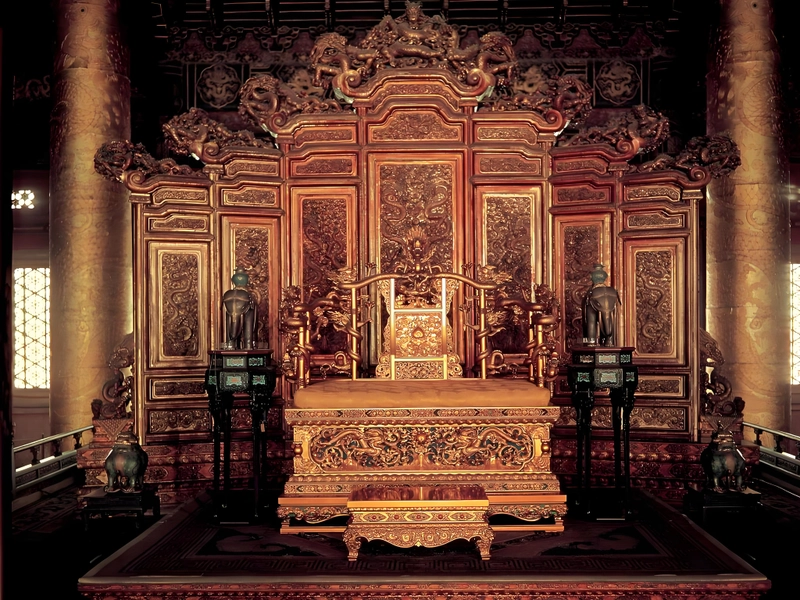
In ancient China, authority was expressed not only through laws, decrees, and armies but also through the height, materials, and ornamentation of Chinese chairs. Among all traditional Chinese chairs, the Dragon Throne stood as the ultimate symbol of supreme power and divine right. Majestic in form, carved from solid wood and inlaid with gold and precious stones, this piece of Chinese antique furniture embodied the very essence of Chinese craftsmanship. Its tall back, featuring intricate carvings of dragons, phoenixes, and auspicious clouds, represented not just comfort but the spiritual weight of sovereignty.
When the emperor sat upon the Dragon Throne, gazing down at his ministers, awe and reverence filled the hall. As ancient drama proclaimed: “Majesty over all under Heaven, seated upon the realm.” The imperial throne was more than a piece of traditional Chinese furniture—it was political symbolism materialized, a masterpiece of Chinese furniture design that declared imperial authority visible to all.
Beneath the emperor, high-ranking officials occupied Grand Master Chairs (Taishi yi)—seats that embodied dignity, order, and the refined aesthetics of Ming-style chair craftsmanship. Slightly higher than ordinary Chinese wooden chairs, with balanced proportions and precise carvings, they revealed both artistry and hierarchy. To sit, rise, or speak before the emperor followed strict ritual order—each gesture an act of personal cultivation and a public declaration of rank.
The contrast between the Dragon Throne and the Grand Master Chair revealed the carefully layered hierarchy of the imperial court. The Chinese chair here became an extension of authority—its height, material, and placement transforming furniture into a visible architecture of power. Every movement of sitting or standing illustrated the disciplined beauty of classical Chinese chair design, turning political order into aesthetic experience.
In the grand theater of governance, to sit higher was to rule the world; to follow seating etiquette was to preserve harmony under Heaven. The Chinese furniture culture of the court thus embodied the delicate balance between art, ritual, and sovereignty—a timeless testament to Chinese craftsmanship and the political philosophy of design.
The Scholarly Studio — The Chair of Elegance and Virtue
In the refined world of scholars, the study chair (书房椅) represented the intersection of ritual, comfort, and beauty—a cornerstone of Chinese furniture culture. The scholar’s study was both sanctuary and stage, where every piece of traditional Chinese furniture carried meaning. Here, the Chinese chair became the perfect union of ritual propriety, aesthetics, and bodily experience.
The Round-Back Chair (Quanyi), renowned in Ming dynasty furniture, embodied the ancient Chinese philosophy of “Heaven is round, Earth is square.” Its flowing circular arms and balanced form offered both elegance and comfort, symbolizing harmony between heaven, humanity, and design. This iconic Ming-style chair illustrates the refined proportion and structure characteristic of Chinese furniture craftsmanship.
The Official’s Hat Chair (Guanmao yi) symbolized dignity, virtue, and restraint. With its tall back and outward-curving arms shaped like an official’s hat, it encouraged upright posture and inner discipline—qualities deeply rooted in classical Chinese chair design and Confucian ethics.
The Rose Chair (Meigui yi), delicate yet strong, represented the pinnacle of Chinese craftsmanship and taste. Crafted from fine hardwoods such as huanghuali or zitan, it showcased the precision of Chinese wooden chair artistry. Scholars read, painted, or drank tea upon it, enjoying both beauty and balance—an aesthetic dialogue between comfort and cultivation.
Within this refined Chinese furniture art, every act of sitting or rising became an expression of moral discipline and aesthetic sensibility. The scholar’s bearing revealed his inner harmony, reflecting the essence of Chinese cultural aesthetics. As the saying goes: “One’s bearing reveals one’s integrity.” In this serene setting, the traditional Chinese chair was not merely a seat, but a mirror of one’s spirit—where ritual, beauty, and virtue converged.
The Common World — The Chair of Everyday Life
Beyond the court and the study lay the bustling world of markets, inns, and teahouses, where chairs spoke the language of daily life. Here, they embodied warmth, practicality, and shared experience.
The Folding Chair (jiàoyǐ), also known as the “official’s folding chair,” gained popularity during the Song and Yuan dynasties. Lightweight and portable, it symbolized mobile authority—used by officials in temporary settings, yet also found in homes, shops, and among travelers. Its flexibility mirrored the fluidity of status and movement across both official and civilian spheres.
The Lamp-Hanger Chair (dēngguà yǐ), simple and sturdy, was the quintessential seat of teahouses, inns, and common homes. In Ming and Qing times, people gathered on these chairs to drink tea, listen to storytellers, debate, or enjoy performances. It captured the pulse of daily life—an unassuming vessel of social interaction and cultural continuity.
The Spring Bench (chūndèng), plain and humble, was the most common seating in ordinary households. Whether in kitchens, marketplaces, or courtyards, it offered a place for rest, conversation, and community. As vividly depicted in Dream of the Red Chamber, the spring bench witnessed countless moments of domestic life and human warmth—a symbol of everyday resilience and connection.
Together, these chairs mark a movement from power to the people: from the formal to the familiar, from ritual to life. The folding chair carried authority, the lamp-hanger chair held social warmth, and the spring bench embodied the pulse of common life. As the proverb says, “In the marketplace’s smoke and fire, one can find peace anywhere.” Each chair tells a story of coexistence between hierarchy and humanity—of Chinese furniture’s evolution from solemnity to simplicity.
Discipline and Punishment — The Chair of Restraint
In traditional China, the chair also served darker, disciplinary functions. Beyond comfort and ritual, it became an instrument of moral education and authority—employed in official interrogations, family discipline, and community punishment.
Benches and Punitive Sitting
During the Ming and Qing dynasties, offenders were sometimes forced to sit for long hours on hard benches as punishment. The discomfort fostered repentance and reinforced obedience. Such “punitive sitting” embodied the physical enforcement of moral and hierarchical order, teaching submission through bodily endurance.
The Stirrup Chair and the Tiger Bench
In interrogations, specialized chairs restrained movement and imposed psychological pressure. The stirrup chair immobilized the body, while the infamous tiger bench inflicted pain by forcing the legs into rigid postures. These devices symbolized not only punishment but also the intertwining of discipline and moral correction within the justice system.
Cultural Meaning
Such punitive seats formed the mirror image of the throne: where elevated chairs symbolized honor, low benches represented humility and correction. Through the act of “sitting,” individuals internalized the social order—experiencing authority both physically and emotionally.
The Balance of Body and Mind — The Chair of Contemplation
Leaving behind the world of punishment and politics, we enter the realm of introspection. Here, the Chinese chair becomes a bridge between body, spirit, and philosophy—a medium for harmony within.
The Zen Chair (chányǐ)
Inspired by Buddhist and Daoist practice, it is designed for meditation and self-cultivation. Its modest height and simple form encourage upright posture and mindful breathing, guiding one toward tranquility. This type of traditional Chinese chair embodies a philosophy of living—reminding people to maintain inner order amid external chaos. Scholars and monks alike used it as a companion for contemplation, peace, and spiritual cultivation.
The Reclining Chair (tángyǐ)
In contrast, it celebrates physical relaxation. Soft and spacious, it allows the body to release tension and rediscover balance. Whether used for an afternoon nap or leisure reading, it exemplifies the art of bodily ease. In modern times, it has become a staple of Chinese home furniture, continuing the traditional wisdom of “nourishing body and mind through rest.”
Though seemingly opposite, the Zen chair and the recliner complement each other: one nurtures the soul through stillness, the other the body through rest. As the saying goes, “Sit to calm the mind, recline to nourish the body.” Both reflect the pursuit of holistic harmony—turning Chinese chairs into an art of living and a testament to Chinese furniture craftsmanship.
A Dialogue of Civilizations — The Chair as Cultural Metaphor
As the curtain falls, the Chinese chair is revealed not merely as furniture but as a vessel of civilization—a dialogue between form, philosophy, and social structure.
In Chinese tradition, the chair serves as a microcosm of hierarchical society. Each type has its distinct social identity: the Dragon Throne symbolizes imperial authority; the Grand Master Chair (taishi yi) represents bureaucratic prestige; the scholar’s chair reflects refinement and virtue; the Spring Bench (chūndèng) conveys the warmth of everyday life. Sitting is an act of meaning—an expression of identity, decorum, and cultivation. Every movement embodies order, respect, and the rich heritage of Chinese furniture culture.
In contrast, the sofa of the West emphasizes equality, comfort, and leisure. Its wide, soft form allows freedom of posture and highlights personal space. It reflects a culture valuing individual comfort and social equality—a different yet equally profound philosophy of life.
The contrast between the Chinese chair and the Western sofa is a poetic dialogue between civilizations: one rooted in hierarchy and ritual, the other in freedom and ease. Yet both remind us that the way we sit reveals who we are.
From sitting on the ground to sitting on Chinese chairs, from strict decorum to relaxed comfort, every act of sitting whispers the wisdom of life, the rhythm of civilization, and the philosophy of being human—capturing the essence of traditional Chinese furniture design and the evolution of Chinese sitting culture.
Related Vocabulary — Chinese Chairs
| Chinese | Pinyin | English |
|---|---|---|
| 椅子 | yǐ zi | chair |
| 中国椅子 | zhōng guó yǐ zi | Chinese chair |
| 明式椅 | míng shì yǐ | Ming-style chair |
| 书房椅 | shū fáng yǐ | study chair / scholar’s chair |
| 圆背椅 | quán bèi yǐ | round-back chair |
| 官帽椅 | guān mào yǐ | official’s hat chair |
| 玫瑰椅 | méi guī yǐ | rose chair |
| 折叠椅 | jiǎo yǐ | folding chair |
| 灯挂椅 | dēng guà yǐ | lamp-hanger chair |
| 春凳 | chūn dèng | spring bench |
| 龙椅 | lóng yǐ | Dragon Throne |
| 太师椅 | tài shī yǐ | Grand Master Chair |
| 坐姿 | zuò zī | sitting posture |
| 盘腿坐 | pán tuǐ zuò | cross-legged sitting |
| 跪坐 | guì zuò | kneeling sitting |
| 禅椅 | chán yǐ | Zen chair |
| 躺椅 | tǎng yǐ | reclining chair |
FAQ: Chinese Chairs
- Q1: What is the history of Chinese chairs?
- Chinese chairs (中国椅子) evolved from sitting on the ground to elevated furniture, reflecting changes in lifestyle, spatial design, and social rituals. From mats and low tables to Ming-style chairs, every innovation mirrors the rise of Chinese civilization and furniture craftsmanship.
- Q2: How did chairs change social life in ancient China?
- The introduction of chairs redefined interaction, etiquette, and hierarchy. Elevated seating marked authority and respect, while homes evolved from open multifunctional spaces to structured zones like studies, dining rooms, and reception halls.
- Q3: What are the most famous traditional Chinese chairs?
- Notable examples include the Dragon Throne (symbol of imperial power), Grand Master Chair (bureaucratic prestige), Round-Back Chair (Quanyi), Official’s Hat Chair (Guanmao yi), and the Rose Chair (Meigui yi), each representing cultural, moral, and aesthetic values.
- Q4: Can I experience traditional Chinese chairs today?
- Yes! Antique shops, museums, classical gardens, and cultural exhibitions in cities like Beijing, Suzhou, and Hangzhou showcase authentic Chinese chairs. Some hotels, teahouses, and heritage homes also allow visitors to sit on replicas of Ming or Qing-style furniture.
- Q5: Were Chinese chairs only for the elite?
- No. While imperial and scholar chairs symbolized power and refinement, everyday chairs like the Spring Bench (chūndèng) and Lamp-Hanger Chair (dēngguà yǐ) served households, markets, and teahouses, providing comfort and fostering community.
- Q6: Did Chinese chairs have other functions besides sitting?
- Yes. Some chairs served disciplinary purposes, like the stirrup chair or tiger bench for moral correction, while others, like Zen chairs (chányǐ) and recliners (tángyǐ), promoted meditation, contemplation, and relaxation, balancing body and mind.
- Q7: How do Chinese chairs reflect philosophy and culture?
- Each chair embodies Confucian ethics, ritual propriety, and aesthetic sensibility. From hierarchy to meditation, Chinese furniture design conveys identity, virtue, and the philosophy of harmony between humans, nature, and space.
- Q8: What’s the difference between Chinese chairs and Western sofas?
- Chinese chairs emphasize hierarchy, ritual, and posture, reflecting social order and cultural refinement. Western sofas focus on comfort, equality, and leisure. Together, they illustrate a dialogue of civilizations through the art of sitting.