Do You Know How To Say All Times Of The Day In Chinese
Table of Contents [hide]
- The Basics: Hours, Minutes, and Seconds in Mandarin
- Reading the Clock: How to Tell Time in Chinese Step-by-Step
- Parts of the Day in Chinese: Morning, Afternoon, Evening, and Night
- Chinese Time Vocabulary: Essential Words for Daily Use
- Idiomatic and Natural Chinese Daily Time Phrases
- Common Mistakes Beginners Make with Chinese Time Expressions
- Practice Drills: Reinforce Your Chinese Time Skills
- From Classroom to Real Life: Using Chinese Time Expressions Authentically
- Quick Reference Table: Chinese Time Expressions and Equivalents
- FAQ
The Basics: Hours, Minutes, and Seconds in Mandarin
Telling time in Chinese is refreshingly logical once you grasp its core building blocks: shí (hour), fēn (minute), and miǎo (second). Unlike English’s varied phrasing (“quarter past,” “half after”), Mandarin follows a consistent, additive structure—making it one of the most accessible aspects for beginners learning Chinese time expressions. To say any time, you simply state the hour, add shí, then the minutes with fēn, and optionally the seconds with miǎo. For example, 3:27:05 is sān diǎn èrshíqī fēn wǔ miǎo—literally “three o’clock twenty-seven minutes five seconds.” Note that diǎn (o’clock) replaces shí when specifying exact hours (e.g., 8:00 is bā diǎn, not bā shí), but shí reappears in compound phrases like “8 hours and 15 minutes” (bā shí yīgè xiǎoshí yīshíwǔ fēn)—a distinction vital for mastering Chinese daily time phrases. The numerals 1–12 are used for hours, while minutes and seconds run 0–59 using standard Chinese numbers (e.g., 0 is líng, so 9:05 is jiǔ diǎn líng wǔ fēn). Crucially, Mandarin doesn’t use AM/PM. Instead, parts of the day in Chinese are marked by time adverbs: zǎoshang (morning), xiàwǔ (afternoon), wǎnshang (evening), and yèlǐ (night)—so 7:15 becomes qī diǎn yīshíwǔ fēn wǎnshang to clarify it’s in the evening. This contextual layer helps avoid ambiguity and deepens your grasp of how to say times of the day in Chinese naturally. As you practice, pay attention to tone changes—especially in common combinations like yī fēn (first minute) where yī shifts from first tone to fourth before fēn. Mastering these beginner Chinese time words unlocks real-world utility: reading train schedules, scheduling video calls, or asking “What time is it?” (Jǐ diǎn le?). With just ten minutes of daily drill using flashcards or voice repetition, you’ll internalize Chinese time vocabulary faster than expected. Remember: consistency beats complexity. Start with whole hours (bā diǎn, shí diǎn), add fēn next (bā diǎn sānshí fēn), then layer in miǎo and time-of-day markers. Before long, you’ll be confidently using Chinese time expressions in conversation—and understanding native speakers’ natural speech. Learn more: Flexible Chinese Classes | Flexi Classes - Group Chinese Classes in Beihai.
Reading the Clock: How to Tell Time in Chinese Step-by-Step
Telling time in Chinese follows a clear, logical structure—once you grasp the pattern, you’ll be able to convert any digital or analog time into natural-sounding Chinese time expressions with confidence. First, master the core Chinese time vocabulary: numbers 1–59 (e.g., yī, èr, sān…), the word diǎn (‘o’clock’, pronounced with a third tone), and fēn (‘minute’, first tone). Unlike English, Chinese doesn’t use ‘a.m.’ or ‘p.m.’—instead, it relies on context and explicit parts of the day in Chinese: zǎoshang (morning, ~5 a.m.–12 p.m.), xiàwǔ (afternoon, ~12–6 p.m.), wǎnshàng (evening/night, ~6 p.m.–midnight), and língchén (early morning, ~midnight–5 a.m.). These are essential for clarity, especially when saying times like ‘7:15 a.m.’ (zǎoshang qī diǎn shíwǔ fēn) versus ‘7:15 p.m.’ (wǎnshàng qī diǎn shíwǔ fēn). To learn Chinese time expressions step-by-step: start with the hour (e.g., sān diǎn = ‘3 o’clock’), then add minutes after fēn—no ‘and’ or ‘past/to’ constructions. For example, 3:45 is sān diǎn sìshíwǔ fēn—not ‘quarter to four’. Half-past times use bàn (‘half’) directly after diǎn: 8:30 = bā diǎn bàn. Quarter past and quarter to are expressed literally: 9:15 = jiǔ diǎn shíwǔ fēn; 9:45 = jiǔ diǎn sìshíwǔ fēn (not ‘quarter to ten’). Note that ‘o’clock’ is only used for exact hours—skip diǎn if stating just the hour in casual speech (e.g., ‘It’s 10’ → shí diǎn, not *shí). Also, avoid English-style phrasing like ‘three forty-five’—Chinese always says ‘three o’clock forty-five minutes’. When practicing how to tell time in Chinese, begin with whole hours, then add minutes incrementally. Use Chinese daily time phrases in context: ‘I wake up at 6:20 a.m.’ → wǒ měi tiān zǎoshang liù diǎn èrshí fēn qǐchuáng. This reinforces beginner Chinese time words while building fluency. Remember: tone accuracy matters—sān (third tone) ≠ sān (first tone), and fēn (first tone) ≠ fèn (fourth tone, meaning ‘portion’). Finally, internalize the rhythm: [Hour] + diǎn + [Minutes] + fēn (if minutes ≠ 0), optionally prefixed by zǎoshang/xiàwǔ/wǎnshàng/língchén. With consistent practice, you’ll move beyond memorizing isolated terms and start thinking in real-time Chinese time expressions.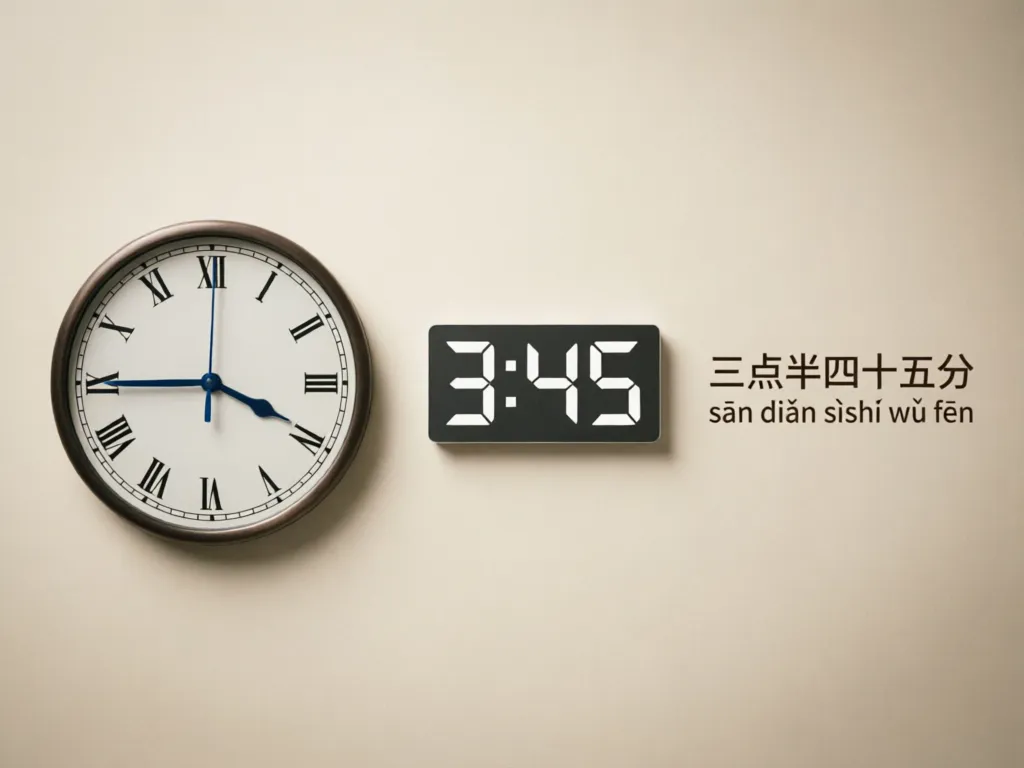 Learn more: Online Chinese Classes | Learn Mandarin Online with RPL School.
Parts of the Day in Chinese: Morning, Afternoon, Evening, and Night
Mastering how to say times of the day in Chinese starts with understanding the four core parts of the day in Chinese: zǎoshang (morning), xiàwǔ (afternoon), wǎnshàng (evening), and yèwǎn (night). These aren’t just standalone nouns—they’re essential modifiers that shape how you build accurate, natural-sounding Chinese time expressions. Unlike English, where ‘morning’ can float loosely (“I’ll call you morning”), in Mandarin these terms attach directly to numbers or clock times to create precise daily time phrases. For example, 7:30 isn’t just qī diǎn bàn—it becomes qī diǎn bàn zǎoshang (7:30 a.m.) to distinguish it from qī diǎn bàn xiàwǔ (7:30 p.m.). This distinction is critical because Chinese doesn’t use a.m./p.m.; context comes entirely from the time-of-day marker. Zǎoshang covers roughly 5:00 a.m. to 11:59 a.m., though native speakers often reserve it for early hours—think breakfast, commuting, or morning routines. Xiàwǔ begins at noon (12:00) and extends until about 5:59 p.m., aligning with work hours and lunch-to-dinner transition. Wǎnshàng picks up from around 6:00 p.m. through bedtime—dinner, study, family time—and is the most commonly used term for scheduled evening activities (e.g., wǎnshàng bā diǎn kàn diànshì — “watch TV at 8 p.m.”). Yèwǎn refers specifically to late night, typically after 10:00 p.m., evoking quiet, rest, or nocturnal activity (e.g., yèwǎn shí èr diǎn shuìjiào — “go to sleep at midnight”). Note: While wǎnshàng and yèwǎn both translate to ‘evening’ or ‘night’, their usage differs—wǎnshàng is neutral and broad; yèwǎn feels more literary or formal and implies darkness or lateness. When learning Chinese time vocabulary, remember these markers always follow the time—not precede it. So it’s *three o’clock afternoon*, not *afternoon three o’clock*. Also, avoid stacking them: “xiàwǔ wǎnshàng” is incorrect. Each time slot has its own designated term. Beginners often overuse wǎnshàng, but precision matters: saying “wǎnshàng liǎng diǎn” (2 p.m.) sounds jarring—it should be “xiàwǔ liǎng diǎn”. To learn Chinese time expressions effectively, practice pairing each part of the day in Chinese with real-life scenarios: your wake-up time, lunch break, favorite show, or bedtime routine. Flashcards with audio help cement pronunciation—zǎoshang (zow-shung), xiàwǔ (shyah-woo), wǎnshàng (wun-shung), yèwǎn (yeh-wan). And don’t forget regional nuance: in some southern dialects or informal speech, people may say shàngwǔ instead of zǎoshang—but standard Mandarin uses zǎoshang. With consistent exposure, these beginner Chinese time words become intuitive building blocks for telling time in Chinese accurately and confidently.
Chinese Time Vocabulary: Essential Words for Daily Use
Mastering how to say times of the day in Chinese starts with building a strong foundation in Chinese time vocabulary. Unlike English, Mandarin doesn’t use ‘a.m.’ or ‘p.m.’—instead, it divides the 24-hour day into distinct parts of the day in Chinese, each marked by specific time markers and modifiers. To learn Chinese time expressions effectively, begin with the core structure: [hour] + 点 (diǎn, ‘o’clock’) + [minute]. For example, 3:00 is 三点 (sān diǎn), and 7:15 is 七点十五分 (qī diǎn shíwǔ fēn). But fluency goes beyond numbers—knowing common shortcuts and natural phrasing makes your speech sound native. Half-past is expressed as 半 (bàn, ‘half’), placed right after 点: 两点半 (liǎng diǎn bàn) = 2:30. Quarter-to uses 差 (chà, ‘short of’) + [minutes] + 分 + 到 (dào): 两点四十五分 sounds formal, but natives often say 差一刻三点 (chà yí kè sān diǎn)—literally ‘a quarter short of three o’clock’. Similarly, quarter-past is 一刻 (yí kè), so 9:15 becomes 九点一刻 (jiǔ diǎn yí kè). These Chinese daily time phrases are essential for real-life interactions—from scheduling meetings to catching trains. Don’t forget key modifiers: 早上 (zǎoshang, ‘morning’, roughly 5–11 a.m.), 下午 (xiàwǔ, ‘afternoon’, 1–5 p.m.), and 晚上 (wǎnshang, ‘evening/night’, 6 p.m.–midnight). Note that 中午 (zhōngwǔ) means ‘noon’ (12 p.m. exactly), while 凌晨 (língchén) covers 12–6 a.m. These parts of the day in Chinese replace English’s a.m./p.m. system entirely—so saying 下午三点 (xiàwǔ sān diǎn) unambiguously means ‘3 p.m.’, not ‘3 o’clock in the afternoon’ as a translation might suggest. Also, remember that Chinese time expressions rarely use ‘:’ or ‘.’—time is always spoken in full words. Beginner Chinese time words like 现在 (xiànzài, ‘now’), 一会儿 (yíhuìr, ‘in a moment’), and 马上 (mǎshàng, ‘right away’) add practical context to conversations about timing. When you’re ready to practice, try converting your daily routine: ‘I wake up at 6:45 a.m.’ → 我早上六点四十五分起床 (Wǒ zǎoshang liù diǎn sìshíwǔ fēn qǐchuáng). Consistent exposure to authentic usage—like listening to weather reports or train announcements—reinforces how to tell time in Chinese naturally. And because time language is highly patterned, mastering just 12 core terms unlocks over 90% of everyday needs. With this focused set of beginner-friendly terms, you’ll move beyond memorizing isolated words and start forming accurate, confident Chinese time expressions. Whether you’re planning your day, booking tickets, or chatting with friends, these fundamentals empower you to navigate time in Chinese—not as a puzzle, but as a living, intuitive part of communication. Keep practicing aloud, emphasize tone accuracy (especially on diǎn, bàn, and kè), and soon, asking ‘What time is it?’ (现在几点?—Xiànzài jǐ diǎn?) will feel as effortless as checking your watch.
Idiomatic and Natural Chinese Daily Time Phrases
Beyond the textbook basics of how to tell time in Chinese—like ‘xiàn zài shì liǎng diǎn’ (It’s 2 p.m.) or ‘qī diǎn sān shí fēn’ (7:30 a.m.)—real fluency lies in mastering Chinese daily time phrases that native speakers actually use. These idiomatic, context-rich expressions reflect how time is culturally experienced—not just measured. For instance, instead of saying ‘wǔ diǎn sìshí fēn’, a Beijing office worker might say ‘chū mén de shíhòu’ (the time you leave home) when rushing out at 8:15 a.m., or ‘xiàbān shíjiān’ (work end time) to refer to 6 p.m. without naming the hour at all. That’s the nuance of authentic Chinese time vocabulary: it’s relational, routine-based, and deeply tied to daily life rhythms.Consider ‘chī wǎnfàn de shíhòu’ (dinnertime)—a phrase far more natural than ‘shíjiān shì bā diǎn’ (It’s 8 o’clock) when inviting friends over. Or ‘shàngkè yǐqián’ (before class starts), used by students to mean “right before 9 a.m.” without ever uttering a number. Even ‘yèlǐ’ (at night) isn’t just ‘after dark’—it carries connotations of quiet family time, late work, or neighborhood strolls, depending on tone and context. These parts of the day in Chinese aren’t fixed clock slots; they’re cultural markers shaped by shared habits: ‘zǎoshàng hǎo’ (good morning) peaks between 6–9 a.m., but ‘zǎoshàng’ itself can stretch from sunrise until lunch for many rural speakers.
Beginner Chinese time words often overlook this layer—but it’s essential for sounding natural. Try swapping ‘wǒ měi tiān qī diǎn qǐchuáng’ (I wake up at 7 every day) with ‘wǒ měi tiān zài chī zǎofàn yǐqián qǐchuáng’ (I wake up before breakfast)—instantly more conversational and grounded in lived experience. Similarly, ‘shàngbān shíjiān’ (work start time) signals professionalism and punctuality in emails, while ‘fàngxué shíjiān’ (school dismissal time) is the universal cue parents use to coordinate pickups. These phrases are your linguistic shortcuts—they compress meaning, convey expectation, and build rapport.
To learn Chinese time expressions effectively, anchor them to routines: pair ‘shàngwǔ’ (morning) with ‘kāihuì’ (meeting), ‘xiàwǔ’ (afternoon) with ‘hē kāfēi’ (drink coffee), and ‘wǎnshàng’ (evening) with ‘kàn diànshì’ (watch TV). Notice how ‘zhōngwǔ’ (noon) almost always appears with ‘chī wǔfàn’ (eat lunch), never in isolation. This is how native speakers internalize time—not as digits, but as actions and transitions. Mastering these patterns helps you move beyond mechanical how to say times of the day in Chinese into intuitive, culturally resonant communication.

Common Mistakes Beginners Make with Chinese Time Expressions
Beginners tackling how to say times of the day in Chinese often stumble on three core pitfalls—each undermining clarity and sounding unnatural to native speakers. First, misplacing time particles is extremely common. Learners frequently say *‘wǔ diǎn zài shàngwǔ’* (literally “five o’clock at morning”) instead of the correct *‘shàngwǔ wǔ diǎn’*. In Chinese time expressions, parts of the day in Chinese—like shàngwǔ (morning), xiàwǔ (afternoon), wǎnshàng (evening), and língchén (early morning)—must precede the hour, never follow it. This isn’t optional syntax; it’s grammatical necessity. Saying *‘bā diǎn wǎnshàng’* sounds like ‘eight o’clock evening’, violating the fixed structure: [part of day] + [hour] + [minute, if any]. Second, confusion between 12-hour and 24-hour usage leads to serious misunderstandings. Unlike English, Mandarin doesn’t use AM/PM markers—but it *does* rely on contextually precise parts of the day in Chinese. For example, ‘7:00’ could mean *qī diǎn*—but without specifying *shàngwǔ* or *xiàwǔ*, it’s ambiguous. Crucially, *língchén qī diǎn* means 7 a.m., while *qī diǎn* alone defaults to 7 p.m. in many spoken contexts—especially after noon. Never assume ‘qī diǎn’ = 7 a.m.; always anchor it with the appropriate time-of-day term. Third, tone-related pronunciation errors sabotage comprehension instantly. The word for ‘hour’, *diǎn*, carries the third tone (falling-rising), yet beginners often flatten it to a neutral or first tone—making it sound like *diān* (a different word entirely). Similarly, *wǔ* (five) must be pronounced with the third tone, not as *wū* (first tone) or *wù* (fourth tone); mispronouncing *wǔ diǎn* as *wù diǎn* can unintentionally evoke *‘wù diǎn’* (‘mistake point’), causing confusion or amusement. These aren’t minor slips—they’re barriers to being understood. To learn Chinese time expressions effectively, drill minimal pairs aloud: *shàngwǔ wǔ diǎn* vs. *xiàwǔ wǔ diǎn*, recording yourself and comparing to native audio. Use flashcards that pair Chinese daily time phrases with visual anchors—e.g., a sunrise icon next to *língchén liǎng diǎn*, a moon beside *wǎnshàng jiǔ diǎn*. And remember: Chinese time vocabulary isn’t just about numbers—it’s about spatial-temporal framing. When you say *‘shàngwǔ’*, you’re not adding an afterthought—you’re defining the semantic container for the time. Mastering this shifts your output from textbook-accurate to conversation-ready. Consistent practice with real-life scenarios—ordering coffee at *shàngwǔ shí diǎn*, scheduling a call at *wǎnshàng bā diǎn sānshí fēn*—reinforces both grammar and tone. With focused attention on particle order, contextual time markers, and tonal precision, how to tell time in Chinese becomes intuitive, not intimidating.Practice Drills: Reinforce Your Chinese Time Skills
Ready to lock in your ability to express time in Chinese? These self-guided practice drills target real-world fluency—no teacher required. First, the Listening Warm-Up: Play audio clips (or use free apps like HelloChinese or TTS tools with Mandarin voices) saying times like ‘bā diǎn sān shí fēn’ (8:30), ‘shí èr diǎn wǔ fēn’ (12:05), and ‘liǎng diǎn yī kè’ (2:15). After each, pause and write down the time in Arabic numerals—then check. This builds instant recognition of Chinese time vocabulary and trains your ear for tone shifts (e.g., ‘yī’ becomes ‘yí’ before fourth-tone syllables like ‘kè’). Next, Fill-in-the-Blank Sentences: Complete these using correct Chinese time expressions. Example: ‘Wǒ měi tiān qī diǎn _____ qǐchuáng.’ (Answer: ‘bàn’ → 7:30). Try five more: (1) ‘Tāmen de huìyì cóng _____ kāishǐ.’ (9:45); (2) ‘Wǒ yào zài _____ dào gōngsī.’ (10:20); (3) ‘Diàn yǐng shì _____ kāishǐ de.’ (6:50); (4) ‘Wǒmen chī wǎnfàn zài _____ zuǒyòu.’ (7:15); (5) ‘Gōnggòng qìchē měi _____ lái yí cì.’ (15 minutes past the hour). Answers reinforce beginner Chinese time words like ‘kè’ (15 min), ‘bàn’ (30 min), and ‘yī kè zhōng’ (15 minutes). Third, Speaking Challenges: Set a timer for 60 seconds and speak aloud *without pausing*: name three parts of the day in Chinese (zǎoshang, xiàwǔ, wǎnshang), then list four Chinese daily time phrases (e.g., ‘qī diǎn bàn shàngbān’, ‘shí èr diǎn wǔ fēn chī wǔfàn’). Record yourself and compare to native pronunciation—focus on tone accuracy, especially for ‘shí’ (second tone) vs. ‘sì’ (fourth tone). Finally, contextualize it: Write one short paragraph (5–6 sentences) describing *your* typical day using at least six different how to tell time in Chinese constructions—including AM/PM distinctions (e.g., ‘shàngwǔ bā diǎn’ vs. ‘xiàwǔ sān diǎn’). Read it aloud twice—first slowly, then at natural speed. Consistency beats intensity: do just 10 minutes daily. Within two weeks, you’ll notice faster recall of Chinese time expressions and greater confidence in real conversations. Remember—learning Chinese time expressions isn’t about memorizing isolated terms; it’s about internalizing patterns: hour + ‘diǎn’ + optional minute + optional part-of-day marker. Mastering how to say times of the day in Chinese opens doors to scheduling, travel, and deeper cultural connection. Keep your notes handy, revisit tricky forms (like ‘yī kè’ vs. ‘sān shí fēn’), and celebrate small wins—each correctly spoken time in Chinese is proof you’re building lasting fluency in time in Chinese.From Classroom to Real Life: Using Chinese Time Expressions Authentically
Mastering how to say times of the day in Chinese isn’t just about memorizing numbers and ‘diǎn’—it’s about using Chinese time vocabulary fluently in real, high-stakes moments. When your train departs at 14:35, you’ll need to read ‘xià wǔ èr diǎn sān shí wǔ fēn’ on the platform screen—not just recognize it in a textbook. Likewise, if a colleague texts ‘wǒmen qī diǎn jiàn ba!’ (‘Let’s meet at 7 p.m.!’), you must instantly grasp that ‘qī diǎn’ here means evening, not morning—context and parts of the day in Chinese matter deeply. That’s why learning Chinese time expressions goes beyond drills: it’s about decoding rhythm, tone, and cultural logic. For example, while English speakers say ‘7 a.m.’ or ‘7 p.m.’, Mandarin relies on time-of-day markers like ‘shàng wǔ’ (morning), ‘xià wǔ’ (afternoon), ‘wǎn shàng’ (evening), and ‘líng chén’ (early morning). So ‘qī diǎn’ alone is ambiguous—but ‘shàng wǔ qī diǎn’ (7 a.m.) or ‘wǎn shàng qī diǎn’ (7 p.m.) removes all doubt. In scheduling appointments, native speakers often omit ‘shàng wǔ’/‘xià wǔ’ when context is clear—but beginners should include them until they develop intuition. Try this: When booking a WeChat video call, reply with ‘hǎo de, míng tiān xià wǔ sān diǎn kě yǐ ma?’ (‘OK, is tomorrow at 3 p.m. okay?’). Notice how ‘xià wǔ’ anchors the time—and how the polite ‘kě yǐ ma?’ softens the request. For transport, listen for phrases like ‘chē kāi zài wǔ diǎn líng yī fēn’ (‘The bus leaves at 5:01’) or ‘huǒ chē hái yǒu shí fēn zhōng dào’ (‘The train arrives in 10 minutes’)—here, ‘hái yǒu’ + time + ‘dào’ signals urgency. And when making weekend plans, natives rarely say ‘zài xīng qī liù shàng wǔ’; instead, they’ll say ‘liǎng tiān hòu shàng wǔ’ (‘Saturday morning’) or simply ‘zhōu liù shàng wǔ’, trusting shared context. To internalize these Chinese daily time phrases, practice aloud with real-world triggers: set your phone clock to Chinese, narrate your day using beginner Chinese time words (e.g., ‘wǒ qī diǎn qǐ chuáng, bā diǎn chī zǎo fàn’), and record yourself saying departure times from a Beijing subway map. Crucially, remember that telling time in Chinese involves tone precision—‘sì’ (four) and ‘shí’ (ten) both carry the fourth tone, but mispronouncing ‘shí’ as ‘sì’ turns ‘7:10’ (qī diǎn shí fēn) into ‘7:40’ (qī diǎn sì shí fēn), a costly error. Finally, embrace natural shortcuts: ‘bā diǎn guò le’ (‘It’s past 8’) or ‘jiǔ diǎn chà shí fēn’ (‘10 to 9’) are common in speech—even though textbooks often skip them. With consistent exposure and intentional use, how to tell time in Chinese shifts from academic exercise to intuitive habit.Quick Reference Table: Chinese Time Expressions and Equivalents
| Time Expression | Pinyin | Literal Meaning |
|---|---|---|
| 早上好 | zǎoshang hǎo | Good morning (before 12 p.m.) |
| 下午好 | xiàwǔ hǎo | Good afternoon (12–6 p.m.) |
| 晚上好 | wǎnshàng hǎo | Good evening (after 6 p.m.) |
| 凌晨 | língchén | Early morning (12–6 a.m.) |
FAQ
Why does Chinese use "diǎn" instead of "o'clock" when telling time?
Because "diǎn" (点) literally means "point" or "hour mark" on the clock face—it’s the standard, native term for "o'clock" in Mandarin, unlike English loan translations.
How do you say "half past" in Chinese, and is it literal?
You say "bàn" (半), meaning "half," placed after the hour—e.g., 2:30 is "liǎng diǎn bàn" (two o'clock half). It’s concise and not translated as "half past."
Do Chinese speakers use the 24-hour clock in daily conversation?
Rarely—spoken Mandarin almost always uses the 12-hour system with context or time-of-day words (like "shàngwǔ" or "xiàwǔ") to distinguish AM/PM.
How do you express minutes past the hour, like 3:17?
You say the hour + "diǎn" + the minute number directly—e.g., "sān diǎn shíqī fēn" (three o'clock seventeen minutes); "fēn" (minutes) is required for non-zero minutes.
Is it correct to omit "fēn" when saying times like 4:05?
No—"fēn" must be included for any minute value other than zero; "sì diǎn wǔ fēn" is correct, while "sì diǎn wǔ" is incomplete and unnatural in standard speech.